






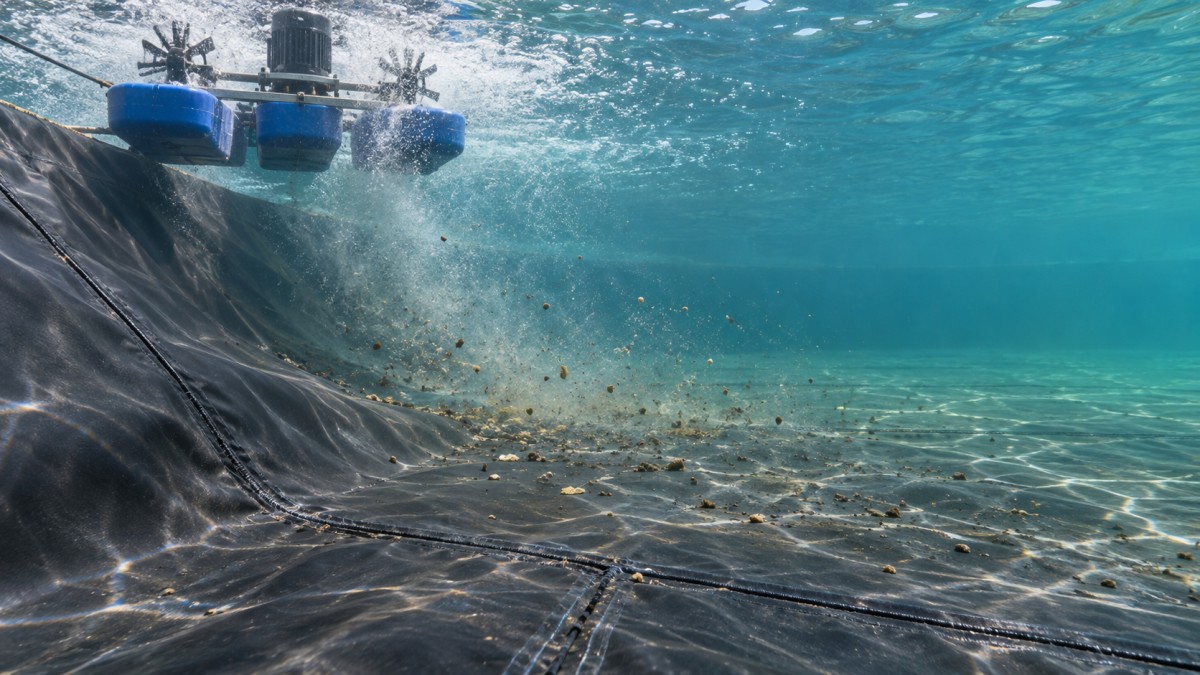
Yes, an aquaculture aerator can resuspend sludge in a lined pond. It happens when currents or turbulence near the bottom become strong enough to lift settled waste into the water. A geomembrane liner prevents direct erosion of the underlying soil while intact, but feed residues, feces, dead algae, and other solids can still accumulate on its surface and be disturbed.
Whether this becomes a problem depends on the aerator’s circulation pattern, its position, water depth, and the condition of the sludge. Some movement of solids can help carry waste toward a collection area. Persistent disturbance across the pond, however, can increase turbidity and expose more organic material to oxygenated water, adding to oxygen demand. The practical question is whether aeration supports oxygen delivery and waste collection without repeatedly scattering settled deposits.
How aerator currents reach sludge on the liner
An aerator does not have to touch the bottom to disturb it. Surface equipment creates circulation that extends beyond the visible splash or wake. Water pushed across the surface must return through other parts of the pond, and that return flow may travel close to the liner. Where it accelerates, turns, or meets a shallow slope, it can lift loose solids.
A paddlewheel generates directional flow that can transport waste along the pond floor. A splash or impeller aerator creates turbulence around the unit and broader circulation through the surrounding water. A submerged jet can disturb deposits directly if its discharge points toward the bottom. With diffused aeration, rising bubbles draw water upward and create compensating flows; diffuser placement and the surrounding sludge therefore matter even without a mechanical impeller near the liner.
These patterns make equipment labels insufficient for predicting sludge movement. A surface aerator in a shallow pond can affect bottom deposits more strongly than the same unit in deeper water. Conversely, a deeper pond can still develop concentrated bottom currents where its geometry channels returning water.
Sludge condition also changes the response. Fresh, loose particles are generally easier to move than consolidated deposits. Thick sludge may have a soft upper layer that lifts readily while heavier material remains in place. An apparently stable pond can become cloudy after an aerator is relocated, after the water level drops, or as waste accumulates within an established circulation path.
When solids movement helps—and when it creates trouble
In a lined pond designed around a collection zone or bottom drain, controlled transport of solids can support sludge removal. The circulation needs to carry waste toward that destination, with operating conditions that allow collection and discharge. A visible movement of particles is therefore not automatically evidence of poor aerator placement.
The concern grows when solids remain suspended throughout the pond or settle repeatedly in areas that are difficult to clean. Circulation can redistribute waste without removing any of it. Increasing aerator power may improve oxygen transfer while also spreading the sludge load more widely, leaving the underlying waste-management problem unresolved.
Organic solids matter because their decomposition consumes oxygen. Disturbing a deposit can increase contact between that material and the water, potentially increasing oxygen demand even while the aerator supplies oxygen. The net effect depends on the waste load, oxygen transfer, circulation, and biological activity. Cloudy water alone cannot show whether oxygen conditions have improved or deteriorated.
Disturbance of strongly anaerobic deposits can also bring oxygen-poor water and reduced substances into the water column. The risk depends on the deposit and water chemistry; ordinary particle movement should not automatically be treated as a toxic release. Dark sludge, unusual odors, changing dissolved oxygen, or abnormal animal behavior warrant closer investigation before making a large circulation change.
Several observations help distinguish useful solids transport from excessive disturbance:
- A cloud originating near the aerator or along its flow path: This supports a connection with local turbulence, especially if it follows startup or repositioning.
- Waste reaching a collection zone: This suggests circulation is serving the intended layout, provided the accumulated solids are actually removed.
- Repeated settling and lifting in the same area: This indicates a persistent interaction between deposits and the circulation pattern.
- Cloudiness throughout the pond: This needs broader investigation because algae, incoming water, and other sources can also affect clarity.
The liner changes what needs protecting
A lined pond separates the water from the underlying soil, which helps distinguish resuspended waste from soil erosion. It does not make the pond bottom maintenance-free. Deposits can collect in wrinkles, at slope transitions, around drains, and in areas with weak circulation. Those features influence both where sludge settles and how easily it can be removed.
Sludge movement and liner damage are separate issues. Suspended organic particles do not by themselves establish that a geomembrane is being damaged. More direct concerns include equipment touching the liner, unsecured components moving against it, abrasive debris, and cleaning tools scraping the surface. Currents can also make loose liner areas move, so visible movement deserves inspection of installation and restraint conditions.
Floating aerators need positioning and mooring arrangements that maintain suitable clearance as water levels change. Submerged equipment, supports, cables, and anchors should follow the equipment and liner installation requirements. A unit that appears safely separated from the bottom at full operating depth may have inadequate clearance after drawdown.
There is no universal clearance distance that guarantees both sludge control and liner protection. Impeller geometry, discharge direction, pond depth, liner layout, and mounting arrangements all affect the result. Equipment instructions and the pond’s installation details provide the starting limits; observation under operating conditions shows whether the resulting flow disturbs deposits.
What to check before changing aeration
Start with a simple map of the pond: water depth, aerator locations, flow direction, drains, and visible sludge accumulation. Pay particular attention to shallow margins and places where currents turn or converge. A localized plume may be addressed through position or orientation, while widespread disturbance may reflect excessive accumulated waste or a circulation layout that does not support collection.
Compare clarity and dissolved oxygen before and after a controlled adjustment, using consistent observation points and allowing for changes in feeding, wind, and weather. Where practicable, check oxygen near the bottom as well as in the upper water. A surface reading can miss conditions in deeper or poorly circulated areas. Maintain the oxygen supply required by the stock throughout the assessment.
Turning off aeration simply to obtain clearer water can create a more serious oxygen problem. Where the setup allows it, a modest change in position, discharge direction, or operation of individual units may reveal the cause while preserving adequate aeration. Moving equipment can transfer the disturbance elsewhere, so inspect the whole circulation path after an adjustment.
For equipment selection, oxygen-transfer figures and motor power answer only part of the question. A surface unit such as the Best Quality Fish Farming Pond Splash Aerator illustrates why circulation details also matter. Impeller material options and motor protection address equipment suitability and operation; they do not establish whether bottom sludge will remain settled. Assess the unit’s operating depth, flow pattern, mounting arrangement, and fit with the pond’s waste-collection layout.
If deposits have become extensive, changing aerator position may offer only temporary relief. Sludge removal must be compatible with the geomembrane, particularly around seams, wrinkles, drains, and fittings. Aeration can support transport toward a removal point, but it cannot eliminate the accumulated solids.
A workable arrangement maintains sufficient oxygen, keeps equipment clear of the liner, and directs waste toward a place where it can be removed. If the water becomes cloudy after a change, trace where the particles originate and where they settle before increasing power again. That observation often provides a more useful next step than judging the pond by the size of the surface splash.
