






Two aquaculture aerator reports are comparable only when their oxygen transfer results use compatible test methods, reference conditions, and power measurement boundaries. Similar headline values can conceal different water depths, impeller settings, electrical inputs, or calculation assumptions. A higher reported oxygen transfer rate therefore does not automatically identify the better machine.
For technical evaluation, separate three questions: how much oxygen the tested unit transferred under standardized conditions, how much electrical power it consumed, and how closely the test arrangement represents the intended pond installation. Standard oxygen transfer rate (SOTR) and standard aeration efficiency (SAE) answer the first two. Expected pond performance requires additional operating assumptions and evidence.
Establish what each report actually measured
Start with the test method and equipment identity. A useful report identifies the method and edition, laboratory, test date, aerator model, and configuration. For an impeller unit, configuration includes impeller geometry, rotational speed, immersion, and mounting arrangement. A report covering a model family needs a clear connection between the tested machine and the model being evaluated.
A standard number on a specification sheet does not establish that the reported performance was measured under that standard. Ask for the test report and any declared deviations. Where submissions cite different methods, compare their procedures and reference conditions before accepting their results as equivalent.
Clean-water oxygen transfer testing commonly follows the recovery of dissolved oxygen after deoxygenation. The resulting concentration-versus-time data are used to estimate a volumetric oxygen transfer coefficient, often written as kLa. The calculation then relates that coefficient to water volume and the oxygen concentration driving force. Reports should make this calculation traceable.
Inspect the supporting measurements:
- Test geometry: tank dimensions, working water volume, depth, and aerator position.
- Water conditions: temperature, salinity or relevant water chemistry, and barometric pressure.
- Instrument setup: dissolved oxygen probe locations, calibration records, and sampling interval.
- Operating conditions: speed, immersion, voltage, frequency, and measured power.
- Data treatment: fitting interval, exclusions, repeat runs, and reported variability.
Probe placement matters because an impeller creates circulation and local differences in oxygen concentration. A probe in a strongly aerated region may not represent the whole tank. Multiple measurement locations, together with an explanation of mixing adequacy, provide stronger support for treating the water volume as a single system. Where probe traces diverge substantially, the evaluator should examine whether the calculation method still fits the test conditions.
Put SOTR and SAE on the same basis
SOTR expresses oxygen transfer capacity after correction to defined reference conditions. These commonly include clean water at 20°C, zero dissolved oxygen, and a stated atmospheric pressure basis. The report should identify the exact convention used. A result labelled only “oxygen transfer rate” may instead describe transfer at the measured temperature and oxygen concentration.
The distinction matters because oxygen transfer depends on the difference between the water’s oxygen saturation concentration and its existing dissolved oxygen concentration. As dissolved oxygen rises, that driving force decreases. Temperature affects both oxygen solubility and the transfer coefficient, while salinity and pressure affect saturation concentration. Comparing uncorrected results from different conditions can produce a misleading ranking.
For a conventional clean-water calculation, SOTR is derived from the transfer coefficient corrected to the reference temperature, the water volume, and the reference saturation concentration. Check the temperature correction factor and saturation calculation specified by the method. Applying a second pressure or temperature correction to an already standardized result can distort the comparison just as much as omitting a required correction.
SAE = SOTR ÷ measured power input. With SOTR in kilograms of oxygen per hour and electrical input in kilowatts, SAE is expressed as kilograms of oxygen per kilowatt-hour. Both the oxygen transfer value and the power denominator must refer to the same operating condition.
Motor nameplate power is insufficient evidence for that denominator. A rated motor output and measured electrical input describe different quantities. For a three-phase unit, the report should show how real electrical power was measured; voltage and current alone do not establish input power without accounting for power factor. If a drive or other essential equipment consumes power, its inclusion should be explicit and consistent across submissions.
The Aquaculture Equipment Impeller Pond Aerator illustrates this distinction. Its ZY3.0G specifications list 3.0 kW motor power, oxygenation capacity of at least 4.5 kg/h, and efficiency of at least 1.5 kg/(h·kW). Dividing the two listed figures gives 1.5, but that arithmetic alone does not establish a measured SAE. Technical acceptance still requires the oxygen transfer definition, standardization conditions, and actual electrical input used in the test.
A cited SC/T6010-2001 designation should be linked to the applicable test procedure and report. An ISO 9001 quality-management certification, meanwhile, does not establish an individual aerator’s oxygen transfer performance.
Check whether an apparent advantage exceeds the uncertainty
Once the calculation basis matches, examine repeatability. A small difference between two reported SAE values may be less meaningful than variation between runs, instruments, or installations. Look for individual run results, the number of repetitions, and an explanation of uncertainty. Decimal precision does not demonstrate measurement accuracy.
A convincing report allows an evaluator to follow the result from dissolved oxygen traces and power readings through to the final standardized values. Review whether the fitted curve represents the observations across the selected interval. Unexplained removal of early or late readings, inconsistent probe responses, or unexplained changes in operating power deserve attention because they can affect the calculated transfer coefficient.
Test geometry also limits interpretation. A shallow tank and a deeper tank can produce different circulation patterns, even with identical machines. Wall proximity, immersion, and water volume may change oxygen transfer. Standardization corrects defined environmental variables; it does not erase every effect of the physical test arrangement.
Where two reports leave these effects unresolved, a common-condition comparison is more defensible than a forced numerical ranking. Specify the same method, water depth, operating configuration, electrical boundary, and reporting requirements for both units. Independent testing is particularly useful when the remaining performance difference would materially change equipment quantity or operating cost.
Translate the result into a pond decision
Clean-water SOTR provides a controlled comparison, but it is not the oxygen delivery rate a stocked pond will receive throughout operation. Pond water contains suspended solids, dissolved substances, and biological material that can alter transfer. Actual dissolved oxygen, temperature, salinity, and atmospheric pressure also change the available driving force.
Engineering estimates may use an alpha factor to represent the effect of process water on the transfer coefficient and a beta factor to represent changes in oxygen saturation concentration relative to clean water. These factors need a justified basis for the water and equipment concerned. Borrowing them from an unrelated application can create a precise-looking estimate with weak practical support.
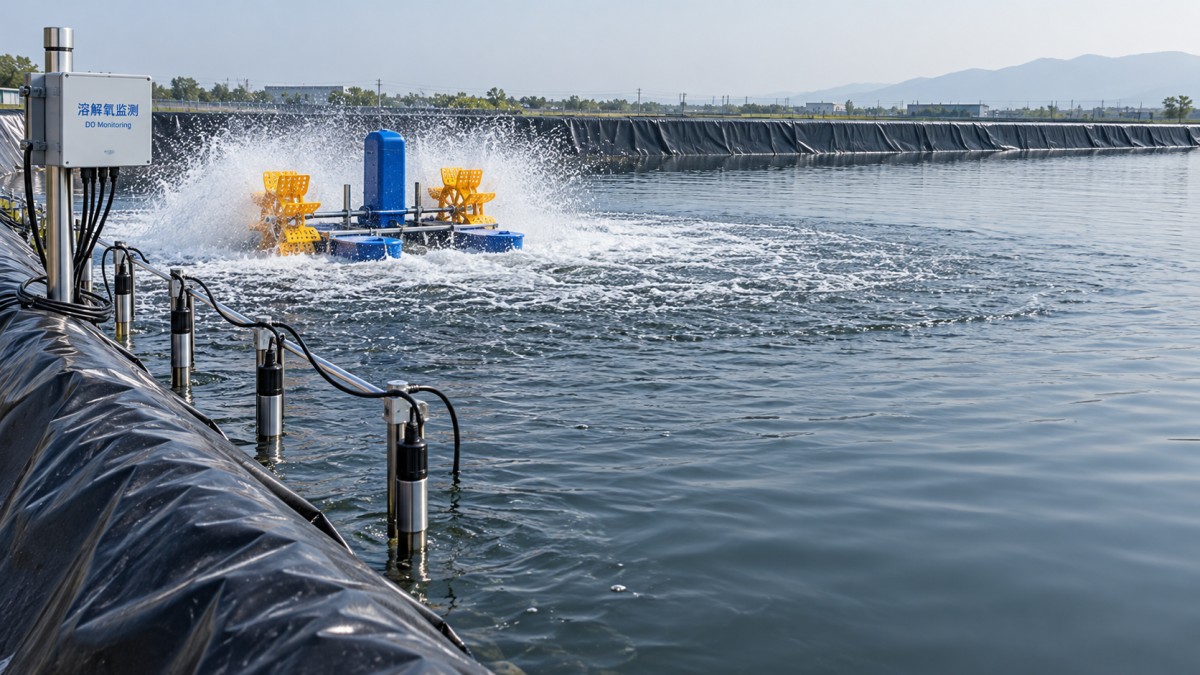
For a geomembrane-lined pond, evaluate circulation alongside transfer efficiency. Pond shape, depth, aerator placement, and obstructions influence whether oxygenated water reaches poorly mixed zones. Installation details should also protect the liner from unsuitable anchors, support contact, and moving components. A laboratory SOTR cannot demonstrate adequate circulation throughout that pond.
The final comparison should therefore record standardized capacity and efficiency separately from the expected operating duty. State the assumed pond temperature, target dissolved oxygen, water conditions, and required oxygen supply, then identify which assumptions have supporting measurements. When those assumptions determine the equipment count, a site trial or agreed commissioning measurements can provide more useful evidence than another decimal place in the laboratory result.
An aerator report supports selection when it makes the performance claim traceable and its limits visible. If one submission provides that evidence and another offers only headline capacity and rated motor power, the immediate task is to close the evidence gap before treating the two machines as technically ranked.