






A permanent magnet aerator can save electricity at partial load, but the saving is not guaranteed by the motor type. The strongest case is a variable-speed system that reduces electrical input as oxygen demand falls while maintaining adequate oxygen transfer and pond circulation. A high-efficiency motor running continuously at full speed cannot, by itself, match output to lower biological demand.
The decisive comparison is therefore not rated motor efficiency or power consumption at the same speed. It is total electricity use at equivalent oxygen delivery, with acceptable dissolved oxygen distribution throughout the pond. Lower kilowatts are useful only if the reduced-speed operating point still meets those requirements.
Separate motor efficiency from reduced aeration demand
A permanent magnet synchronous motor uses rotor magnets rather than the induced rotor currents required by an induction motor. This eliminates the induction motor’s rotor copper losses and can improve efficiency. However, stator copper losses, magnetic losses, mechanical losses and inverter losses remain. Their relative importance changes with speed and torque.
“Partial load” can describe different operating conditions. A motor delivering reduced torque at approximately constant speed is not operating in the same way as an aerator slowed down to reduce both torque and oxygen delivery. These conditions require separate efficiency data. A single nameplate efficiency value cannot establish performance across either operating range.
There are also two distinct sources of savings:
- Lower conversion losses: the motor and drive consume less electricity to deliver the required shaft power.
- Better demand matching: speed control avoids producing unnecessary aeration when oxygen demand is lower.
The second effect can exceed the first, but it is not exclusive to permanent magnet technology. An induction-motor aerator with a suitable variable-frequency drive can also reduce output. Comparing a variable-speed permanent magnet unit with a fixed-speed induction unit combines the benefits of motor design and control strategy; it does not isolate the permanent magnet motor’s contribution.
Why reduced speed does not prove better oxygen efficiency
For some rotating equipment under dynamically similar conditions, shaft power varies approximately with the cube of rotational speed. This relationship helps explain why speed reduction can sharply reduce power demand. It should not be applied automatically to every paddlewheel, propeller, aspirating or surface aerator.
Aerators involve a free water surface, air entrainment, changing immersion and sometimes a minimum speed needed to establish effective spray or suction. As speed changes, the flow pattern may change rather than remain geometrically similar. Oxygen transfer therefore does not necessarily decline in proportion to power, or according to a simple affinity law.
A paddlewheel may draw less power at reduced speed while producing a weaker spray and less circulation. An aspirating unit may lose effective air intake below a particular operating point. A surface aerator may develop a different wetted area or turbulence pattern. These effects determine whether slower operation improves or worsens oxygen delivery per kilowatt-hour.
The useful performance measure is oxygen transferred per unit of electrical energy:
Oxygen transfer efficiency on an energy basis = oxygen transfer rate (kg O2/h) ÷ total electrical input (kW).
Under standardized clean-water conditions, this is commonly expressed as standard aeration efficiency, or SAE, in kg O2/kWh. The electrical measurement boundary must be stated: motor shaft output, drive output and incoming supply power are not interchangeable.
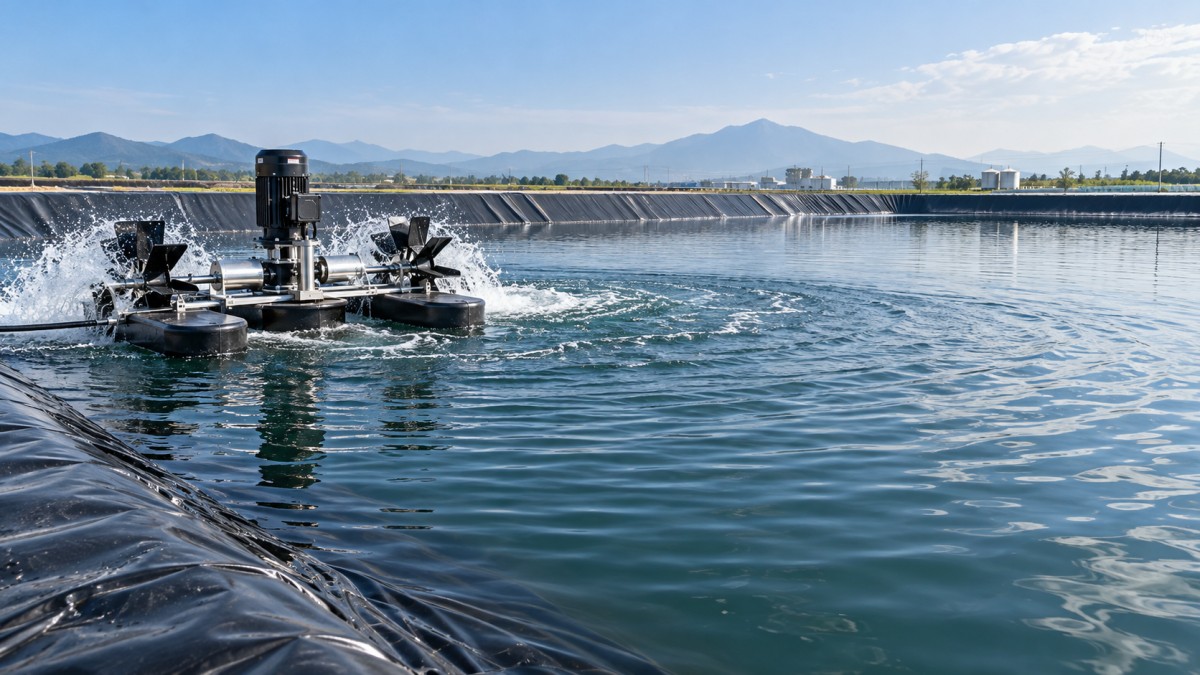
A meaningful performance curve plots both electrical input and oxygen transfer against speed at a defined immersion depth. The preferred operating region is where oxygen delivery meets demand, energy efficiency remains favorable and circulation is still sufficient—not necessarily the lowest available speed.
Clean-water results need an operating-water interpretation
Standard oxygen transfer tests provide a controlled basis for comparing equipment. The ASCE/EWRI standard for measuring oxygen transfer in clean water is a relevant reference. Such testing does not directly establish oxygen delivery in a stocked aquaculture pond.
Actual transfer depends on water temperature, salinity, existing dissolved oxygen, atmospheric pressure and water constituents that affect gas transfer. As dissolved oxygen approaches saturation, the concentration driving force decreases. A favorable clean-water rating cannot be treated as a constant field oxygen supply.
Comparisons should identify the test method, reference conditions, water depth, immersion, equipment configuration and power measurement boundary. Where clean-water results are converted to operating-water performance, the correction assumptions—including alpha and beta factors where applicable—should be disclosed rather than treated as universal constants.
This distinction matters when oxygen demand falls. A lower transfer rate may reflect a higher pond dissolved oxygen concentration, not deteriorating equipment performance. Conversely, maintaining a satisfactory reading beside an aerator does not establish adequate oxygen availability at remote or deeper locations.
Mixing can set the minimum usable load
An aerator supplies oxygen and moves water. These functions are coupled, but their minimum requirements need not fall together. Lower biomass respiration may permit reduced oxygen input while accumulated solids, pond geometry or thermal stratification still require substantial circulation.
If speed reduction creates poorly mixed zones, the operator may need additional circulation equipment or longer aerator runtime. Those energy requirements belong in the comparison. Otherwise, apparent savings at the aerator can be offset elsewhere in the system.
For geosynthetic-lined ponds, equipment positioning also affects mechanical compatibility. A liner such as Landfill Pond Liner Virgin HDPE Geomembrane performs a containment function; it does not establish aeration efficiency. Aerator supports, anchors and moving components must be arranged to avoid concentrated loads, abrasion or contact with the liner. Required clearance and operating depth should remain valid throughout the permitted speed range.
Reduced-speed limits should therefore reflect both the aerator’s hydraulic behavior and the pond’s circulation needs. A drive’s ability to command a low frequency is not evidence that the corresponding operating point is suitable.
What test evidence establishes a credible saving?
A defensible assessment needs a motor-and-drive efficiency map and an aerator performance curve. Neither substitutes for the other. The motor map explains electrical conversion losses; the aerator curve shows what useful output those losses support.
IEC 60034-2-1 provides methods for determining rotating electrical machine losses and efficiency, subject to its scope and applicable test conditions. For variable-speed applications, the applicable converter-fed motor test method should also be identified. IEC 61800-9-2 addresses efficiency assessment of power drive systems. Compliance with an applicable motor or drive test method does not certify oxygen transfer performance.
The supporting data should include:
- Measured incoming electrical power across the proposed speed and load range, including drive losses.
- Oxygen transfer rates at corresponding speeds, with test conditions and uncertainty stated.
- Immersion depth, water level, rotor configuration and any gearbox or transmission losses.
- Minimum operating speed, continuous-duty restrictions and thermal limits.
- Evidence of adequate circulation and dissolved oxygen distribution at reduced output.
Electrical input should be measured with instrumentation suitable for the waveform and measurement location. Estimating power from current alone is unreliable because voltage, power factor and drive behavior can change with load. Nameplate kilowatts are a capacity rating, not a measurement of actual consumption.
Evaluate the control strategy over the duty cycle
Lower oxygen demand does not always favor continuous slow operation. A fixed-speed aerator operating intermittently may consume less energy than a continuously running variable-speed unit if full-speed oxygen transfer is particularly efficient and mixing remains adequate during off periods. Conversely, intermittent operation may cause unacceptable dissolved oxygen fluctuations or stagnant zones.
The comparison must therefore cover a representative operating period, not one favorable operating point:
Total energy = sum of measured electrical power × time at each operating condition.
The alternatives should meet the same dissolved oxygen limits under comparable biomass, feeding, temperature and water-level conditions. Control settings also matter: sensor location, fouling, response delay and switching deadbands can change runtime independently of motor efficiency.
A robust reduced-load strategy combines representative dissolved oxygen measurements with a defined minimum speed or circulation requirement. It also needs sufficient reserve output to respond when demand rises; the average pond reading alone is not a safe basis for reducing capacity.
A permanent magnet aerator offers credible partial-load savings when measured motor-and-drive efficiency remains favorable, oxygen transfer declines less rapidly than electrical input, and reduced-speed operation preserves necessary mixing. If the evidence consists only of a rated efficiency figure or a lower current reading, the energy-saving claim remains unproven. The acceptance criterion should be lower total electricity consumption while maintaining the required oxygen conditions across the intended operating range.