






Where do geosynthetics actually save money compared with traditional materials?
For procurement teams, the real comparison is rarely “material A versus material B” on unit price alone. The bigger question is what the project will cost once transport, installation speed, rework risk, service life, and maintenance are included. In many cases, geosynthetics reduce cost because they replace thick layers of aggregate, concrete, clay, or other bulk materials with lighter engineered products that are faster to install and easier to ship.
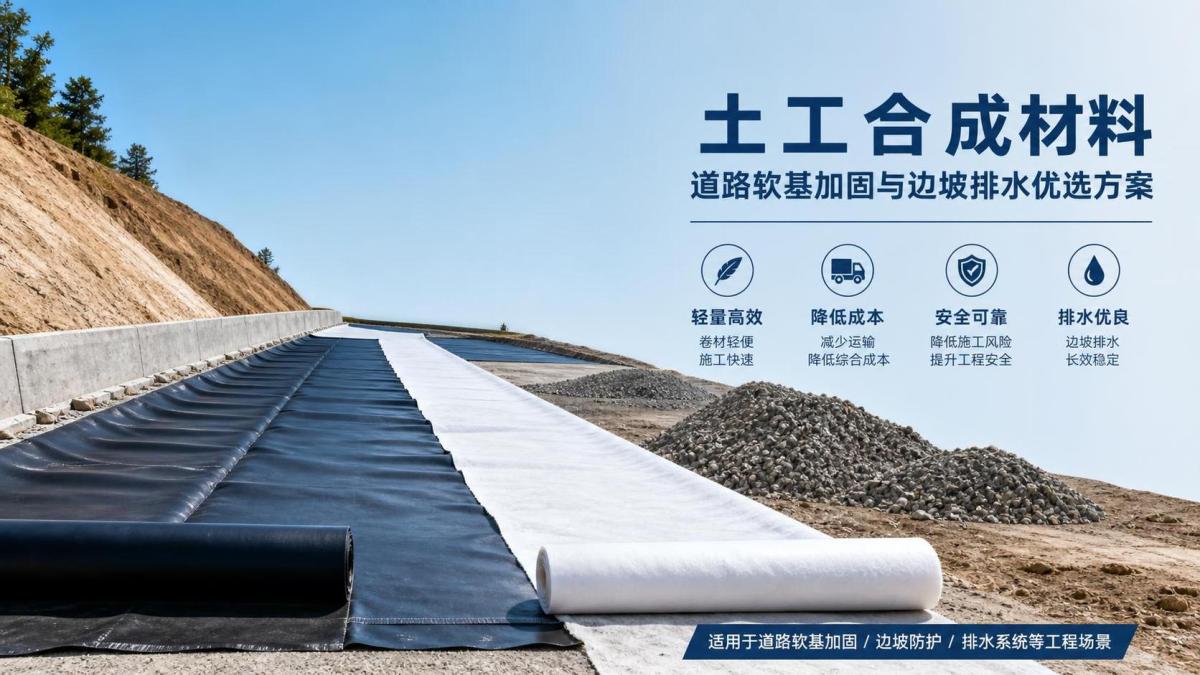
That cost advantage tends to be strongest when the site is remote, hauling fill is expensive, the construction window is tight, or the subgrade is weak. A roll of geotextile or geomembrane is easier to move, store, and deploy than truckloads of traditional material. Fewer deliveries usually mean lower fuel cost, less handling, and fewer chances for schedule disruption.
Where buyers sometimes get it wrong is comparing only the purchase price per square meter or per ton. That hides the labor, equipment hours, and long-term repair exposure that often decide the true project cost.
In which applications is the cost gap usually the clearest?
The clearest savings usually show up in separation, filtration, reinforcement, drainage, erosion control, and containment work. Think road subgrades, landfill lining, pond lining, slope stabilization, drainage layers, and foundation improvement. In those jobs, geosynthetics often replace part of the mineral layer, reduce excavation depth, or improve performance enough to avoid overbuilding the structure.
For example, if a weak subgrade would normally require a thicker aggregate section, a suitable geosynthetic layer may help stabilize the base and reduce imported fill. On a containment project, a geomembrane can offer a more controlled barrier than compacted clay where local clay quality is inconsistent or the site space is limited. That does not mean traditional materials disappear from the design. It means the engineered layer can do more work with less volume.
Do geosynthetics always reduce risk, or only in certain conditions?
Only in the right conditions. Geosynthetics reduce risk when the product type matches the function, the specification is clear, and installation quality is controlled. They can lower the risk of settlement, contamination, washout, clogging, or premature failure, but they are not interchangeable by name alone.
A common procurement mistake is buying on thickness or mass alone without checking the performance requirement behind the design. Tensile strength, puncture resistance, permeability, elongation, chemical resistance, and seam performance may matter more than a headline dimension. If the application is aggressive, such as exposed UV, chemically active water, or repeated mechanical loading, the wrong product can create more risk than the traditional material it was meant to replace.
What should a buyer compare besides the quoted material price?
A useful procurement comparison usually includes the full installed and operating impact. At minimum, check these items:
- Delivered cost, not ex-factory price only
- Freight volume and unloading requirements
- Installation speed and crew size
- Equipment needed on site
- Waste rate and cutting loss
- Expected maintenance exposure
- Failure consequences if the material underperforms
- Documentation package: test data, quality records, packing list, and inspection support
This is where an experienced supply chain partner matters. For international buyers, delays often come not from the product itself but from inspection gaps, customs document errors, or inconsistent batch control.
When do traditional materials still make more sense?
There are plenty of cases where traditional materials remain the practical choice. If local aggregate is abundant and cheap, labor is readily available, and the design does not need a high-performance separator, liner, or reinforcement layer, the savings from geosynthetics may narrow. The same is true when site crews are unfamiliar with installation details and there is no plan for supervision or testing. A technically better material can become a commercial problem if the project team cannot install it correctly.
Buyers should be especially careful on projects where the specification is vague. “Use geotextile” is not enough. The function has to be defined first, then the required properties.
How do you judge whether the specification is strong enough for sourcing?
If you cannot tell what failure the product is meant to prevent, the specification is still too weak for purchasing. A workable RFQ should identify the application, installation environment, required performance properties, roll dimensions or panel details where relevant, and any testing or inspection documents needed before shipment.
What risks show up after purchase if the sourcing decision was too price-driven?
The usual problems are not subtle. Rolls arrive with inconsistent labeling, supporting test documents do not match the batch, installation crews discover the material tears too easily, or the hydraulic behavior is unsuitable for the soil. Then the project starts burning money through downtime, replacement freight, claims, or field fixes.
In aquaculture and water-related environments, corrosion and long-term exposure can create a similar issue with equipment selection. A buyer looking at lifecycle cost rather than sticker price may favor equipment designed for aggressive conditions. For example, Three Balls Impeller Aerator for Fish Farming uses engineering plastic or stainless steel impellers and is described for operation in strongly corrosive conditions without frequent impeller replacement or repainting. That kind of detail matters because maintenance interruptions can erase any upfront savings from a cheaper alternative.
Can geosynthetics shorten project schedules in a way that matters commercially?
Very often, yes. Faster installation is one of the most overlooked financial benefits. If a project can reduce earthmoving, shorten wet-weather exposure, or limit the number of truck movements, the schedule becomes less fragile. That matters to procurement because late completion brings its own cost: idle labor, equipment standby, missed operating windows, and contract pressure.
This is especially relevant when imported materials, inspection, and logistics need to stay coordinated. A one-stop supply process with quality inspection and shipment management can remove friction that buyers otherwise have to manage across multiple vendors.
What is the most practical buying approach for procurement teams?
Start with function, not product name. Ask what the layer or material must achieve, what site condition creates the risk, and what failure would be most expensive. Then compare options on installed cost, logistics burden, document quality, and maintenance exposure.
If two offers look similar, the better one is usually the one with clearer technical data, cleaner batch traceability, and fewer assumptions pushed onto the buyer. That is where geosynthetics often win: not because they are always cheaper on paper, but because they can reduce the number of things that go wrong between design, shipment, installation, and long-term use.