






Start with the failure mode, not the material name
When project teams compare geosynthetics, they often start by asking for a quote on a geotextile or a geomembrane. That is usually too early. The better sequence is to define what must not fail on the job: rutting in a road base, leachate escape in a landfill, water loss in a pond, or face movement in a retaining wall. Once that is clear, the material choice becomes more disciplined and the risk of buying the wrong product drops fast.
For project managers, this matters because the wrong geosynthetics decision rarely shows up as a simple product defect. It shows up later as rework, drainage issues, punctures during installation, difficult seam inspections, or a design that looks fine on paper but is expensive to build in real site conditions.
Check the function before you check the specification
A lot of avoidable confusion comes from mixing functions. One layer may be expected to separate soft subgrade from aggregate, another to reinforce, another to drain, and another to act as a barrier. Sometimes one product can handle more than one job; often it cannot. If the drawing or procurement sheet says only “use geosynthetics,” stop there and break the requirement down.
- Roads: separation and reinforcement usually drive the choice first, then survivability during placement.
- Landfills: containment, chemical resistance, puncture resistance, and seam quality are usually higher priority than simple tensile values.
- Ponds: anti-seepage performance matters, but subgrade smoothness, UV exposure, and edge anchoring often decide service life.
- Retaining walls: reinforcement interaction with fill, drainage control, and construction sequence need to be checked together.
If your team cannot name the primary function in one sentence, you are not ready to compare offers.
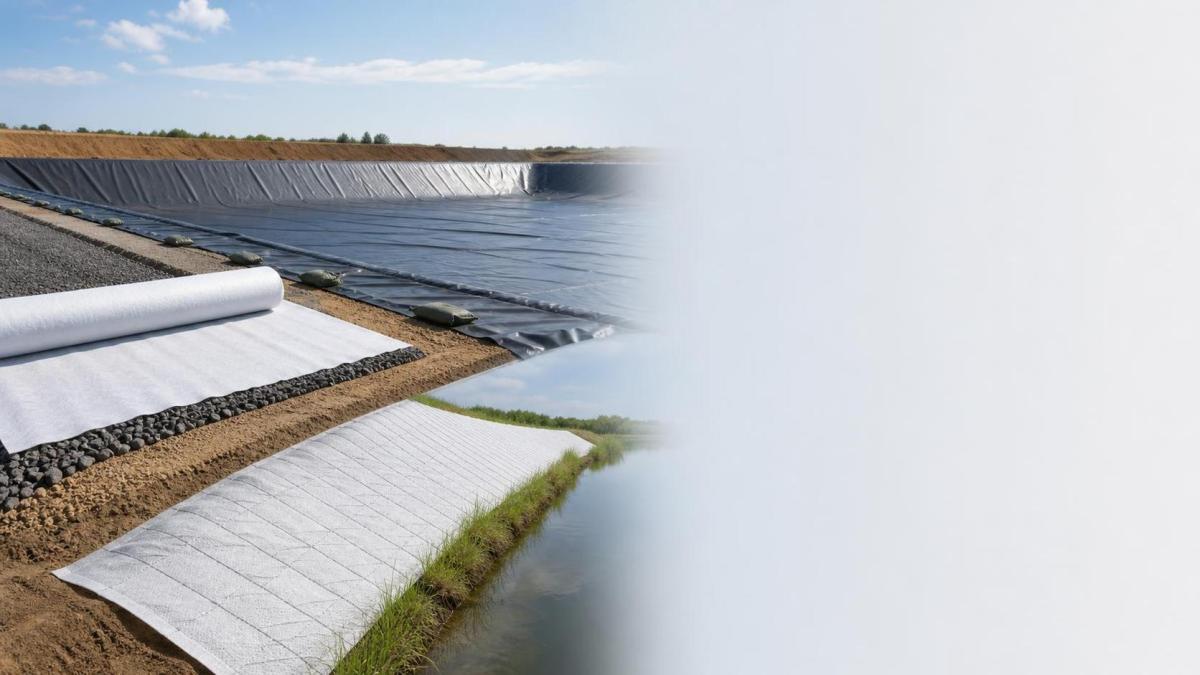
Road projects: focus on subgrade behavior and installation damage
For roads, teams often over-focus on tensile strength and under-focus on what happens during aggregate placement. If the subgrade is weak, wet, or highly variable, the first question is whether you need separation only or separation plus reinforcement. A separator that clogs or tears during construction will not help much even if its datasheet looks strong.
Check these points on the front end:
- What is the actual subgrade condition at the time of construction, not just in the design report?
- What aggregate size will be placed directly above the layer?
- Will construction traffic run over it before sufficient cover is placed?
- Is filtration needed, especially where water movement through the soil profile is expected?
A common mistake is selecting a lighter product to save cost, then losing that saving in slower placement, torn sections, and extra overlap. On roads, ease of installation is not a minor convenience. It directly affects schedule and waste.
Landfills: do not separate liner selection from the protection system
Landfill decisions go wrong when the barrier layer is treated as a standalone purchase. The liner, the protective geotextile, the subgrade finish, and the overlying drainage or cover layer work as one system. If one part is mismatched, the whole assembly is exposed.
For barrier applications, material type matters. HDPE geomembrane is commonly chosen where chemical resistance and longer-term durability are major concerns. PVC geomembrane may be considered where flexibility is more critical to the installation condition. The right choice depends on the waste profile, exposure condition, seam method, and how tight the geometry is around penetrations and corners.
Before approving procurement, check the specification for puncture-related risk, not just nominal thickness. The surrounding layers, especially underlayment and cover materials, affect whether the liner survives construction. Where a composite option is suitable, Geosynthetics geotextile and geomembrane may help combine anti-seepage and drainage functions in water conservancy, municipal engineering, and anti-pollution applications, but only if the assembly matches the project detail and installation method.
Ponds: look beyond leakage and ask how the liner will live on site
Pond work looks straightforward until the field conditions start dictating performance. The liner may hold water well in theory, but ponds fail early when subgrade preparation is rough, anchor trenches are weak, or UV exposure is not taken seriously. In exposed applications, aging resistance and weather tolerance are not side notes.
A practical review should include the following:
- Subgrade smoothness and removal of sharp inclusions.
- Expected water chemistry, especially if salts or oils are present.
- Sun exposure and whether cover soil or other protection will be used.
- Detailing at pipe penetrations, corners, and perimeter anchorage.
If the project is in a temperature range with large day-night swings, ask for material behavior across the actual service environment, not a generic statement from a brochure. This is where complete thickness options can help because thickness affects handling, puncture resistance, and field survivability.
Retaining walls: reinforcement choice is only half the decision
In retaining wall systems, the reinforcement layer gets most of the attention, but drainage and backfill compatibility are just as important. A strong reinforcement product will not compensate for poor drainage behind the wall or poorly graded fill that cannot interact properly with the system.
The field check is simple: review the backfill specification, compaction sequence, drainage path, and connection details at the same time. If those are handled by different parties, get them aligned before the first shipment arrives. Many wall delays come from discovering too late that the selected material roll dimensions, installation direction, or overlap details do not fit the construction sequence.
Use product data to answer site questions
Datasheets are useful when they answer a real project question. They are less useful when teams compare isolated numbers with no installation context. For example, breaking strength, elongation at break, CBR puncture resistance, tearing strength, peel strength, permeability, thickness, and hydrostatic pressure resistance all matter differently depending on whether you are managing road separation, seepage control, or liner protection.
If you are reviewing a product with thickness options from 0.2 mm to 0.9 mm, do not assume thicker is always better. Thicker material may improve puncture resistance and barrier robustness, but it can also affect handling, welding efficiency, and detailing around tight geometry. Match the number to the construction method and the consequence of damage.
Procurement checks that save time later
Once the technical direction is clear, procurement still needs discipline. Ask for the product data sheet, the roll dimensions, the relevant test items listed in the project specification, and the inspection scope for incoming goods. On international supply projects, logistics details matter more than many teams expect: damaged packaging, inconsistent roll labeling, and poor coordination between shipment timing and site readiness can create expensive idle time.
Where the job calls for combined anti-seepage, isolation, or reinforcement performance across sectors such as transportation, construction, tunnel, dyke, ditch, or waste-dump pollution control, a system like Geosynthetics geotextile and geomembrane can be worth reviewing because it covers a broad range of application needs and includes options tied to puncture resistance, peel strength, and hydrostatic pressure resistance. The key is to compare those values against the actual design requirement and installation exposure, not against a generic benchmark.
A workable decision order for project teams
If you need a practical order, use this one: define the failure mode, confirm the layer function, review site installation risk, then compare material type and test data. After that, check roll handling, seaming or joining method, protection layers, and delivery timing. That sequence keeps the decision tied to field performance instead of pushing the team into a price-first comparison that usually misses the real cost drivers.
Good geosynthetics selection is rarely about finding the strongest or cheapest product on a sheet. It is about matching function, environment, and construction reality early enough that the material still has a fair chance to perform once it reaches the site.