






How immersion depth affects impeller aerator oxygen transfer
Immersion depth can change an impeller aerator’s oxygen transfer performance by altering water circulation, surface turbulence, and motor load. For technical evaluators comparing equipment for lined aquaculture ponds, deeper submergence does not automatically mean better aeration: oxygen delivery must be assessed alongside power consumption, pond geometry, and operating conditions. This article examines how impeller immersion influences these variables, which measurements support reliable comparisons, and how to identify a practical operating depth that balances oxygen transfer efficiency with mechanical limits and the needs of geosynthetic-lined systems.
Define immersion before comparing performance
“Impeller aerator” can describe different equipment configurations. A surface rotor and a paddle wheel both disturb the air–water interface, but their blade geometry, rotational speed, and discharge patterns differ. An immersion setting that works for one design should not be transferred directly to another.
For a paddle wheel, immersion is commonly described as the depth reached by the lowest paddle tip below the operating water surface. Other surface aerators may use a manufacturer-defined reference point. The technical file should identify that reference, the rotor dimensions, and whether the measurement was taken while stationary or running. Waves, float movement, and equipment trim can make operating immersion different from a static measurement.
Measure both ends of a long assembly. Uneven flotation can leave one end underloaded and the other excessively submerged, even when the average depth appears acceptable.
Why oxygen transfer does not increase indefinitely with depth
At shallow immersion, blades engage less water. They may create visible spray without producing enough bulk circulation to move oxygenated water away from the aerator. Increasing immersion can increase water displacement, strengthen the discharge current, and renew the exposed water surface. These effects can improve oxygen transfer, provided rotational speed and the intended flow pattern are maintained.
Beyond a useful operating range, additional submergence raises hydrodynamic resistance. More input energy may go into moving water rather than creating effective air–water contact. Depending on blade design, splash and surface breakup may become less effective. A diesel drive can lose speed under excessive load; an electric drive may draw more current or encounter overload protection.
This creates an important distinction: the depth producing the highest oxygen transfer rate may not produce the highest oxygen transfer efficiency. A larger oxygen output is not automatically worthwhile if energy use rises faster. Conversely, an efficient shallow setting may fail to deliver enough total oxygen during peak pond demand.
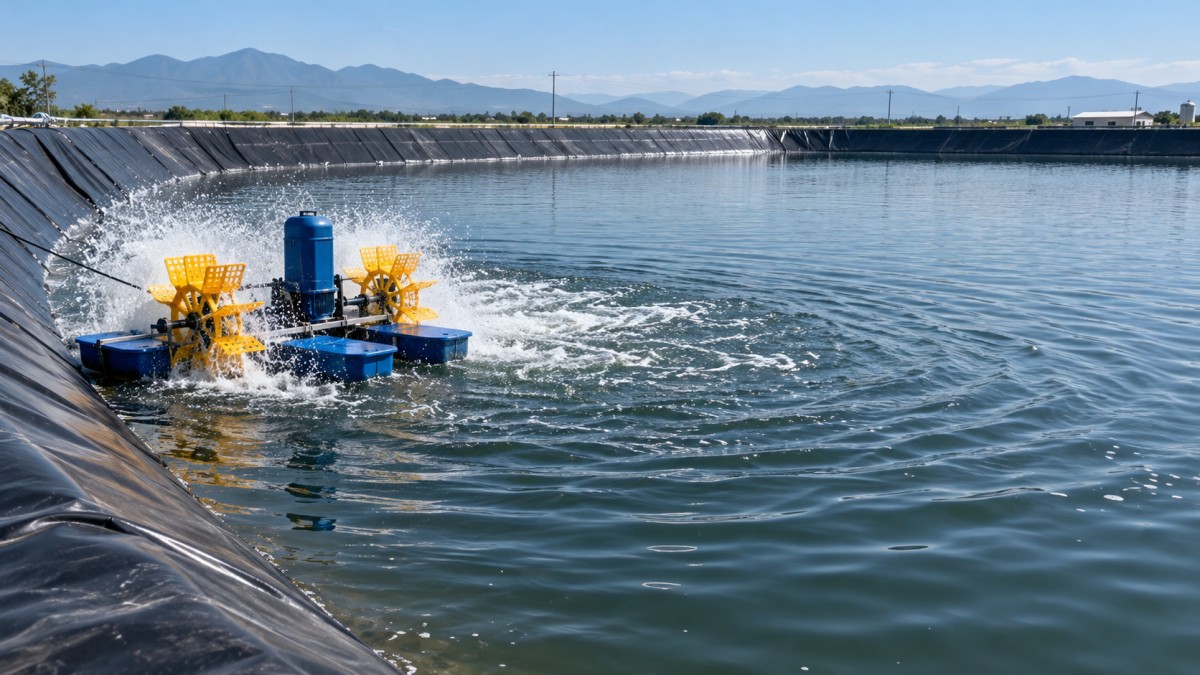
The relevant relationship is therefore a performance curve, not a universal depth recommendation. Blade geometry, speed, flotation, and drive capacity all influence where the practical operating range lies.
Read oxygen ratings with their test conditions
A rating in kilograms of oxygen per hour is incomplete without its measurement basis. Standard oxygen transfer rate, or SOTR, describes transfer under defined reference conditions. Standard aeration efficiency, or SAE, relates that standardized transfer to power input, usually expressed in kilograms of oxygen per kilowatt-hour. Neither should be confused with the oxygen delivered under actual pond conditions.
Clean-water testing procedures, such as those covered by ASCE/EWRI 2, provide an established basis for evaluating oxygen transfer. Any claimed conformity should identify the applicable edition and supporting report. Temperature, atmospheric pressure, salinity, dissolved oxygen concentration, and water quality affect how a test result translates to a fish or shrimp pond. Oxygen uptake also changes as dissolved oxygen approaches saturation.
For example, the 12 Impeller Diesel Operated Paddle Wheel Aerator lists an oxygen transferring ability of 6.5 kg/h and an 8 HP diesel engine. Its diesel drive is relevant where electrical power is unavailable. However, those specifications alone do not establish the best immersion depth or standardized efficiency. The evaluator still needs the test immersion, rotational speed, water conditions, and actual input measurement.
Engine nameplate power is not the same as measured operating power. For diesel equipment, fuel consumption provides a useful operational comparison, while shaft-power-based efficiency requires an appropriate measurement method. Electrical input, shaft power, and fuel energy are different accounting boundaries; supplier comparisons should use the same one.
Lined ponds add hydraulic and installation constraints
In geosynthetic-lined aquaculture ponds, aerator positioning must account for the geomembrane as well as oxygen distribution. Strong currents do not inherently damage a correctly designed lining system. The concern is concentrated flow acting on exposed folds, loose edges, inadequately supported areas, or accumulated debris. Anchors, cables, and moving equipment can introduce separate abrasion or puncture risks.
Deeper blade engagement may strengthen circulation, but the resulting current should be checked against pond slopes, corners, drainage points, and sediment collection zones. Increased flow can redistribute settled solids rather than remove them. A vigorous surface current also does not prove that bottom water receives adequate oxygen.
Maintain clearance between rotating components and the liner throughout expected water-level and equipment movements. Mooring arrangements should avoid uncontrolled rubbing against the geomembrane. Where fastening or penetrations are required, details should follow the lining system’s engineering requirements rather than improvised site fixes.
Establish an operating range through controlled checks
Start within the manufacturer’s permitted immersion range. Adjust in documented increments, allowing operation to stabilize before recording results. Keep rotor configuration and intended speed consistent; record any actual speed change rather than assuming the drive maintains it.
- Record immersion, water level, rotational speed, equipment trim, and the selected energy-input measure.
- Measure dissolved oxygen at several locations and depths, including weak-circulation areas away from the discharge.
- Log temperature, salinity where relevant, weather, and pond operating conditions that could affect comparisons.
- Check vibration, engine or motor loading, float stability, mooring movement, and clearance from the lining system.
A production-pond trial is useful for assessing distribution and operational suitability, but a short dissolved oxygen rise cannot be treated as a standardized oxygen transfer test. Stock respiration, sediment demand, photosynthesis, and natural surface exchange can distort the result. Where a guaranteed transfer rate matters, request a documented test using an agreed procedure.
Jinan Dingshun Import & Export Co., Ltd. supplies geosynthetics, aquaculture equipment, and engineering equipment, integrating procurement, quality inspection, customs declaration, logistics, and after-sales service. For a combined liner-and-aerator package, that coordination is most useful when operating-depth instructions, assembly details, inspection requirements, and maintenance documentation are aligned before shipment.
Specify an acceptable immersion range rather than a single setting without tolerances. The final choice should deliver sufficient oxygen and circulation, remain within drive limits, and accommodate water-level changes without threatening liner clearance. If the supplier cannot explain the conditions behind the oxygen rating, resolve that gap before using the number to size the installation.
