






The cost of importing an aquaculture aerator depends less on motor power than on its packed dimensions, shipment size and delivery terms. A low equipment price can lose its advantage when bulky floats, protective crates or destination handling charges raise the cost of getting each complete unit into saleable inventory.
The useful comparison is therefore not freight per shipment, but delivered cost per complete, undamaged unit. That requires separating the equipment price, transport charges, import duties and taxes, and the costs of releasing and delivering the cargo. Two quotations are comparable only when they cover the same route, packing configuration and scope of service.
Packed volume can matter more than machine weight
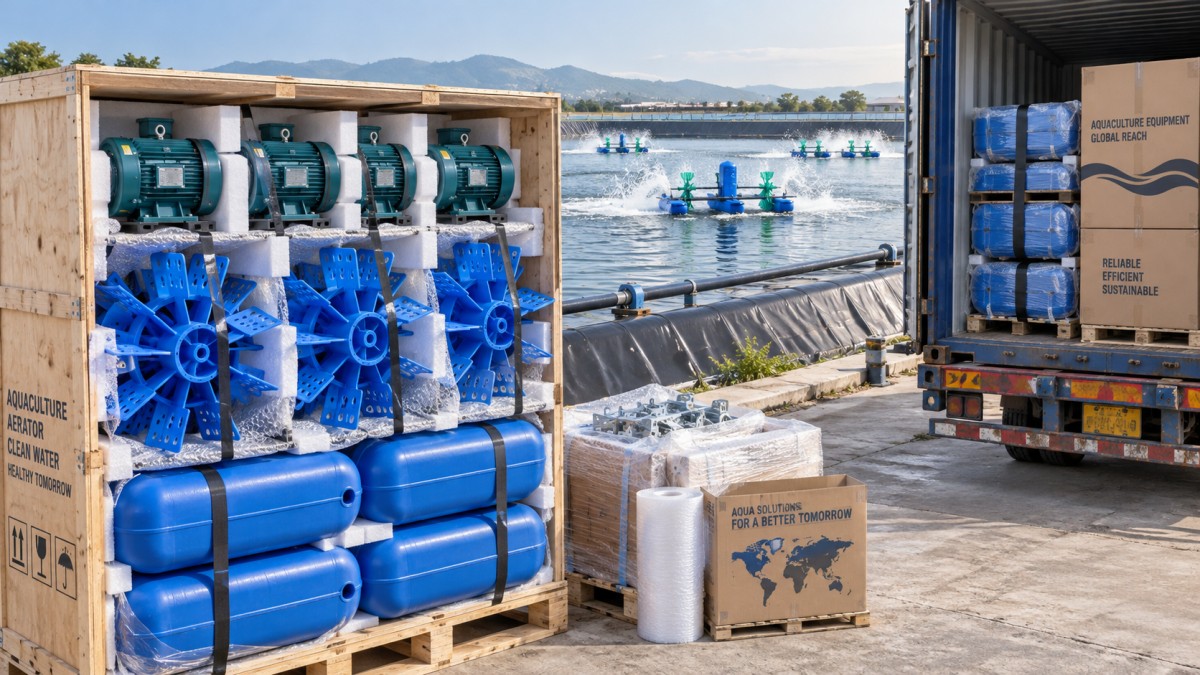
Aerators combine components with different shipping characteristics. Motors are relatively dense; floats, frames and paddlewheel assemblies can occupy substantial space without adding much weight. Freight calculations use the cargo as packed, not the dimensions or net weight shown on a product specification sheet.
For air freight, chargeable weight is generally the greater of actual gross weight and volumetric weight, calculated using the carrier’s applicable divisor. Less-than-container-load ocean freight, or LCL, commonly uses a weight-or-measure basis, with minimum charges and calculation rules set by the service provider. Lightweight but bulky equipment can therefore attract charges driven primarily by volume.
Consider a hypothetical shipment of 20 units. If each packed unit occupies 0.25 cubic metres, the total is 5 cubic metres. Reducing each package to 0.18 cubic metres lowers that total to 3.6 cubic metres—a 28% reduction. This does not mean the entire shipping bill falls by 28%, because documentation, minimum charges and other fixed costs remain. It does show why packing design deserves attention before negotiating freight rates.
The Variable Frequency Surge Aerator, for example, lists a whole-machine weight of 29 kg. That figure alone cannot establish its shipping cost: the packed gross weight, external dimensions and inclusion of accessories still need confirmation. An impeller diameter is likewise not a substitute for carton dimensions.
Request a packing list showing every package’s dimensions, gross weight, contents and quantity. Confirm whether floats, controllers, cables and mounting parts are included. A quotation based only on the motor carton can materially understate the volume of a complete saleable system.
Compact packing must not transfer costs to assembly or damage
Disassembly can make transport more economical. Nesting floats, separating frames or packing impellers alongside motor assemblies may reduce unused space. However, freight savings should be measured against the work required after arrival: sorting parts, assembling units, checking connections and replacing missing hardware.
Shared cartons also change inventory handling. Packing several machines’ accessories together may save space, but opening those cartons to fulfil individual orders creates labour and traceability requirements. Each complete unit should remain identifiable through package markings and component lists.
Protection is particularly important around shafts, impellers, electrical connectors and controllers. A smaller package is not an improvement if components can move or carry loads they were not designed to withstand. Specify restraints, cushioning and moisture protection alongside dimensions. Confirm stackability as well: cargo that cannot support other freight can restrict loading options or attract additional charges.
LCL and full-container shipping have different cost structures
LCL allows smaller orders without paying for an entire container, but the ocean freight line is only part of its cost. Consolidation, terminal handling, deconsolidation, documentation and warehouse release charges can materially affect the total. On a small shipment, minimum fees may produce a high delivered cost per unit even when the quoted ocean rate looks attractive.
Full-container-load shipping, or FCL, spreads container-level costs across the units loaded. Its value depends on usable capacity, not merely the container’s nominal volume. Package shape, door clearance, stacking limits, weight distribution and unloading requirements determine what actually fits.
There is no universal cubic-metre threshold at which FCL becomes cheaper. Obtain LCL and FCL quotations for the same cargo, delivery location and shipment window. Include origin charges, destination charges and final delivery in both comparisons.
A larger order may reduce transport cost per unit while increasing inventory exposure and financing costs. Filling a container with slow-moving voltage variants or spare assemblies solely to improve freight efficiency can tie up more cash than it saves. Loading efficiency should follow a realistic stock plan.
Transport mode and delivery location reshape the bill
Air freight can make sense for urgent replacement motors, controllers or a small initial order. Complete aerator assemblies may be less economical by air because bulky components increase chargeable weight. Separating urgent compact parts from routine ocean replenishment can control cost without delaying every item.
Routing also matters. A cheaper port-to-port service may involve transshipment, a less convenient arrival terminal or higher inland transport costs. Compare transit schedules and destination access, rather than assuming the lowest ocean rate produces the cheapest delivery.
The warehouse address is part of the calculation. Container delivery may require suitable vehicle access, unloading equipment and an agreed unloading window. Where these are unavailable, cargo may need transfer through a depot and delivery on another vehicle, adding handling and transport charges.
Freight quotations also have validity periods. A rate received before production starts may not remain available when the goods are ready. Confirm the cargo-ready date, likely booking window, applicable surcharges and whether the quotation covers the intended sailing.
Delivery terms decide which costs remain outside the quote
An Incoterms rule should be accompanied by a precise named place or port and the applicable version. “FOB China” or “delivered price” does not provide enough detail to compare obligations.
Ask for a charge schedule identifying prepaid and collect items. Destination charges deserve particular scrutiny when the supplier arranges LCL freight: a low prepaid freight amount can coexist with substantial charges payable before cargo release.
Customs and release delays can erase freight savings
Duty rates depend on destination rules, tariff classification, origin and customs value. Classification should reflect the actual machine and shipment configuration, not a generic description such as “aquaculture equipment.” Separately shipped motors, controllers or replacement parts may need different treatment from complete machines.
Provide the customs broker with specifications, component descriptions, invoices and packing details before dispatch. Check applicable electrical requirements and whether solid-wood crates or pallets require ISPM 15 treatment and marking. Incomplete documents or unsuitable packaging can lead to inspection, correction costs and delayed release.
Import tax should be shown separately from freight. Where legally recoverable, it may be a cash-flow requirement rather than a permanent inventory cost; recovery depends on local rules and documentation.
Delay-related charges also need definition. Terminal storage, container demurrage and detention can arise under different conditions. Obtain the applicable free-time allowances and tariffs, and arrange clearance and delivery before those allowances expire. Cargo insurance should be assessed separately, including its deductible, coverage and claim evidence requirements.
Compare the cost of saleable stock, not the headline freight rate
A practical comparison adds equipment, export packing, origin transport and handling, international freight, insurance, destination handling, brokerage, nonrecoverable duties and taxes, and delivery to the warehouse. Include predictable unloading and assembly costs, while keeping recoverable taxes separate.
Divide that amount by the number of complete saleable units. Then test the variables most likely to change the result: larger-than-quoted packages, a missed sailing, additional destination fees or a different loading quantity. Before confirming an order, lock down the packing specification, shipment scope and charge boundaries. Those details provide a stronger basis for protecting resale margins than a freight quote viewed in isolation.
