






How to check electrical safety before starting an aquaculture aerator
Before starting an aquaculture aerator, a quick visual inspection is not enough to confirm electrical safety. Wet conditions, damaged cables, poor grounding, and unsuitable protective devices can expose workers to electric shock. A motor that ran normally yesterday may be unsafe today after heavy rain, cable movement, or maintenance.
The practical approach is to separate routine pre-start observations from electrical tests requiring a qualified electrician. Check the installation, review its test records, and keep power isolated whenever a fault remains unresolved. Production pressure—especially when dissolved oxygen is falling—is not a reason to bypass protection.
Establish isolation before inspecting the installation
Locate the correct disconnect and identify every possible power source. Pond equipment may have automatic timers, remote controls, generator supplies, or variable-frequency drives. Pressing the stop button does not establish electrical isolation, and an automatic control can restart equipment unexpectedly.
Apply the site’s lockout procedure before handling cables, opening enclosures, or working near moving parts. A qualified person must verify absence of voltage using an appropriate tester before electrical work begins. Drives and capacitors may retain energy after disconnection; follow the manufacturer’s discharge instructions.
Keep personnel out of the pond during inspection and commissioning. If electrical leakage is suspected, prevent access to the water and nearby conductive structures until the installation has been assessed. Do not enter the pond to retrieve a damaged cable.
Trace the cable from the supply to the motor
Inspect the entire accessible cable route, not just the section beside the motor. Pay particular attention to bank edges, float attachments, cable glands, and places where vehicles or maintenance tools cross the route. A cable can look acceptable from above while its underside has been rubbed against a bracket.
- Look for cuts, crushed sections, cracking, exposed conductors, heat discoloration, and improvised taped joints.
- Check that cable glands grip the outer sheath and provide strain relief; terminals should not carry the cable’s weight.
- Allow for normal float movement and water-level changes without letting slack reach paddles, shafts, or sharp edges.
- Confirm the cable is suitable for its actual exposure, including sunlight, moisture, and immersion where applicable.
A taped repair is not evidence that a cable is safe for pond service. Damaged cable should be replaced or repaired through an approved method by qualified personnel. Long cable runs also require assessment of conductor size and voltage drop; matching the plug to the socket proves neither.
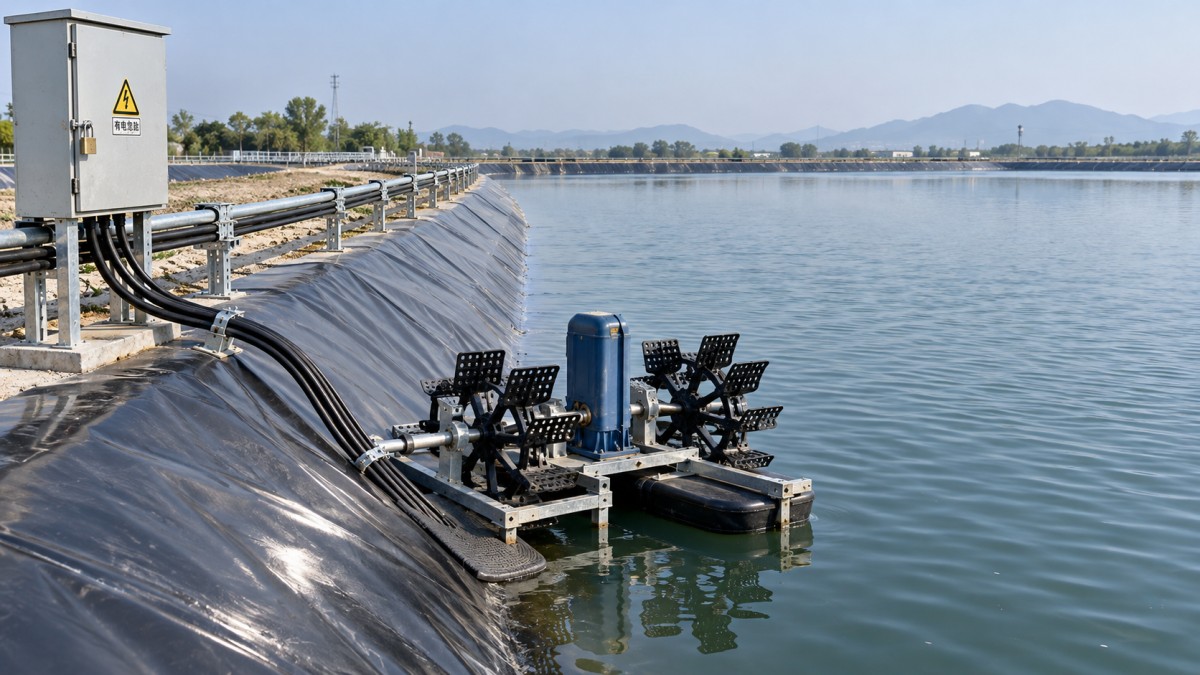
In lined ponds, protect both the cable and the geomembrane
HDPE-lined fish and shrimp ponds introduce a separate installation concern: cables, supports, and aerator restraints can abrade the liner. Avoid dragging equipment across exposed geomembrane, and use project-approved supports or protective pads where contact is unavoidable. Anchors must follow the pond design rather than being driven through the liner for convenience.
A pond-lining product such as Anti-Seepage Waterproof HDPE Smooth Geomembrane for Fish Shrimp Pond Farming provides seepage control, but it is not an electrical safety barrier. Its advertised puncture, UV, and corrosion resistance does not replace protective earthing or fault protection. Check the selected thickness and installation details against the project specification; do not treat the liner as insulation protecting workers from an electrical fault.
Verify grounding through records and testing
For equipment requiring protective earthing, inspect the accessible earth connection for corrosion, loose hardware, or a missing conductor. However, seeing a green-and-yellow wire does not prove that a continuous protective path exists back to the supply.
Before initial commissioning, and after relevant repairs or relocation, a qualified electrician should verify protective-conductor continuity and the fault-protection measures required for the installation’s earthing arrangement. Whether additional bonding is needed for accessible metalwork depends on the installation and local rules. A separate earth rod is not automatically a substitute for a proper protective conductor.
Insulation-resistance testing may also be necessary, particularly after water ingress, prolonged storage, or cable damage. Test methods and acceptance limits must suit the motor and connected electronics. Applying an insulation tester through a drive or control module without following its instructions can damage equipment.
Check water protection and supply compatibility
Inspect terminal boxes, plugs, sockets, and control cabinets for cracked covers, deteriorated seals, missing gland plugs, and evidence of moisture. An enclosure’s IP rating describes defined protection conditions, not unlimited resistance to flooding or pressure washing. A splash-resistant connection should not sit where pond water can submerge it.
Position connections above foreseeable water levels and away from direct aerator spray. Check inside enclosures only under verified isolation and by authorized personnel. Condensation, salt deposits, or corrosion warrant investigation even when the outside appears dry.
Compare the motor nameplate with the available voltage, frequency, and phase supply. The electrician should verify cable capacity, protective-device selection, motor overload settings, and supply conditions. For three-phase equipment, phase sequence and phase loss deserve attention. Wrong rotation can affect aerator operation; never rearrange conductors while energized.
Confirm residual-current protection—not just a working breaker
An ordinary circuit breaker primarily protects against overcurrent; it should not be mistaken for personnel shock protection. Residual-current protection—such as an RCD or GFCI, depending on the market—must be selected and installed according to local requirements and the equipment configuration.
Where fitted, operate the device’s test button at the manufacturer’s specified intervals. This checks its test mechanism, not the entire earthing system or actual trip performance. Commissioning verification requires suitable instruments and a qualified electrician.
Drive-controlled motors need particular care because electronic drives can affect residual-current protection. Confirm the compatible device type with the drive manufacturer and installation designer. Repeated tripping is a fault to investigate—not a reason to bypass the device or increase its trip threshold without an approved assessment.
Release the aerator for a controlled start
Start only after defects are closed, covers and guards are secured, personnel are clear, and required electrical test results are accepted. Observe from a dry, safe position. Stop immediately for protective-device trips, smoke, abnormal vibration, or unexpected rotation. Do not approach energized equipment to investigate a suspected fault.
Record the equipment identifier, inspection date, defects, test references, and release authorization. Jinan Dingshun Import & Export Co., Ltd.’s procurement, quality inspection, logistics, and after-sales support across geosynthetics and aquaculture equipment can help coordinate equipment documents and replacement components. Those documents support site verification; they do not replace it.
If grounding, cable condition, moisture protection, or protective-device suitability remains uncertain, keep the aquaculture aerator isolated. Use a separately verified backup aeration arrangement while the defect is resolved, rather than turning an oxygen-management problem into an electrical emergency.