






To secure an impeller aerator cable against abrasion, route it clear of moving parts and rough edges, support it with broad, cushioned clamps, and protect unavoidable contact points with a suitable sleeve or smooth guide. Leave controlled slack wherever the equipment moves. A cable pulled tight between the bank and the aerator can transfer movement directly to the motor entry, while an oversized loose loop can drift into the impeller or rub across the pond liner.
The arrangement must suit the installation. A fixed unit needs protection from vibration and sharp frame edges; a floating unit also needs room for movement within its mooring limits and changes in water level. In a geomembrane-lined pond, the cable supports must protect both the electrical cable and the waterproofing beneath it.
Find the contact points before adding restraints
Stop the aerator, isolate its electrical supply, and prevent accidental restart before handling the cable or reaching near the equipment. Have a qualified person verify safe isolation where required. If the cable has exposed conductors, deep cuts, cracking, or damage near the motor entry, keep the unit out of service until the cable has been assessed and repaired or replaced appropriately. A protective sleeve cannot restore damaged electrical insulation.
Trace the cable from the supply connection to the motor. Look for polished areas, flattened sections, cuts, and places where dirt has collected around a contact point. Examine the underside of the cable as well: wear against a frame or pond edge may be hidden from above.
Pay particular attention to four locations:
- The motor cable entry: tension or repeated bending here can load the gland and compromise its seal.
- Frame crossings: a seemingly smooth bracket may have a weld, burr, or narrow edge beneath the cable.
- The transition onto the bank: changes in direction can concentrate pressure against concrete, stone, or an exposed liner edge.
- Slack near the water: unsupported cable can drift toward rotating parts, snag on mooring hardware, or drag along the pond bottom.
Consider the equipment’s full permitted movement, rather than its position on a calm day. With power isolated, assess the cable path at the limits allowed by the moorings and expected water levels. If the cable becomes taut before the mooring restrains the aerator, the routing needs adjustment. The electrical cable must never serve as a mooring line or lifting rope.
Support the cable without crushing it
Start by moving the route away from the source of abrasion wherever practical. A sleeve over a cable that repeatedly slides across a sharp edge remains a wear item. Removing the contact, using an approved smoother route, or installing a rounded guide reduces the burden on the protective material.
On a fixed frame, use cable clamps or cushioned saddles sized for the cable’s outside diameter and suitable for the exposure. The support should distribute pressure over a broad area and restrain the cable without visibly flattening its jacket. Check that cushion materials are compatible with the jacket and that exposed hardware has no sharp edges.
Cable ties can help organize a run, but narrow ties pulled hard can create concentrated pressure. Where ties are appropriate, choose types suitable for sunlight and moisture, use a smooth supporting surface, and avoid tightening them until the jacket indents. Keep trimmed ends away from the cable and from areas operators handle. Do not clamp onto connectors, cable glands, or an existing damaged section.
Place supports where they prevent sagging into hazards and control movement at changes of direction. Follow the equipment and cable manufacturers’ requirements for support spacing and bend radius; there is no single spacing that suits every cable and aerator. Keep bends gradual, particularly beside a gland or connector. A short, tight bend at the end of a rigid support can become the new failure point.
For a floating installation, provide a smooth, controlled loop in a clear area where it can flex as the aerator moves. Check that it accommodates the permitted movement without reaching the impeller, shaft, or other rotating parts. Support the shore-side run independently so its weight does not pull on the motor entry. Use manufacturer-approved strain relief where needed.
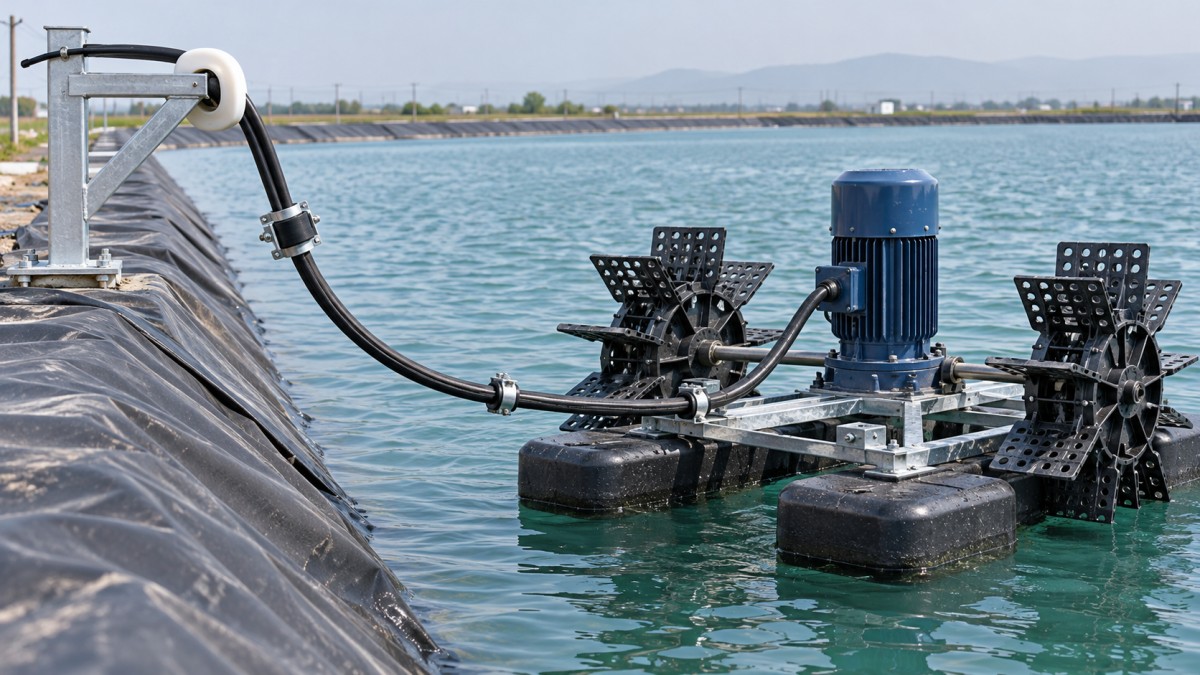
The useful visual check is the entire route: supported cable on the frame, gradual bends, protection at the bank crossing, and a movement loop kept clear of the operating envelope. Looking only at the nearest clamp can miss a tension problem farther along the run.
Choose protection for the contact and exposure
Abrasion protection should match the way wear occurs. A stationary bank crossing may need a smooth conduit or guide. A section that flexes with the aerator may need a flexible sleeve intended for repeated movement. Avoid extending rigid protection into a moving section where its end would concentrate bending.
Choose sleeves and guides for the actual conditions: sunlight, water exposure, pond treatments, temperature, and movement. Any cable that will be submerged must itself be approved for that use. Adding a sleeve or conduit does not make an unsuitable electrical cable suitable for immersion.
Check the protection’s internal surface and its ends. Rough conduit cuts, exposed reinforcement, and hard sleeve edges can abrade the jacket they are meant to protect. Use appropriate smooth fittings or edge protection, and secure the sleeve so it cannot migrate and expose the original contact point. Keep its attachment points from becoming new pressure spots.
Wrapping ordinary tape around a rubbing point offers little control over the underlying movement. It may also conceal deterioration during inspection. Protective covers should allow periodic access to the jacket, especially where grit can enter. A sleeve containing sand can continue wearing the cable internally even when its outer surface appears intact.
For long enclosed sections, have the cable installation checked for any effect on heat dissipation and electrical loading. Keep connections accessible for inspection and use connections rated for their location. Do not place an ordinary plug, improvised splice, or taped joint in a wet section of the route.
Keep cable hardware off the pond liner
In a lined pond, cable protection and liner protection need separate attention. A sleeved cable may still rub the geomembrane, and a metal clamp that is harmless to the cable may damage the liner. Avoid dragging cable runs across the bottom, placing exposed fasteners against the membrane, or driving stakes through it to create convenient fixing points.
Support the bank transition from suitable infrastructure outside the liner where practical. If a support must bear on the lined area, use a liner-compatible arrangement that spreads the load, with a protective layer specified for the installation. Remove trapped stones and grit before placing it. A small scrap of soft material beneath a heavy bracket should not be assumed to provide adequate protection.
For ponds using a waterproof fish-pool geomembrane such as Sale Black hdpe pond liner Waterproof Fish Pool geomembrane, select the support detail around the actual membrane material, thickness, and underlying surface. Waterproofing and tensile performance do not establish resistance to repeated rubbing by cables or concentrated loads from hardware. Any necessary penetration needs a designed sealing detail rather than an improvised hole.
After installation, observe the aerator from a safe position during startup and normal operation. Watch for vibration, cable movement through clamps, tightening at the motor entry, and contact at the bank. Isolate the supply again before making adjustments.
Inspect the route after repositioning the aerator, changing moorings, significant water-level changes, or storms, and include it in routine equipment checks. Open removable sleeves when necessary to inspect hidden contact areas. If wear returns at the same location, revise the route or support arrangement before adding more covering. Repeated damage is evidence that movement, pressure, or trapped grit remains unresolved.
