






How to troubleshoot excessive vibration in an impeller aerator
Excessive vibration in an impeller aerator can signal more than routine wear. An unbalanced impeller, loose mounting hardware, shaft misalignment or bearing damage may be responsible. The useful question is not simply “Which part is shaking?” but “What changed before the shaking started?” A unit that vibrates after relocation needs a different investigation from one that gradually developed noise over several weeks.
In geomembrane-lined fish ponds, there is another concern: movement can bring hardware, cables or mooring components into contact with the liner. Troubleshooting should protect both the aerator and the pond containment system, starting with safe isolation rather than repeated trial runs.
Stop safely, then capture the symptoms
Shut the machine down immediately if vibration is accompanied by scraping, smoke, a burning smell, visible cracking, violent rocking or repeated protection trips. Follow the site’s lockout procedure, isolate every power source and have a qualified person verify that the equipment is de-energized. Wait for complete standstill before approaching rotating components. Never inspect an energized machine from the water.
If pond oxygen supply is critical, arrange backup aeration while repairs proceed. Continuing to run a damaged unit to avoid an interruption can turn a replaceable component fault into a larger failure.
Record what was observed before shutdown: whether shaking began immediately or after warming up, whether it followed cleaning or an impeller replacement, and whether the whole floating assembly moved or vibration appeared concentrated at the drive. These are diagnostic clues, not proof. A video taken from a safe bank position can help support teams understand the movement.
Check flotation and restraints before dismantling the drive
On a floating installation, uneven flotation can change impeller immersion and produce uneven hydraulic loading. Check for damaged floats, water ingress, displaced brackets and unequal positioning. Compare the assembly with its installation drawing; do not assume that an apparently level motor means the entire platform is correctly set.
Inspect mooring lines for looseness, excessive tension or a changed anchor position. A restraint that pulls one side downward can make the machine rock, while an overly loose arrangement may allow repeated movement against surrounding equipment. Restore the specified arrangement rather than tightening every line as far as possible.
In a lined pond, check clearance from the geomembrane at the lowest operating water level. Look for rubbing by cables, brackets and restraints. Avoid improvised anchors or supports that puncture the liner or place sharp, concentrated loads on it. Suspected liner damage needs separate inspection by personnel familiar with the installed geosynthetic system.
Inspect the impeller for uneven loading and damage
With the unit safely isolated and accessible, inspect the entire impeller, including its underside and hub. Weed, fishing line and uneven deposits can disturb balance or interfere with rotation. Remove contamination using methods suitable for the impeller material; aggressive scraping can damage an engineering-plastic component.
Look for chipped edges, cracks, bent sections, abrasion and signs that the impeller has contacted another surface. Check hub seating and fastening against the manufacturer’s instructions. If symptoms began after replacement, verify part compatibility, orientation and mounting—not merely whether the replacement fits the shaft.
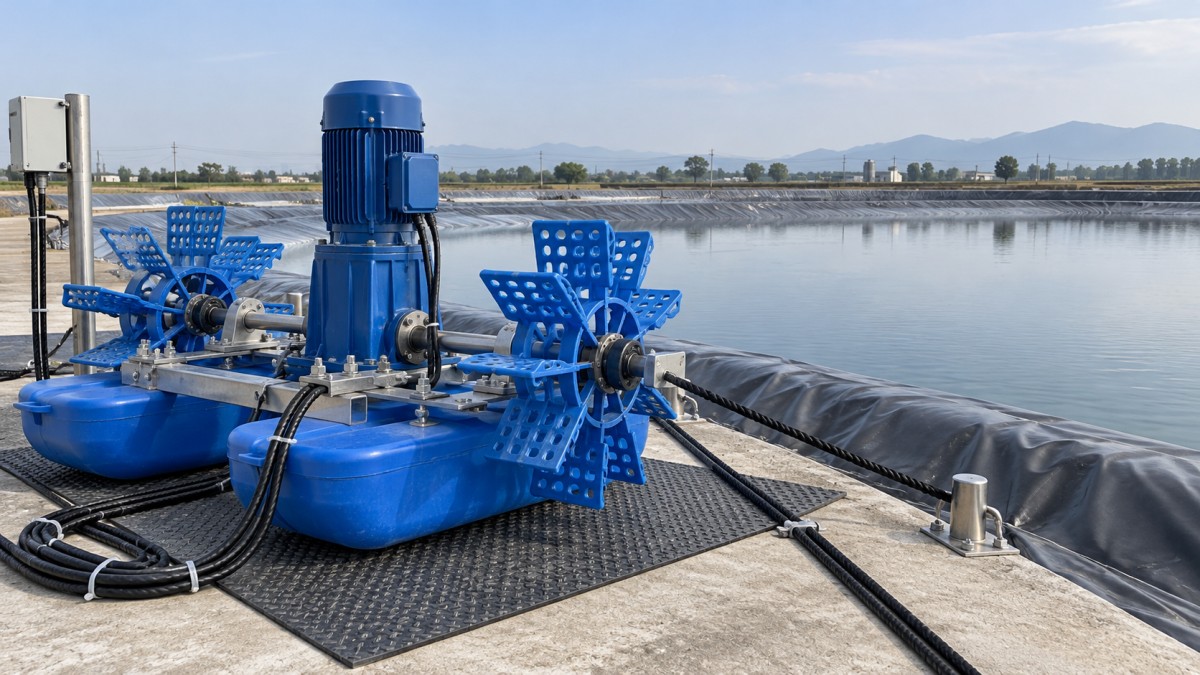
Do not straighten a damaged impeller by eye, grind material away to “balance” it or add improvised weights. Shape changes affect both balance and water loading. A cracked or distorted component generally needs replacement or manufacturer-approved assessment, not a pond-side repair.
Material also matters when ordering parts. The Impeller Aerator Fish Pond Aerator Fish Farming Aerator range lists engineering-plastic and stainless-steel impeller options for different environments. Confirm compatibility with the exact model and drive configuration before substituting materials; corrosion resistance alone does not establish mechanical interchangeability.
Follow the mechanical path from mounting to bearings
Check frame joints, motor mounting points and drive fasteners for movement marks, missing locking devices, elongated holes or cracks. Tighten to the specified torque and sequence. If a fastener repeatedly loosens, investigate the joint rather than simply applying more torque. The mounting surface or bracket may already be damaged.
Where the design allows safe manual rotation, check for roughness, tight spots and abnormal play after isolation. Do not force movement through a brake or geared assembly. Bearing noise combined with noticeable play warrants closer inspection, but resistance alone does not confirm bearing failure.
Shaft runout and alignment require measurement against the equipment’s tolerances. A dial indicator can help identify a bent shaft or an incorrectly seated hub. Do not apply a universal alignment limit to every aerator: direct-drive and geared arrangements have different requirements. Where a gearbox is fitted, check lubricant condition, leakage and service history according to its manual.
Replacing bearings without correcting shaft distortion, water ingress or misalignment often leaves the original cause in place. Establish why the bearing deteriorated before closing the repair.
Investigate electrical symptoms without bypassing protection
If vibration comes with poor starting, unusual humming, overheating or protection trips, involve a qualified electrician. For three-phase equipment, phase loss or supply imbalance can contribute to abnormal motor operation. Required checks may include terminal condition, supply voltage and phase currents, using appropriate electrical safety procedures.
The linked range describes built-in protection against phase loss and overheating. That protection is not a vibration monitor, and a trip does not identify the failed component. Never bypass it to keep the aerator running. Likewise, a motor that does not trip is not necessarily mechanically sound.
Restart under controlled conditions and verify the repair
Before restarting, restore guards, confirm fastener security, route cables clear of moving parts and check flotation and restraints. Test only under the operating conditions specified by the manufacturer. Running an impeller out of water is not a reliable substitute for a pond test and may be prohibited for the equipment.
Observe from a safe position. Compare vibration, noise and motor current with previous healthy operation where records exist. If using a vibration instrument, repeat measurements at the same accessible locations and operating conditions. Without a model-specific limit, a single reading should not be treated as a universal pass or fail.
Stop again if abnormal movement persists. Cleaning-related imbalance may be resolved by removing deposits; cracked impellers, excessive bearing play and bent shafts require a different repair decision.
For specialist support, send the model, serial number, nameplate photo, installation photos, symptom history and completed checks. Jinan Dingshun Import & Export Co., Ltd. handles geosynthetics, aquaculture equipment and engineering equipment, with quality inspection, logistics and after-sales coordination. A clear service record helps identify compatible parts and whether the next step is an installation correction, component replacement or workshop assessment—not another unsupported trial run.
