






A solar aquaculture aerator can be suitable for an off-grid pond, provided it supplies enough oxygen during the pond’s most demanding hours—not just when sunlight is available. A remote pond may be easy to aerate at midday yet become vulnerable before dawn, when photosynthesis has stopped and fish, microorganisms and sediment continue consuming oxygen. For commercially important stock, a daylight-only unit should not be treated as the sole oxygen safeguard unless monitoring demonstrates that overnight conditions remain acceptable.
The buying decision therefore depends on oxygen demand, seasonal solar availability, energy storage and backup arrangements. In a geomembrane-lined pond, installation adds another constraint: aerators, anchors and pipework must provide effective circulation without puncturing or abrading the liner. Low fuel consumption is valuable, but it does not compensate for oxygen shortages or damaged containment.
Start with the pond’s oxygen requirement
Pond area alone is not a reliable sizing basis. Two ponds with similar dimensions can have very different aeration requirements because of stocking biomass, species, feeding rates, water temperature and organic loading. Depth and geometry also determine whether equipment can distribute oxygen through the occupied water volume.
Before requesting quotations, assemble the operating information that affects demand:
- Pond area, depth profile, water volume and liner arrangement.
- Species, projected peak biomass and maximum daily feed input.
- Seasonal water temperatures and periods of heavy organic loading.
- Dissolved oxygen readings, particularly before sunrise and during stressful weather.
- The species-specific minimum acceptable oxygen level and the operational alarm threshold.
Measurements from a lightly stocked pond should not become the design basis for full production. Where records are unavailable, have the aeration requirement estimated for the intended peak operating conditions, then verify it through monitoring as stocking increases.
Ask suppliers for oxygen-transfer performance, test conditions and the proposed equipment layout. Motor power describes electrical consumption, not the oxygen delivered to the stock. Standardized clean-water performance also needs interpretation for actual pond temperature, dissolved oxygen concentration and water quality. A quotation stating only “suitable for this pond area” leaves the main performance question unanswered.
Match the power architecture to the risk
“Solar-powered” can describe several different arrangements. Their suitability changes sharply when nighttime operation or prolonged cloud cover becomes necessary.
A battery-supported system is not automatically a continuous-duty system. Its runtime must be calculated at the actual aerator load, including controllers, monitoring devices and conversion losses. The controls should also prioritize essential aeration when stored energy becomes limited, rather than exhaust the battery on noncritical loads.
Size for the difficult season, not the annual average
Estimate daily energy use by multiplying each load’s electrical power by its operating hours and adding auxiliary consumption. Size the solar array using local solar availability during the limiting season, with allowances for temperature, shading, dirt and electrical losses. Annual-average sunshine can conceal the cloudy period that determines whether the system is dependable.
Battery selection should use usable energy rather than nameplate capacity. Allow for permitted discharge depth, conversion losses, temperature effects and capacity decline with age. Define the required autonomy explicitly: overnight operation and operation through several poor-sun days are different specifications.
After a low-sun period, the array must both operate the aerator and replenish storage. A design that merely balances an average day’s consumption may recover too slowly. Ask the supplier to show the load assumptions, seasonal generation estimate, usable battery capacity and recharge behavior in one consistent energy assessment.
Choose an aeration method that fits the pond layout
Diffused-air systems place a blower or compressor on land and deliver air to submerged diffusers. This can simplify access to electrical equipment, but performance depends on operating depth, airflow, pressure losses and diffuser condition. Very shallow water reduces bubble contact time, so equipment intended for deeper ponds should not be selected without checking its performance at the actual depth.
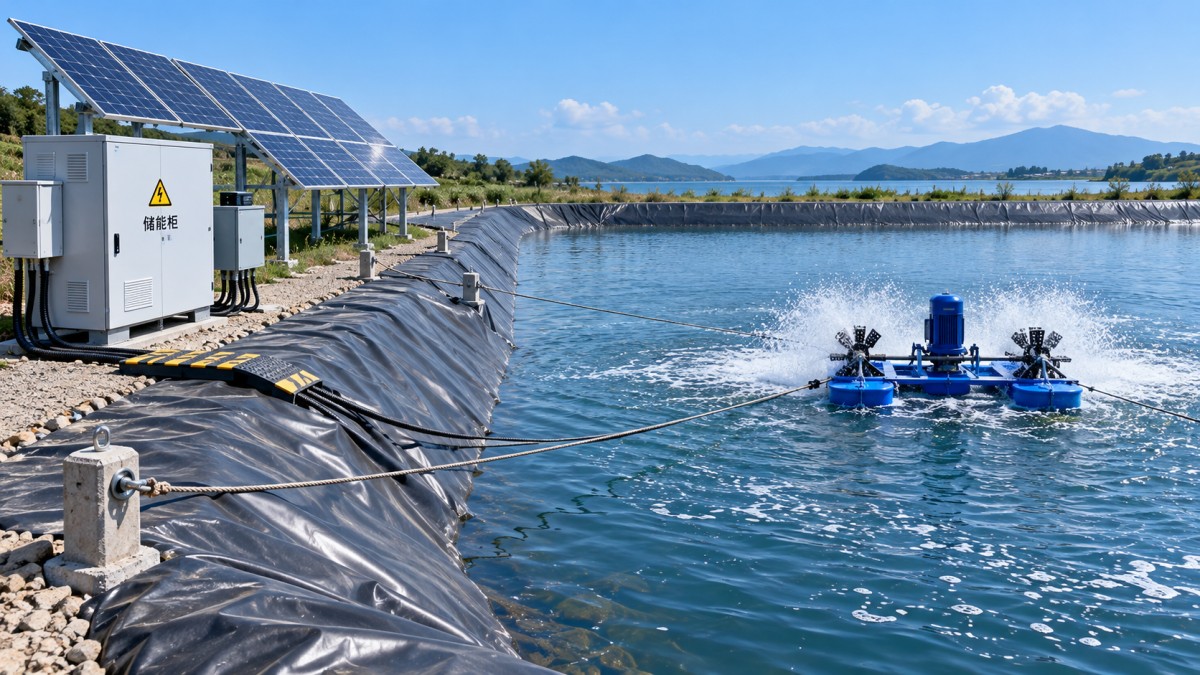
Surface aerators can provide useful circulation and surface oxygen transfer, depending on their design. Their suitability requires checking circulation paths, mounting arrangements and interaction with pond banks. Floating equipment needs secure mooring that accommodates water-level changes without dragging hardware across the membrane.
Ask for a layout showing aerator positions, anticipated circulation, power equipment and maintenance access. Irregular corners or separated pond sections may remain poorly mixed even when total installed power appears adequate. Water movement should reach the stock without concentrating sediment or creating damaging flow near vulnerable liner details.
Protect the geomembrane during installation
Do not place sharp anchors, unprotected metal frames or dragging hoses directly against the liner. Support and restraint details should account for abrasion, wind loads, changing water levels and movement during maintenance. Protective pads, ballast arrangements and any proposed penetrations require approval against the membrane and pond design.
Where liner construction or repair is part of the installation, the Geomembrane Welding Machine BGT-800 Series is a separate joining tool, not an aeration component. Its listed specifications include 230V/120V supply options, 800W/1100W power options and a stated single-film thickness range of 0.2–1.5 mm. Confirm the exact model, membrane compatibility and welding procedure before procurement.
An off-grid site must also provide the selected welder’s required electrical supply during installation. Welding settings and seam acceptance should follow the membrane specification and approved testing procedure; owning a welding machine does not establish seam integrity. Plan this temporary construction load separately from the aerator’s routine energy demand.
Compare ownership cost and failure exposure
Compare quotations over the same operating period and against the same oxygen-delivery requirement. Include panels, mounting structures, batteries, controls, aeration equipment, installation, transport, replacement parts and servicing. Battery replacement and backup fuel can materially affect lifecycle cost even when routine solar generation requires no fuel.
Remote maintenance deserves particular attention. Determine whether operators can clean diffusers, service the blower or motor, replace fuses and troubleshoot controls with available tools. Confirm spare-part availability, warranty exclusions and transport arrangements for failed components. A lower purchase price may lose its advantage if a minor failure leaves the pond without aeration while parts are shipped.
Assess backup against the time available to respond. A manual generator may be reasonable where staff are present and oxygen declines slowly enough for intervention. Where unattended overnight operation is necessary, low-oxygen alarms, automatic backup starting or another independently powered aeration route may be needed. Backup equipment must be maintained and tested under load.
Make acceptance depend on operating evidence
Before approving the purchase, require a written duty specification covering peak stocking conditions, intended operating hours, oxygen-performance assumptions, low-sun autonomy and backup operation. Commissioning should confirm airflow or circulation, electrical consumption, battery charging and alarm behavior. Monitor dissolved oxygen at representative locations, including before dawn, rather than relying on visible bubbles alone.
Choose solar as the primary power source when the energy assessment and verified aeration performance cover the pond’s critical operating periods. Choose a supported hybrid arrangement when oxygen demand is continuous or losses would be severe. Treat direct-solar aeration as supplemental where nighttime adequacy has not been demonstrated, and delay final sizing when stock demand or seasonal solar conditions remain undefined.
