






Can a fish farming aerator keep up with higher stocking density?
Higher stocking density can increase production potential—but it also raises oxygen demand and narrows the margin for error. Can your fish farming aerator keep pace without driving up energy costs or putting stock at risk? For decision-makers managing lined aquaculture ponds, the answer depends on biomass, feeding rates, water temperature and effective oxygen transfer—not motor power alone.
An existing system may support more fish if it has genuine spare capacity and distributes oxygen throughout the pond. However, acceptable dissolved oxygen near a running aerator does not prove that the pond can handle a heavier crop. The useful question is whether the system can protect the stock during the most demanding operating period, including an equipment failure.
Evaluate the harvest biomass, not the stocking-day count
Fish numbers are a poor starting point for sizing aeration. A pond stocked with small juveniles can look comfortable early in the cycle and become oxygen-limited as those fish grow. Build the assessment around expected standing biomass, peak daily feed input and the timing of maximum demand.
Fish respiration is only part of the oxygen budget. Microbial decomposition of uneaten feed, feces and other organic matter also consumes oxygen. A geomembrane separates pond water from the underlying soil, but it does not stop sludge accumulating above the liner. Higher feeding rates therefore require attention to both aeration and solids management.
Consider a planned expansion where pond dimensions stay unchanged while harvest biomass increases. Simply extending aerator operating hours may work during early growth. Near harvest, however, the equipment might already run continuously through the critical overnight period. At that point, there are no extra hours left to buy capacity.
Before approving the increase, assemble records for biomass estimates, feed delivery, water temperature, dissolved oxygen and aerator runtime. Set oxygen targets with species, life stage and production method in mind; a generic survival threshold is not a suitable operating target.
Ask what the oxygen-transfer rating actually represents
Motor power tells you about electrical demand, not how much oxygen reaches the fish. Supplier comparisons should distinguish standard oxygen transfer rate, commonly expressed in kilograms of oxygen per hour, from standard aeration efficiency, expressed in kilograms of oxygen per kilowatt-hour. Both are useful, but neither should be treated as guaranteed pond performance.
Standard ratings typically come from controlled test conditions. Actual transfer depends on temperature, salinity, existing dissolved oxygen, water characteristics and installation. As dissolved oxygen approaches saturation, the driving force for transfer falls. Request the test method, test conditions and configuration behind any quoted rating, then have the field-capacity estimate checked against your pond conditions.
- Confirm whether published power is motor nameplate power or measured electrical input.
- Check that compared units were tested under comparable conditions.
- For diffused-air systems, include blower power, operating pressure, diffuser depth and fouling allowances.
- Ask what maintenance condition the performance claim assumes.
A practical capacity check compares estimated peak pond oxygen demand with effective field transfer, while retaining a contingency margin. Do not subtract daytime algal oxygen production as though it were a dependable overnight supply. Cloud cover and changes in the algal community can make that assumption costly.
In lined ponds, circulation can be the limiting factor
A powerful aerator can still leave poorly mixed corners or deeper zones short of oxygen. Measure away from the equipment as well as near it, including representative depths and areas where solids settle. Pre-dawn readings are particularly useful, but continuous logging can reveal short dips that occasional checks miss.
Paddlewheel aerators can suit ponds needing strong horizontal circulation. Diffused-air arrangements may suit distributed oxygen delivery, provided depth, pressure losses and diffuser servicing are properly assessed. Aspirating or propeller-type units offer other mixing patterns. None is automatically the best choice: pond geometry, operating depth and solids-removal layout determine whether those patterns are useful.
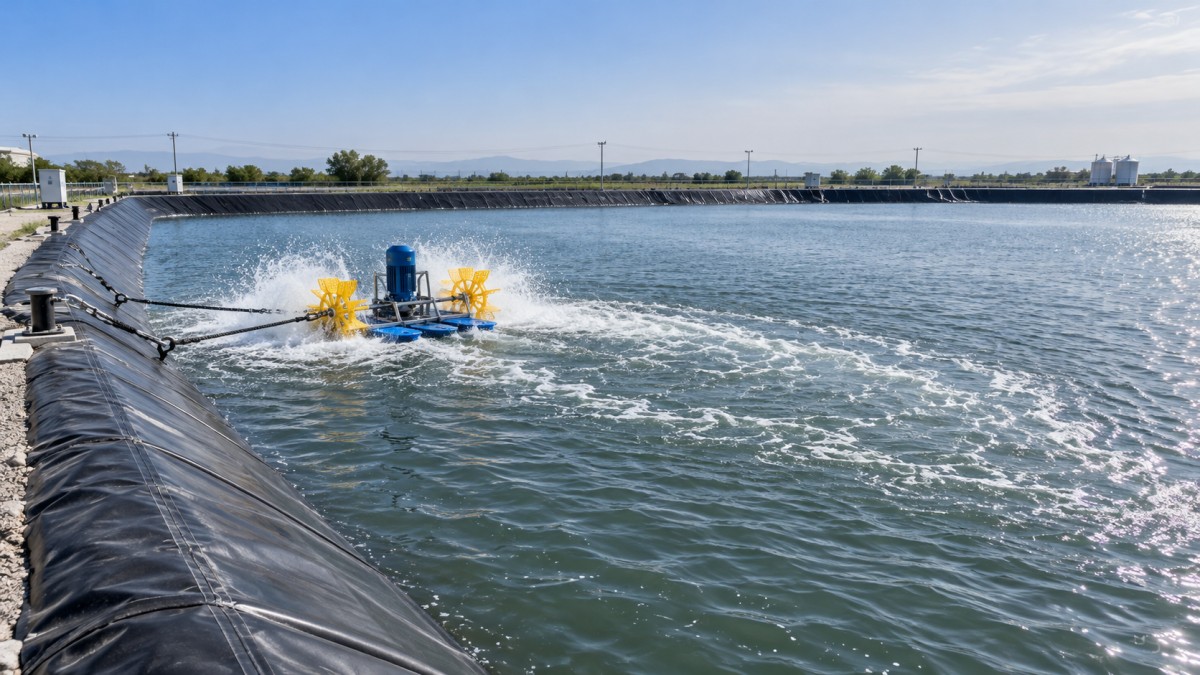
For geomembrane-lined ponds, check clearances, moorings and access routes before adding equipment. Frames, anchors and pipe supports should not create concentrated loads or abrasion against the liner. Strong circulation also needs to be coordinated with the intended sludge collection zone; otherwise, additional mixing may redistribute waste instead of directing it toward removal.
Keep liner integrity in the upgrade scope
If an expansion involves liner replacement or seam repairs, welding equipment belongs in the construction plan—not the oxygen-capacity calculation. The Geomembrane Welding Machine BGT-900 Series lists a single-layer welding thickness range of 1.0–3.0 mm and adjustable welding speed of 1.0–5.0 m/min, with closed-loop temperature and speed control. Suitability still requires confirmation against the specific membrane and site conditions. Trial welds and project-specified seam testing remain necessary; machine settings alone do not establish an acceptable seam.
Choose between repositioning, adding capacity and replacing equipment
If oxygen is adequate near the aerator but low elsewhere, investigate distribution before buying a larger motor. Repositioning units or changing the circulation layout may address the actual problem. If readings decline across the pond despite good mixing and full operation, additional oxygen-transfer capacity is the more likely requirement.
Replacement makes sense when existing equipment has poor verified efficiency, frequent breakdowns or unsuitable electrical requirements. Compare installed operating costs rather than purchase prices alone: electricity, cables and controls, maintenance access, replacement parts and service downtime all belong in the decision.
Adding several units can offer operational flexibility and reduce dependence on one machine. That benefit disappears if all units share an unprotected power supply. Evaluate the remaining capacity with one unit unavailable, along with backup power, alarms and the time needed for staff to respond. A spare machine in storage is not immediate protection unless it can be deployed quickly.
Make the purchase conditional on commissioning evidence
For international procurement, confirm voltage, frequency, electrical protection, spare-parts availability and installation responsibilities before shipment. Jinan Dingshun Import & Export Co., Ltd. works across geosynthetics, aquaculture equipment and engineering equipment, coordinating procurement, quality inspection, customs declaration, logistics and after-sales service. That combined scope is relevant when liner works and aeration upgrades must arrive and be commissioned in sequence.
Increase density in stages, with agreed checkpoints for oxygen trends, feeding response, solids buildup and equipment loading. Commissioning measurements at low biomass are useful for checking installation, but they cannot demonstrate performance at peak production.
A fish farming aerator can keep up with higher stocking density when verified field capacity, circulation and failure protection remain adequate. If that conclusion rests only on horsepower or one good afternoon oxygen reading, delay the stocking increase and gather better evidence.