






Fish gasping at the surface while a fish farming aerator is running need immediate attention. The machine may be working, but oxygen demand can exceed its output, or oxygenated water may not reach the areas where fish are struggling. Similar distress can also develop when ammonia, nitrite, or damaged gills interfere with normal breathing.
The useful first distinction is whether fish lack oxygen in the water or cannot use the oxygen available. Measure dissolved oxygen where the fish are gathered, then compare it with readings elsewhere in the pond. A strong splash beside the aerator cannot answer that question.
Respond to the distress before adjusting the whole pond
When many fish are repeatedly gulping at the surface, gathering around inflows, or crowding the aerator’s discharge, treat the situation as urgent. Normal surface feeding or occasional air breathing in some species looks different from widespread, persistent distress.
- Stop feeding temporarily. Feeding adds oxygen demand through fish metabolism and the breakdown of uneaten feed and waste.
- Keep functioning aeration running and start available backup equipment. Check that each unit is actually moving water normally.
- Measure dissolved oxygen and temperature immediately. Take readings where fish are struggling and away from the aerator.
- Use replacement water only when its quality is suitable. An inlet can help, but low-oxygen, contaminated, or very different-temperature water can worsen the situation.
Avoid suddenly stirring the entire bottom of a deep or stratified pond. Bottom water may contain little oxygen and accumulated decomposition products. Bringing a large volume into the fish’s occupied layer can intensify the shortage. Increase useful aeration while assessing conditions at different depths.
If fish are losing balance, deaths are increasing, or distress continues despite improved oxygen readings, seek prompt aquatic animal health support. Keep a record of measurements, recent feeding, weather changes, treatments, and equipment interruptions.
Measure oxygen where the fish live
A reading taken inside the splash zone can make the pond appear healthier than it is. Check the affected area, the opposite bank, quiet corners, and the normal swimming depth. In deeper ponds, compare surface and deeper water without disturbing bottom sediment. Use a maintained, calibrated meter and allow each reading to stabilize.
Interpret results against the requirements of the species, life stage, and water temperature. A concentration tolerated by one species may stress another. Even fish that survive low oxygen may eat poorly and become more vulnerable to disease.
The pattern across the pond helps identify the next action:
- Low oxygen throughout: total oxygen demand is exceeding the supply. More aeration, reduced feeding, and a review of fish biomass and organic waste are needed.
- Better readings near the aerator, poor readings elsewhere: circulation or equipment placement is limiting oxygen distribution.
- Acceptable oxygen where fish are distressed: investigate water chemistry, gill health, and recent chemical exposure.
Repeat measurements after taking action. Fish becoming less crowded around the aerator is encouraging, but readings should also improve in previously oxygen-poor areas.
Why oxygen demand can outrun a working aerator
Fish, algae, and microorganisms all consume oxygen. At night, photosynthesis stops while respiration continues, so dissolved oxygen commonly falls toward dawn. An aerator that appears sufficient during a sunny afternoon may struggle through the final hours of darkness.
Warm conditions increase the challenge because warmer water holds less dissolved oxygen, while fish and microbial activity can increase oxygen demand. Several cloudy days, a dense algal bloom, or an algal die-off can also disrupt the pond’s oxygen balance. Dying algae consume oxygen as they decompose.
Stocking density should be assessed through current fish biomass, rather than the original number stocked. As fish grow, the same pond and equipment must support a larger biological load. Increased feeding also adds waste that consumes oxygen during decomposition.
A geomembrane liner does not remove this demand. It separates pond water from the underlying soil, but feed residues, feces, and organic sludge can still accumulate on its surface. Persistent sludge pockets need a waste-management response as well as aeration. Remove accumulated material through suitable drainage or cleaning methods rather than repeatedly suspending it around the fish.
Check whether circulation reaches the whole lined pond
Visible turbulence shows that water is moving locally. It does not establish that oxygenated water is circulating through the entire pond. Corners, partitions, irregular banks, and poorly positioned units can leave areas with weak water exchange.
In geomembrane-lined ponds, consider the liner slope, pond depth, drainage arrangement, and anchoring system together. Position equipment to create a useful circulation path through occupied water. Avoid arrangements where adjacent units oppose each other’s flow or repeatedly circulate water through the same small area.
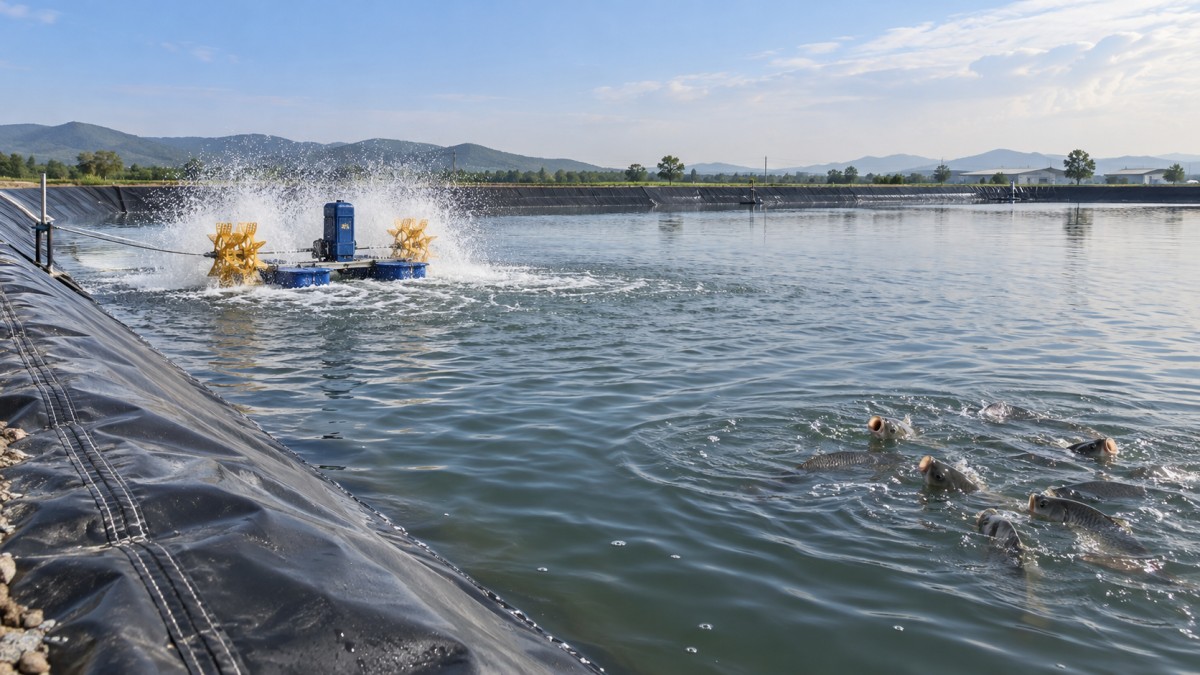
Use oxygen readings and observations of water movement to guide repositioning. Floating foam or debris can reveal surface flow, although it does not show what happens at depth. If one corner repeatedly has low oxygen, compare readings there before and after a placement adjustment.
Protect the liner during changes. Anchors, frames, cables, and moving components should not scrape exposed geomembrane or create concentrated loads. Keep the equipment at its intended operating depth and maintain suitable clearance. A current that continually resuspends bottom waste may increase oxygen demand and irritate gills.
Different aeration arrangements serve different needs. Surface units provide oxygen transfer and circulation near their operating zone; properly designed diffused-air systems can support deeper water. Deep ponds may require a combination, but introducing deeper mixing during an oxygen emergency needs care because of the bottom-water conditions described earlier.
A running fish farming aerator may still underperform
Compare the machine’s present operation with its normal water pattern. A weaker discharge, uneven rotation, abnormal vibration, repeated trips, or intermittent operation can indicate reduced performance. Fouling, entangled debris, damaged components, incorrect immersion, and electrical problems can all reduce useful output.
Inspect equipment only after safely isolating its power. Check the impeller or intake, flotation, mounting position, and accessible mechanical components. Electrical faults and controller settings should be handled by a qualified technician. Increasing speed without resolving the cause can overload equipment or produce an unsuitable flow pattern.
When considering additional capacity, separate motor power from oxygen delivery. Pond area alone is also insufficient for sizing: depth, fish biomass, feeding rate, temperature, and nighttime demand matter. Published oxygen-transfer figures depend on test conditions and should not be treated as guaranteed delivery in stocked pond water.
For example, The Permanent Magnetic Variable Frequency Eruptive Aerator uses an impeller to move water upward and promote contact with air. Its SLB-1.5-1 and SLB-1.5-2 models are listed at 1.5 kW. This design can be considered where local oxygen transfer and water movement are needed, but suitability still depends on pond layout and demand.
When discussing equipment with Jinan Dingshun Import & Export Co., Ltd., provide pond dimensions, operating depth, fish biomass, feeding rate, electrical supply, and oxygen readings from the affected areas. These details are more useful for selecting equipment than pond surface area alone.
If oxygen improves but fish still gasp
Test ammonia, nitrite, pH, and temperature. Ammonia can damage gills, and its more toxic form becomes a greater concern as pH and temperature rise. Nitrite interferes with oxygen transport in the blood, so fish can show respiratory distress even when dissolved oxygen is adequate.
Gill parasites, infection, suspended solids, or chemical exposure can produce similar signs. Persistent rapid gill movement, excess mucus, rubbing, or continuing distress after oxygen recovery warrants examination. These signs help direct investigation but do not identify a disease by themselves.
Aeration supports fish during many water-quality problems, but it does not reliably remove accumulated ammonia or nitrite, or repair injured gills. Avoid blind chemical dosing: treatments may add stress, affect beneficial microorganisms, or increase oxygen demand.
Once the immediate episode settles, check oxygen through the night and near dawn. Adjust operating hours around the period of greatest demand, maintain backup capacity, and review feeding and sludge removal. Resume feeding cautiously when breathing and water conditions have stabilized. The next morning’s readings will show whether the pond has recovered or still needs more capacity, better circulation, or a lower biological load.