






Reliable Backup Power for Aquaculture Aeration
A power outage can turn a productive aquaculture pond into an oxygen emergency. Project managers need backup power that starts reliably and sustains essential aeration.
For prolonged outages, a properly sized generator is usually practical. Batteries suit shorter interruptions, while hybrid systems can bridge generator startup and reduce operational disruption.
Choosing backup power for a fish farming aerator requires checking electrical compatibility, starting demand, oxygen priorities, outage duration, and site access before comparing purchase prices.
Which Aerators Must Keep Running During an Outage?
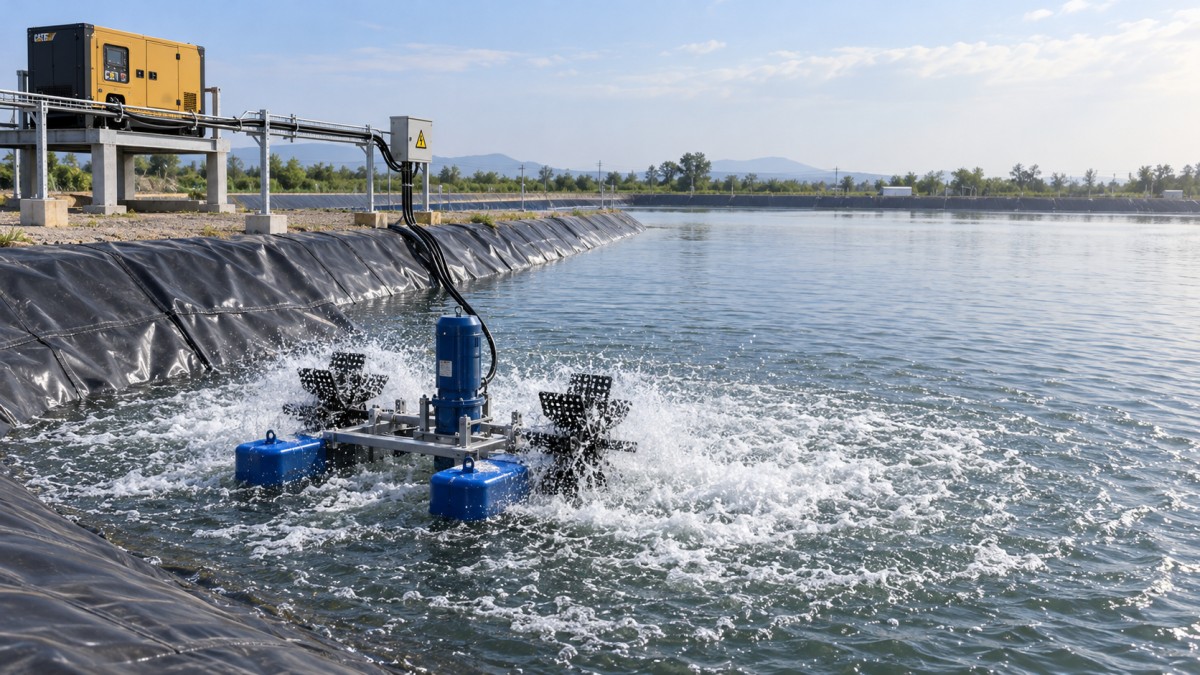
Start by defining essential aeration for each pond. Stocking density, species, water temperature, feeding intensity, and existing dissolved oxygen determine how quickly conditions may deteriorate.
There is no universal safe outage duration. Establish site-specific oxygen thresholds with your aquaculture specialist, using measured pond conditions rather than assuming a fixed survival window.
Identify ponds with the highest biomass and lowest oxygen reserve. Assign their aerators to priority circuits so limited backup capacity supports the most vulnerable stock.
Separate essential loads from equipment that can wait. Include pumps, monitoring systems, alarms, and controls only where their operation is necessary to maintain emergency conditions.
Record the minimum operating arrangement and escalation triggers. Staff should know which aerators start first, when additional units activate, and who responds to declining oxygen.
This approach links investment to operational risk. Funding dependable power for critical ponds often delivers greater protection than buying oversized equipment without a clear response plan.
How Much Backup Capacity Does Your Aerator Actually Need?
Read the motor and controller nameplates before selecting equipment. Confirm voltage, phase, frequency, rated current, electrical input, and the permitted supply characteristics for each aerator.
A motor rating of 1.5 kW may describe mechanical output rather than electricity drawn. Use measured input or manufacturer-confirmed consumption when estimating backup requirements accurately.
Calculate continuous demand by adding essential electrical loads. Then evaluate the largest starting event, including whether other aerators are already running when that motor starts.
Direct-start motors can draw several times their running current. Variable-frequency controls may reduce acceleration demand, but their charging surge and generator compatibility still require verification.
Generators must satisfy both real power, expressed in kW, and apparent power, expressed in kVA. Power factor and controller harmonics can affect the required capacity.
Ask the supplier to evaluate transient voltage drop, frequency recovery, ambient temperature, and altitude. A simple percentage allowance cannot replace checking the actual starting sequence.
Sequential starting can reduce peak demand when operations allow it. Confirm that staggered restarts remain fast enough for pond conditions and work after complete power loss.
Generator, Battery, or Hybrid: Which Fits Your Outage Pattern?
A generator usually offers economical endurance for substantial aeration loads. Its practical reliability depends on fuel availability, regular servicing, starter battery condition, and accessible spare parts.
Evaluate fuel logistics during the conditions that cause outages. Flooded roads, storm damage, or regional shortages can make an apparently adequate fuel plan unreliable precisely when needed.
Battery systems provide fast response and avoid onsite exhaust. However, sustained motor operation requires significant stored energy, and compatible three-phase output may increase system cost.
A hybrid arrangement lets batteries carry essential loads while the generator starts. Specify how charging resumes without overloading the generator or interrupting operating aerators afterward.
Solar generation can replenish storage, but nighttime outages and poor weather limit availability. Base emergency autonomy on stored energy and dependable generation, rather than expected sunshine.
What Does a Practical Runtime Calculation Look Like?
Suppose two priority aerators each consume a measured 1.5 kW, while controls use 0.2 kW. Their combined continuous electrical demand is therefore 3.2 kW overall.
For four hours of operation, those loads require 12.8 kWh delivered to equipment. Battery nameplate capacity must exceed this because conversion losses and reserve reduce availability.
Assuming 90% inverter efficiency and an 80% usable discharge fraction, the illustrative requirement becomes 12.8 divided by 0.90 and 0.80, or approximately 17.8 kWh of nameplate storage.
This estimate excludes aging, temperature effects, and additional reserve. The inverter must separately support continuous output and starting demand at the required voltage and phase.
For a generator, obtain fuel-consumption figures at the expected operating load. Multiply hourly consumption by required runtime, then include contingency fuel and any unusable tank volume.
Choose autonomy from outage records and realistic refueling access. A remote installation may need substantially longer coverage than a farm near reliable roads and service providers.
How Should Aerator Features Influence the Backup Specification?
An efficient fish farming aerator can reduce continuous backup demand, potentially extending battery runtime or lowering generator fuel consumption. Savings should be confirmed under comparable operating conditions.
The Variable Frequency Surge Aerator is listed with a 1.5 kW rating and variable-frequency control. These features justify checking both measured consumption and controlled starting behavior.
Its published specifications include different voltage configurations and oxygen-enrichment figures. Request the exact model datasheet, electrical diagram, and oxygen-transfer test conditions before finalizing any backup purchase.
Do not interpret a broad voltage range as compatibility with every backup source. Confirm phase requirements, controller input limits, protective settings, and restart behavior after transfer.
Supplier-stated energy savings also require context. Compare oxygen delivered per unit of electricity under relevant conditions, since lower consumption alone does not establish adequate emergency aeration.
Jinan Dingshun Import & Export Co., Ltd. can support coordinated procurement of aquaculture equipment and geosynthetics. Request documented compatibility, inspection records, and spare-part availability within the supply package.
How Do You Protect Electrical Equipment and Pond Liners?
Have a qualified electrician design the transfer arrangement, grounding, isolation, and suitable electrical protection. Preventing backfeed is essential for worker safety and proper backup operation.
Position generators above expected flood levels, with suitable ventilation and weather protection. Keep exhaust away from workers, buildings, and air intakes, following manufacturer clearance requirements.
For geosynthetic-lined ponds, locate fuel storage and heavy equipment on suitable foundations outside vulnerable liner areas. Provide spill containment and stable access for maintenance personnel.
Route cables to avoid abrasion, vehicle damage, and tension on floating equipment. Use appropriate supports and approved details wherever services cross embankments or liner boundaries.
Automatic transfer reduces dependence on staff arrival, but test the complete restart sequence. Some controllers require configuration changes or manual resets after losing supply power.
Keep dissolved oxygen alarms independently powered where practical. Early notification gives managers time to mobilize staff if the backup system fails or pond conditions worsen.
What Should Project Managers Verify Before Approving the Investment?
Compare total ownership costs over the expected project life. Include installation, fuel or charging electricity, battery replacement, servicing, spare parts, and staff time for inspections.
Assess these costs against the stock exposed, recovery expenses, and production interruption. Reliable backup becomes easier to justify when financial consequences are tied to specific ponds.
Require a commissioning demonstration with the actual priority loads. Verify transfer time, sequential starts, stable operation, alarms, and return to utility power under representative conditions.
Schedule recurring loaded tests and record results. Exercising an unloaded generator alone does not establish that the complete system can carry aerators during a real outage.
The right backup arrangement combines sufficient oxygen coverage, verified electrical compatibility, and achievable runtime. Choose the system your team can maintain, fuel, test, and operate consistently.