






Run your fish farming aerator before dissolved oxygen reaches the action level set for your stock, rather than waiting for a fixed hour before sunrise. In ponds with a repeated overnight oxygen decline, start early enough to slow that decline while oxygen is still above the minimum acceptable level. Heavily stocked ponds or ponds under adverse conditions may need aeration from evening through the night.
The practical problem is that a pond can look normal at bedtime but become oxygen-stressed before dawn. Fish, algae and microorganisms continue consuming oxygen after photosynthesis stops, so dissolved oxygen often reaches its daily low around sunrise. Waiting until fish gather at the surface leaves little recovery time and can expose stock to severe stress.
Set an oxygen trigger before setting the timer
Two values should guide operation: the desired oxygen range for the species and an earlier intervention level. The intervention level must leave a margin for continued oxygen consumption, equipment startup and circulation across the pond. Do not use the lowest oxygen concentration a species can survive as the routine switching point.
Many warm-water fish are managed toward dissolved oxygen concentrations of about 5 mg/L or higher, but this is not a universal operating threshold. Species, life stage, temperature and production intensity affect requirements; cold-water species commonly need more oxygen. Establish the appropriate target and alarm level using species-specific husbandry guidance.
A reading above the intervention level does not necessarily mean aeration can wait. A rapid downward trend can justify starting immediately, particularly when the next inspection is several hours away. Conversely, a stable reading in a lightly stocked pond may allow a later start, provided overnight monitoring supports that decision.
Measure the overnight decline where fish actually live
A single reading beside the aerator can give false reassurance. Water near splashing or bubbles may have substantially more oxygen than a quiet corner, a feeding area or deeper water occupied by fish. Use a calibrated dissolved oxygen meter and follow its instructions for temperature and salinity compensation.
- Check before or around dusk. Record dissolved oxygen and water temperature at representative locations. Include an area away from the aerator and a depth used by the fish.
- Repeat later in the night. Compare readings from the same locations and depths. This shows whether oxygen is falling slowly or whether demand is outpacing available supply.
- Check again before the expected daily minimum. During initial schedule development or changing conditions, take additional readings rather than relying on yesterday’s timer setting.
- Verify the response after startup. Confirm that oxygen stabilizes or rises beyond the immediate aerator discharge zone. Running equipment without improving pond conditions is not an adequate response.
Keep sampling methods consistent. A surface reading should not be compared with a previous bottom reading as though they represent the same water. Inspect the probe, calibrate it as specified, and allow readings to stabilize before recording them.
For a rough planning estimate, divide the difference between the current oxygen reading and the intervention level by the recent hourly rate of decline. Treat the resulting time as a warning window, not a guaranteed deadline: oxygen consumption and mixing can change overnight. Start before that window closes, with additional margin when measurements are sparse or conditions are deteriorating.
Conditions that move the start time earlier
Intensive systems may require continuous aeration; a short pre-dawn operating period is not automatically sufficient. Where demand remains high throughout the night, starting earlier is more useful than repeatedly restarting equipment only after oxygen falls.
When fish are already showing distress
Fish clustering near inflows, crowding the surface, gulping air or becoming unusually sluggish can indicate oxygen stress. These signs are not specific to low oxygen, but they warrant immediate checks and protective action. Do not wait for sunrise or the next scheduled timer cycle.
Start available aeration if oxygen deficiency is suspected, measure dissolved oxygen promptly, and suspend feeding until conditions stabilize. Check that motors, paddlewheels, diffusers or air lines are actually functioning. A running motor does not prove that the equipment is delivering effective oxygen transfer.
Avoid suddenly disturbing deep, oxygen-poor water without understanding the pond’s depth profile and equipment arrangement. Mixing can initially spread poor-quality water into the fish zone. Persistent distress despite adequate oxygen requires further investigation of temperature, ammonia, nitrite, disease or other water-quality problems rather than simply adding operating hours.
In lined ponds, circulation and liner protection matter
A lined pond still develops oxygen demand from fish, algae, feed residues and accumulated waste. The liner controls seepage; it does not supply oxygen or eliminate the need for overnight measurements. Sludge collecting in poorly circulated areas can increase local demand and make an otherwise acceptable surface reading misleading.
For pond construction or refurbishment, HDPE Pond Liner For Artificial Lake HDPE Pond Liner For Fish Farm provides a waterproof, anti-seepage lining option, with listed thicknesses from 0.5 mm to 3 mm. Thickness and installation details should be selected for the subgrade, expected loads and pond design—not as a way to reduce required aeration.
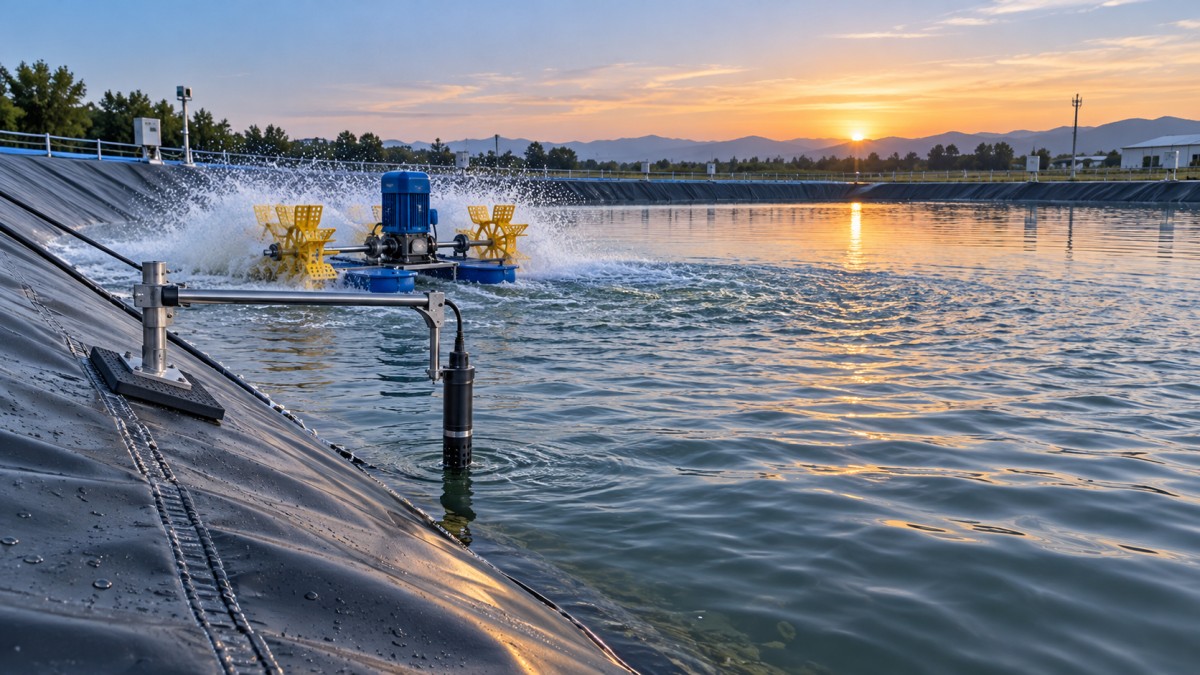
Keep aerator supports, anchors and cables from rubbing against the geomembrane. Protect contact points and inspect areas exposed to vibration or concentrated flow. Arrange equipment to circulate water through occupied areas without directing persistent abrasion toward seams or slopes. After repositioning an aerator, repeat oxygen checks in remote areas to confirm the change has improved circulation.
Decide when to stop from recovery, not daylight
Sunrise does not instantly restore pond oxygen. Photosynthesis may remain limited under cloud cover, and oxygen demand continues as fish become active. Keep the fish farming aerator running until measurements show recovery above the operating target at representative locations, not just beside the machine.
Where aeration is also needed for circulation or waste management, oxygen recovery alone may not justify shutting it down. Follow the operating requirements of the production system and check what happens after any reduction in aeration.
Record startup time, overnight readings, weather, feeding changes and recovery time. Use those records to adjust timers, but retain monitoring and a backup power plan for high-risk nights. When oxygen continues falling with all installed equipment operating, the issue is no longer just timing: oxygen-transfer capacity, distribution or stock demand needs reassessment before the next overnight period.