






Why does good geotextile still fail early on some jobs?
Because most early failures are installation failures, not product failures. On site, the geotextile only performs as designed if the foundation is prepared correctly, the sheet is placed without damage, overlaps are kept consistent, and the material is held in position during cover placement. When any of those steps are rushed, the first signs usually show up fast: pumping fines, blocked drainage paths, localized rutting, edge pullout, or separation loss under traffic.
For project managers, this matters because these problems rarely stay small. A wrinkle that gets buried can create a weak zone. A torn section can let aggregate punch through. A short overlap can open under load and undermine the whole layer continuity. The repair bill usually comes long after the crew has left the site.
What is the most common installation mistake?
Poor subgrade preparation is still the most common one. Teams sometimes focus on the roll specification and overlook what sits underneath it. If the subgrade has protruding stones, standing water, deep ruts, soft pockets, or construction debris, the geotextile is already at risk before the first truckload of cover material arrives.
A practical field check is simple: the surface should be reasonably smooth, free of sharp objects, and stable enough that the geotextile will lie flat without bridging hollows. If the fabric is spanning voids instead of resting on the surface, load transfer becomes uneven and puncture risk goes up.
Are wrinkles and slack really a serious issue?
Yes. Wrinkles are not just cosmetic. Once cover material is placed, folded or bunched geotextile can shift load paths, reduce contact with the subgrade, and create stress points. On haul roads or working platforms, that often turns into premature deformation exactly where the sheet was not lying flat.
The usual cause is laying too much material out ahead of the cover operation, especially in wind or on uneven ground. Crews should place only the length they can secure and cover in a controlled window. If wrinkles appear, flatten them before aggregate placement. Driving over them and hoping they settle out is where trouble starts.
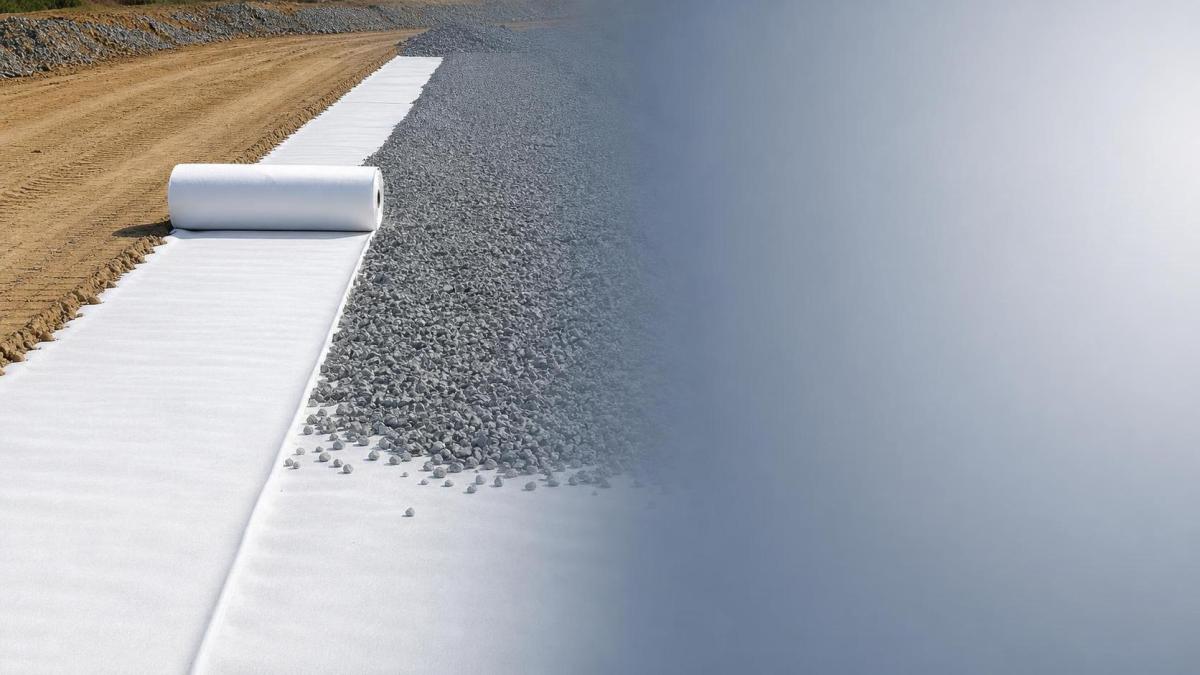
How do overlap mistakes lead to drainage or separation problems?
Overlap errors break continuity. If adjacent sheets do not overlap enough for the site condition, the edges can separate during aggregate spreading or under traffic. Once that happens, fines migrate upward, aggregate migrates downward, and the separation function starts to disappear.
The correct overlap is not one universal number. It depends on subgrade stability, expected loading, and whether the surface is flat or uneven. The right way to manage it is to check the project specification, approved shop drawings, and method statement together before installation begins. If the subgrade is weaker than expected, overlap details often need a more conservative approach.
When should a geotextile be anchored, pinned, or otherwise restrained?
Any time sheet movement is likely during placement. Slopes, windy conditions, long unsupported runs, and areas where cover placement starts from one edge all increase the chance of shifting. If the fabric moves, overlap control is lost and folds develop quickly.
Project managers should not leave this to improvisation. The restraint method should be defined before work starts, including where anchoring begins, how edges are held, and how the crew sequences material placement. That is especially important around transitions, drainage details, and toe or crest terminations.
Can cover material placement damage the geotextile even if the fabric was laid correctly?
Very easily. A properly installed geotextile can still be ruined by poor aggregate placement. Direct dumping from excessive height, sharp oversized stone, sudden turning movements by equipment, or allowing tires and tracks to contact exposed fabric can tear or displace it in minutes.
The safer practice is to place the initial cover layer in a controlled, progressive way, keeping equipment off the exposed geotextile unless the installation method specifically allows it. If the site is soft, the first lift thickness becomes a control item, not a convenience item.
What should be checked before accepting a damaged area as “minor”?
Do not judge by appearance alone. A small visible tear may sit in a high-stress zone, while a puncture hidden under temporary cover may be more serious than a long superficial scratch. At minimum, check location, tear size, whether the damage crosses overlaps, whether subgrade contamination has already occurred, and whether the area will carry repeated loading.
Repairs should follow the project repair procedure, typically with a patch extending beyond the damaged area by the specified margin. What matters is restoring continuous function, not just covering the hole.
Do seams matter for geotextile work, or are overlaps enough?
For many separation and filtration applications, overlaps are common. In some project conditions, though, welding or seaming may be used where movement control or continuity is more critical. If a detail requires joining compatible plastic materials in related waterproofing or geomembrane work, equipment quality and temperature control matter a great deal. One example is Double Heating Extrusion Welding Gun BGT-610 Series, which is designed for PE, PP, and PVDF applications and uses an independent heating system with digital temperature control. That kind of specification is relevant when the drawing calls for thermal joining, not as a substitute for geotextile placement discipline.
Which site documents actually help prevent installation mistakes?
The documents that reduce failure are the ones crews can act on in real time:
- Approved layout or placement drawings
- Material data sheet identifying the correct geotextile type
- Method statement covering subgrade preparation, overlaps, restraint, and cover placement sequence
- Inspection and hold-point checklist
- Repair procedure for tears, punctures, and displaced sections
If one of these is missing, the crew usually fills the gap with habit. That works until site conditions change.
What are the warning signs that installation quality is already slipping during the job?
If you only control three things on site, what should they be?
Control the surface, control the overlap, and control the first cover layer. Those three items drive most of the long-term result. When geotextile failures show up early, they are usually traceable to one of them.
A useful rule for project leaders is this: do not inspect geotextile as a roll product only. Inspect it as an installed system. The material, the ground below it, and the way it gets covered are all part of the same performance decision.