






Why do geotextile standards become such a big issue in public works procurement?
Because in public works, the material is rarely judged only by whether it can do the job in theory. It also has to pass design review, procurement checks, site inspection, and often third-party documentation review. A geotextile that looks acceptable on a datasheet can still create trouble if its test methods, declared properties, or supporting documents do not match the project specification.
For project managers, that means compliance is tied to two things at once: the standard named in the contract and the performance values required for the actual function. If either side is missing, the risk shows up later as delays, re-testing, rejected submittals, or disputes over responsibility.
Which standards usually matter most?
The short answer is that there is no single global standard covering every public project. What matters most depends on the country, the owner, and whether the geotextile is being used for separation, filtration, drainage, reinforcement, or protection. Still, most compliant public tenders revolve around the same types of references:
- Product standards or specification standards that define what the material must do in service
- Test method standards for tensile strength, puncture resistance, permeability, opening size, and durability-related properties
- Installation or application standards where the material function is tied to roads, drainage, erosion control, landfills, or hydraulic works
- Quality documentation requirements such as factory test reports, lot traceability, and conformity declarations
In practice, you will most often see public specifications built around ASTM, ISO, EN, or national transportation and water authority standards. The right question is not “Which system is best?” but “Which system is cited in the bid package, drawings, or technical specification?”
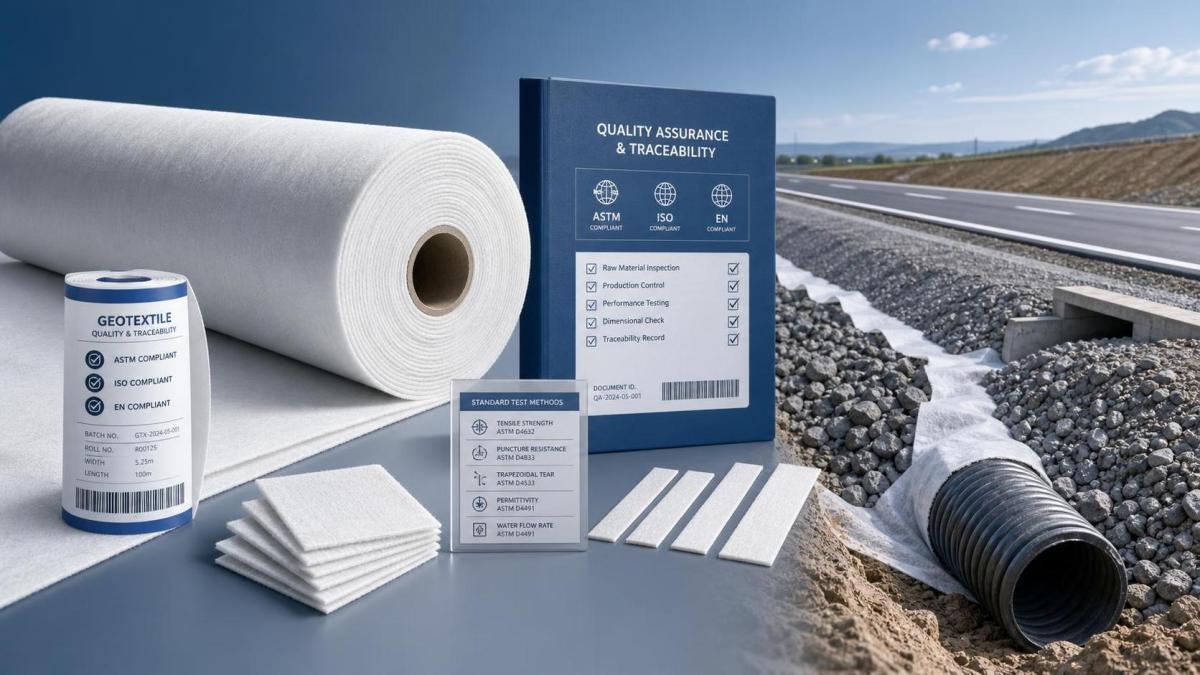
If the spec lists ASTM, ISO, or EN, can they be treated as interchangeable?
Usually, no. That is one of the most common mistakes in cross-border sourcing.
Different standards may measure similar properties in different ways. A tensile result from one method is not always directly comparable to a result from another. The same problem shows up with apparent opening size, water flow, mass per unit area, and puncture resistance. If a tender asks for a property according to a specific standard, the supplied test report needs to follow that same method unless the engineer of record has accepted an equivalent method in writing.
This is where procurement teams get caught: the product may be technically sound, but the paperwork does not line up with the compliance route.
Which performance properties should a project manager check first?
Start with the properties that connect directly to the material’s job on site. For most public works geotextile applications, these are the first items worth checking:
One caution here: a stronger number is not automatically better. A filtration layer with the wrong opening size can fail even if its tensile strength looks excellent.
What documents actually prove compliance?
A brochure is not enough, and a generic test summary is often not enough either. A solid compliance file usually includes:
- The project specification or approved material submittal showing the required standard and property values
- Manufacturer technical datasheets tied to the exact product grade being supplied
- Test reports showing the cited test methods
- Lot or batch traceability records for delivered rolls
- Inspection, labeling, and packaging information that matches the shipment
When import procurement is involved, this document trail matters even more. Companies handling integrated sourcing and quality inspection often help by aligning procurement, pre-shipment checks, and logistics documents so the technical file does not break between factory and site.
What tends to go wrong during approval?
Three problems show up repeatedly.
First, the wrong standard is used for the right property. A supplier may provide tensile data, but from a test method not named in the spec.
Second, the product family is confused. Geotextiles, geomembranes, and other geosynthetics may appear in the same bill of materials, but they are not evaluated the same way. For example, where containment or seepage control is the main function, the relevant compliance path may shift from geotextile performance to geomembrane properties. In municipal engineering, water conservancy, or aquaculture-related lining work, a product such as Sale Black hdpe pond liner Waterproof Fish Pool geomembrane would be reviewed against barrier-function requirements rather than geotextile filtration criteria.
Third, approval is delayed because the delivered goods cannot be tied back to the approved submittal. Even a compliant product can become a problem if roll labels, dimensions, or batch references do not match the submitted documents.
How should managers handle projects that involve both geotextiles and geomembranes?
Treat them as separate compliance items, even when they work together in one system. A geotextile may act as cushion, filter, or separator, while the geomembrane serves as the barrier. The review checklist should follow the function of each layer, not just the overall assembly name.
That matters in practical procurement. If a project package includes a lining component with declared materials such as HDPE, LDPE, or LLDPE, thickness ranges, tensile properties, and low permeability, those are barrier-layer concerns. They should not be mixed into geotextile acceptance without a clear design basis. Keeping the compliance file separated by material function prevents avoidable rejection on site.
Is certification alone enough to approve a geotextile?
No. Certification can support confidence in manufacturing control, but it does not replace project-specific conformance. Public owners usually need to see that the supplied geotextile matches the required standard, the required properties, and the intended use condition.
A useful rule is simple: approve by specification match, test method match, and shipment traceability. If one of those is missing, the risk remains open.
What is the most practical way to reduce compliance risk before purchase?
Ask for a pre-award compliance matrix. It does not need to be fancy. It should list each required property, the cited standard, the required minimum or range, the supplier’s declared value, and the supporting document reference. That single step exposes most mismatches early, before goods are booked, shipped, or installed.
For public works, the best decision is rarely the cheapest roll on paper. It is the material package that can survive review from procurement, design, inspection, and construction at the same time.