






Start by checking whether separation is really the failure point
When subgrade trouble shows up, the first mistake is blaming rutting, pumping, or surface deformation on traffic alone. In many roadbeds, embankments, haul roads, and working platforms, the real problem starts lower down: fine soil migrates upward, aggregate works downward, and the two layers gradually lose their own functions. Once that mixing begins, the base stops behaving like a clean load-spreading layer. You end up paying twice, first for stone, then for maintenance.
That is where geotextile earns its place. Not as a miracle fabric, and not in every failure mode, but as a practical separation layer that keeps the aggregate and the weak soil from contaminating each other while still allowing water to move. For a project manager, the useful question is simple: will a separator reduce contamination enough to preserve thickness, stiffness, and service life under the actual site conditions?
Use this field checklist before you specify anything
- Look at the subgrade condition, not just the design drawing. If the formation is wet, soft, silty, or easily disturbed during trafficking, separation becomes much more important. A dry and stable foundation may need less intervention than a site that starts pumping under the first truck pass.
- Check whether the aggregate is disappearing into the soil. If imported fill is punching into the subgrade, adding more stone without separation usually becomes an expensive loop.
- Watch for fines moving upward. Muddy contamination in the lower base layer is an early warning. Once fines occupy aggregate voids, drainage drops and stiffness follows.
- Ask how the platform will be loaded. Slow, repeated, heavy construction traffic creates different stress than light intermittent access. The more repetition and the lower the initial support, the more valuable a stable separator becomes.
- Do not ignore water. If water is trapped, the problem is not only mixing. You also need filtration and drainage behavior that remains functional under confinement.
This is the point where a nonwoven geotextile is often chosen over a simplistic “more aggregate” response. In weak foundation zones, the separator protects layer integrity from day one instead of trying to recover it later.
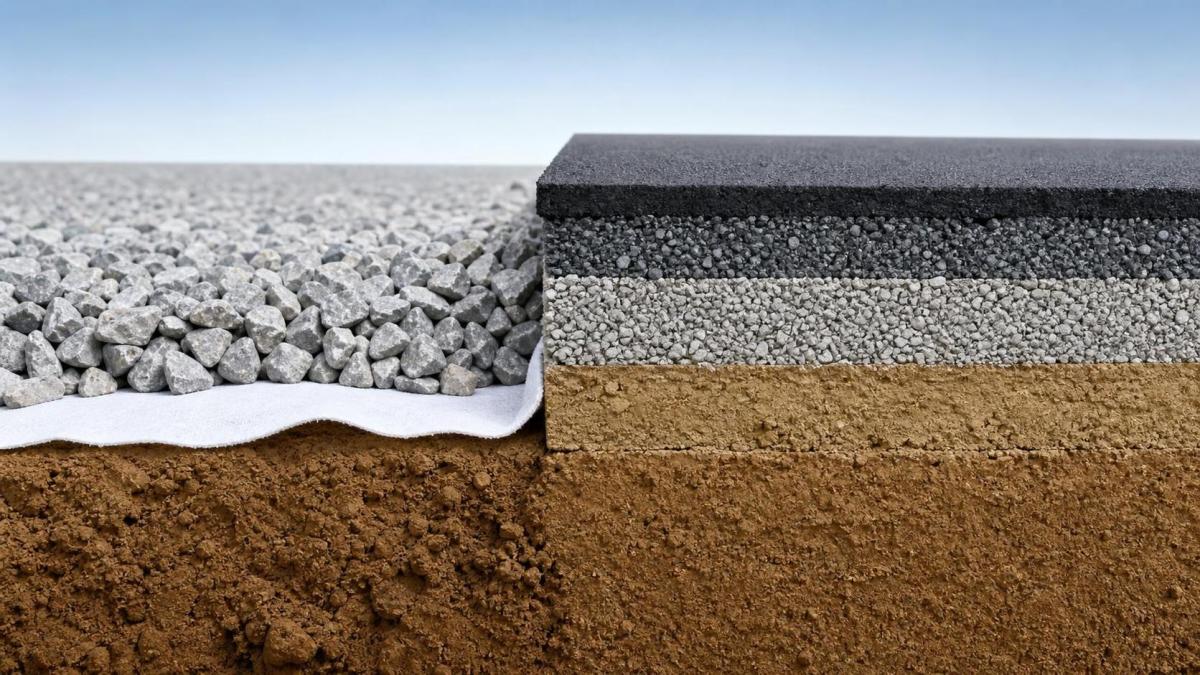
What geotextile actually does in a weak subgrade section
The practical value comes from four linked effects.
Separation: it keeps fine-grained soil and aggregate in their own layers. This is the main defense against thickness loss and base contamination.
Filtration: it allows water to pass while retaining soil particles. That matters where pore water movement would otherwise carry fines into the stone layer.
Drainage support: some nonwoven structures help water move within the plane or across the plane, reducing the wet, unstable condition that accelerates deformation.
Construction survivability: if the material has adequate strength and puncture resistance for the placement method, it gives the crew a workable interface instead of a mud-stone blend that gets worse with every pass.
That combination is why nonwoven products are commonly used between ballast and subgrade, beneath temporary roads, under embankments on weak soils, around drainage features, and in other situations where isolation and water movement must coexist.
Check the product against the job, not against generic marketing claims
A frequent buying error is selecting geotextile by a single headline number. Gram weight matters, but by itself it tells you very little about field performance. What you need is fit between site conditions, installation method, and material behavior.
For example, Continuous Filament Spunbonded Needle Punched Nonwoven Geotextile is offered in a broad mass range of 100 to 800 gsm, widths from 2 to 6 meters, and roll lengths from 30 to 100 meters. Those details are useful because they affect constructability as much as material selection. On a large site, roll handling, overlap planning, and joint count all influence how cleanly the separation layer is actually delivered.
The installation stage is where many good designs get undermined
If you have ever seen aggregate dumped directly onto exposed soft spots from too much height, you already know this part matters. Geotextile improves subgrade performance only when it remains continuous and properly seated on the formation.
- Prepare the subgrade enough to remove sharp protrusions, major ruts, and debris that can puncture the fabric.
- Lay the rolls flat, with planned overlaps suited to the ground condition and placement method.
- Place aggregate in a way that limits direct trafficking on exposed fabric.
- Keep wrinkles and folds under control. A folded separator can create uneven support and localized damage once loaded.
- Inspect after first placement, not only at handover. Early tears are easier to fix before the platform is fully built out.
One more practical note: when the site is extremely wet, crews often rush to gain access quickly. That is exactly when separator damage becomes most likely. Build the first lift with discipline. Recovering a contaminated platform later is slower and more expensive than installing the layer properly once.
Where project managers usually make the wrong call
The usual errors are predictable.
- Using geotextile as a substitute for every ground improvement need. If the subgrade failure is dominated by bearing collapse or deep instability, separation alone will not solve it.
- Choosing by price per square meter without considering rework, extra aggregate consumption, and shortened service life.
- Ignoring the interface with drainage. A separator that preserves layer boundaries but leaves water trapped may still produce a weak, pumping section.
- Assuming all nonwoven geotextile behaves the same. The combination of strength, elongation, chemical resistance, abrasion resistance, and permeability needs to suit the actual application.
In applications such as highways, temporary roads, rail-related ballast separation, retaining wall backfill, and drainage zones, a properly selected nonwoven separator can be a durable and economical part of the section. That is especially true where easy handling, flexibility, and stable water passage under earth pressure are required from the same layer. Products such as Continuous Filament Spunbonded Needle Punched Nonwoven Geotextile are typically considered for those reasons, not because one material fits every weak soil problem.
A workable decision sequence for busy teams
If the site is showing aggregate loss into the subgrade, fines contamination into the base, wet instability, or repeated deformation under early traffic, start with the separation question. Then check whether filtration and drainage are also needed at the same interface. After that, match the geotextile to construction damage risk, roll logistics, and the real loading condition.
That order keeps the decision practical. You are not buying fabric; you are protecting layer function. When the separator is chosen for the actual soil, water, and trafficking conditions, geotextile does exactly what project teams need it to do: keep the subgrade and aggregate from turning into one weak layer, hold performance longer, and reduce the maintenance cycle that starts when mixing is allowed to begin.