






What geosynthetics really change in a project
People often hear geosynthetics described as sheets, grids, or fabrics placed in soil. That is technically true, but it misses the practical point. In project work, geosynthetics are not just materials added to the ground; they are a way to control how water moves, how loads are transferred, and how weak interfaces are separated. That is why they show up in landfills, roadbeds, embankments, ponds, retaining structures, mining areas, and water conservancy works. The material itself matters, but what matters more is which failure mode it is being asked to manage.
For project managers, this distinction is useful because drainage, reinforcement, and containment are often discussed as separate design topics even though they interact on site. Poor drainage increases pore water pressure. Higher pore pressure reduces soil strength. Reduced strength puts more demand on reinforcement. If containment is involved, seepage paths can undermine the whole system. A geosynthetic solution is usually valuable when it handles more than one of these problems at the same time, or when it reduces construction complexity compared with a thicker mineral layer.
Drainage is not only about moving water away fast
One common misunderstanding is to treat drainage as a simple matter of discharge capacity. In reality, drainage performance has to be judged in the field context: soil fines, confining pressure, gradient, and long-term clogging risk all change the result. A drainage geocomposite or geotextile may look adequate in a product table, yet behave differently once compressed under fill or exposed to muddy water. That is why experienced teams do not ask only, “How much water can it pass?” They also ask whether the drainage path will stay open after installation damage, overburden pressure, and filtration demands are taken into account.
This matters in subgrade stabilization, behind retaining walls, and around containment systems. If water is trapped where the design assumed relief, the structure may still be built to specification and yet perform poorly. Geosynthetics help by creating controlled flow paths and by separating drainage media from surrounding soil, which reduces contamination of the drainage layer. That separation function is easy to underestimate. Once aggregate intermixes with soft subgrade or fines migrate into voids, the apparent economy of a thinner section can disappear.
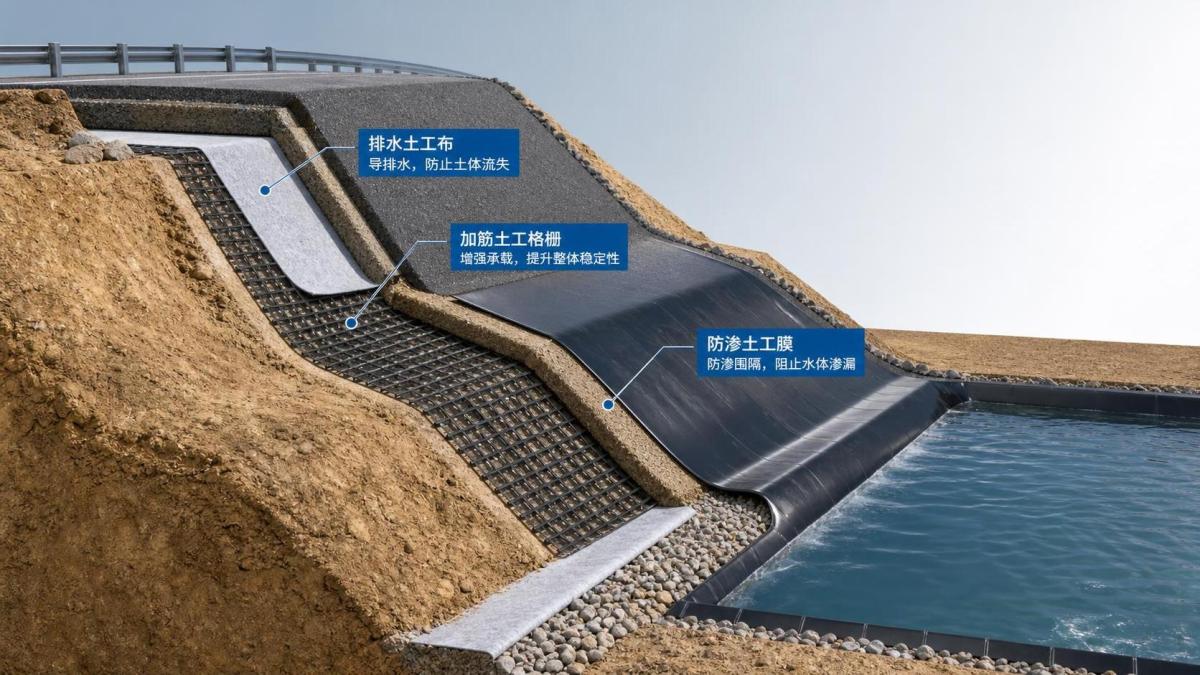
In practical terms, drainage design with geosynthetics is less about replacing every granular layer and more about using the right material where access to quality aggregate is limited, where installation speed matters, or where a more predictable flow path is needed. The best results usually come from matching hydraulic behavior to the expected site conditions rather than assuming one drainage product fits every wet area.
Reinforcement works because soil and polymer do different jobs
Reinforcement is another area where the language becomes misleading. Teams sometimes say a geogrid or geotextile “makes the soil stronger.” More accurately, it improves the performance of the soil-structure system. Soil is good in compression and usually weak in tension. A reinforcement layer introduces tensile capacity, distributes loads, and limits deformation, especially where the subgrade is soft or variable. The result may be reduced rutting, improved bearing behavior, or a more stable slope or embankment.
The important judgment is not whether reinforcement exists, but whether its stiffness, interaction with fill, and installation condition match the intended function. A road platform over soft ground, for example, may need immediate construction support more than ultimate tensile resistance. A steepened slope may depend more on pullout behavior and long-term durability. A reinforced application can underperform even when the nominal strength looks high if the fill is poorly selected, the layer is damaged during placement, or the reinforcement cannot mobilize properly at the interface.
This is why geosynthetics are often chosen not as a standalone answer but as part of a system decision. For a project leader, the gain is often broader than structural performance alone: easier staging in wet conditions, lower imported fill demand, and more predictable construction sequencing. Those benefits are real, but only when the reinforcement mechanism has been identified clearly at the start.
Containment is where material selection becomes less forgiving
Containment applications raise the consequences of a wrong choice. In ponds, landfills, mining pads, municipal works, and petrochemical facilities, the role of a geomembrane is not simply “waterproofing.” It is barrier performance under chemical exposure, stress, settlement, and environmental aging. That means thickness, puncture resistance, stress crack resistance, and weathering behavior are not abstract data points; they define whether the liner can survive installation and service conditions.
Surface texture is a good example of how project context changes the answer. On paper, a smooth liner and a textured liner may appear close if someone looks only at base polymer and thickness. In practice, textured surfaces are often selected where interface friction matters, such as slopes, cover systems, or areas where the liner must interact more securely with adjacent materials. An option such as Textured Geomembrane is typically considered in environmental protection, water conservancy, mining, municipal engineering, and aquaculture projects where seepage control has to coexist with stability demands.
The technical picture is also broader than impermeability alone. HDPE liners used for these applications are available in multiple thicknesses, such as 0.5 mm up to 3.00 mm, with published indicators including tensile yield strength, puncture resistance, tearing load, carbon black content, oxidation induction time, and UV-related retention values. Those parameters do not tell you by themselves whether the product is suitable, but they establish the boundary of where it can reasonably be specified. If the installation area includes rough subgrade, aggressive exposure, or a need for long service life, those details become central rather than optional.
Where decisions usually go wrong
Most mistakes are not caused by misunderstanding the category name. They come from collapsing several functions into one vague requirement. Teams ask for a “liner,” but the actual need may include friction on a slope, resistance to puncture from underlying stone, compatibility with leachate collection design, and field seaming constraints. They ask for “reinforcement,” but the site may first require separation and drainage control before reinforcement can work as intended.
Another common issue is comparing solutions only on initial material cost. In international supply and procurement work, that tends to hide the real variables: quality consistency, inspection discipline, packaging and logistics suitability, customs timing, and after-sales technical response when site questions arise. Companies handling geosynthetics across borders often see that procurement decisions fail not because the material category was wrong, but because the supply chain around it was treated as secondary. Jinan Dingshun Import & Export Co., Ltd., for instance, operates in that space by combining sourcing, quality inspection, customs declaration, logistics, and after-sales coordination, which reflects how these materials are actually delivered into projects rather than how they appear in a brochure.
A better way to evaluate geosynthetics at project stage
A useful starting point is to ask three plain questions. What movement of water must be allowed or blocked? What load or deformation mechanism must be controlled? What interface is most likely to fail first during installation or service? Those questions usually clarify whether the project needs filtration, separation, drainage, reinforcement, containment, or a combination.
Once that is clear, the conversation about geosynthetics becomes more grounded. Product data can be read in context. Installation risks can be discussed early. Tradeoffs between thicker sections, better protection layers, or different surface types become easier to explain internally. That is the point where geosynthetics stop being viewed as generic engineered plastics and start being treated as performance tools with defined limits.
For engineering leaders, that is usually the right level of understanding: not memorizing every material family, but knowing how these materials change drainage behavior, reinforce weak ground, and contain fluids or contaminants without turning the specification process into guesswork.