






Woven vs Nonwoven Geotextile: What Actually Changes in Road and Drainage Performance
The confusion usually starts with a simple assumption: if both products are called geotextile, they should do roughly the same job. In road and drainage work, that assumption causes specification errors. Woven and nonwoven geotextiles can overlap in some applications, but they are built differently, tested differently, and trusted for different field conditions. For a project manager, the real question is not which one is “better.” It is which one matches the failure mode you are trying to prevent.
That matters because road projects rarely fail for one reason alone. A weak subgrade may need separation and reinforcement. A shoulder drain may need filtration without clogging. A temporary access road may need load distribution first and water movement second. If the geotextile is chosen only on unit price or thickness, the material may look acceptable on paper while underperforming once fines migrate, water pressure builds up, or rutting begins.
Woven geotextile is made by interlacing tapes or yarns in an ordered structure. That manufacturing method gives it relatively high tensile strength and low elongation compared with most needle-punched nonwoven materials. In practical terms, woven products are often considered when the design priority is stabilization, separation under traffic, or support over weak ground. They are common in road base construction, working platforms, and haul roads where maintaining aggregate thickness and controlling subgrade pumping are more urgent than maximizing water flow through the fabric.
Nonwoven geotextile is different in both feel and behavior. It is generally formed by bonding or needle-punching fibers into a more random mat structure. That open structure usually gives it better permeability and filtration characteristics, especially where water has to pass while soil particles are retained. In drainage trenches, behind retaining elements, around perforated pipe, or under riprap where filtration is central, nonwoven geotextile is often the more suitable starting point.
The distinction becomes clearer when you stop looking at product names and look instead at hydraulic and mechanical functions.
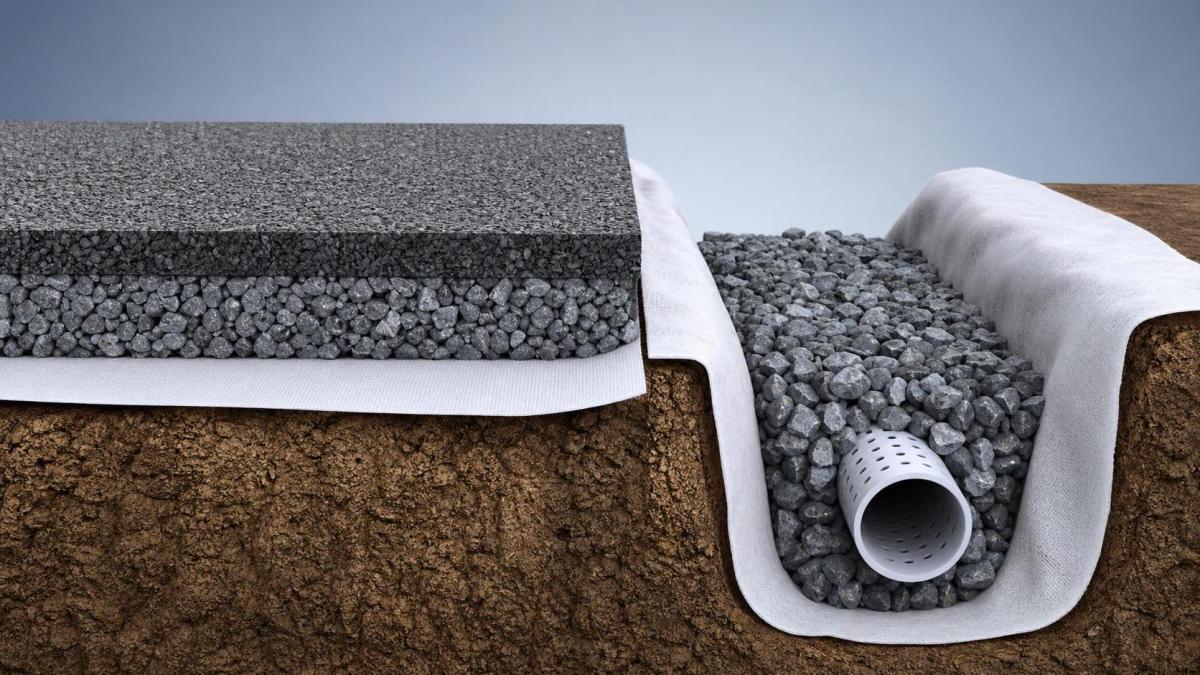
One common mistake is to describe woven geotextile as “for roads” and nonwoven geotextile as “for drainage.” That is too crude to be reliable. Road structures also need drainage, and drainage systems can still face installation stress, puncture, and soil confinement issues. The better approach is to define the dominant function layer by layer: separation, filtration, drainage, reinforcement, protection, or a combination of these. Once that is clear, the specification becomes easier to defend.
What to Check Beyond the Product Category
For technical review, “woven” and “nonwoven” are only the first filter. They do not replace parameter checks. In drainage work, apparent opening size, permittivity, and long-term clogging behavior are more relevant than broad category labels. In road stabilization, tensile strength, elongation, puncture resistance, and installation survivability matter more. If the subgrade contains fine cohesive soil, filtration criteria deserve close attention because a fabric that passes water in the lab can still blind or clog under site-specific conditions.
This is also where experienced sourcing helps. Jinan Dingshun Import & Export Co., Ltd. works with geosynthetics as part of a broader supply chain service covering procurement, inspection, logistics, and after-sales support. In practice, that kind of coordination matters when engineers need the delivered material to match the approved specification, not just the generic product description. For geotextile procurement, consistency across rolls, traceable test data, and packaging suited to site handling can be just as important as the nominal strength grade.
Another point often overlooked is that geotextile rarely works alone. In road and drainage systems, it is part of a layered assembly. A nonwoven filter may sit next to gravel, perforated pipe, or a geonet. A woven separator may be combined with crushed aggregate or even with barrier materials where seepage control becomes part of the design. In containment, ponds, or landfill-related work, the conversation shifts from filtration to impermeability, and that is where geomembranes enter the system rather than geotextiles replacing them.
For example, projects dealing with seepage control in water conservancy, aquaculture, municipal works, or waste containment may require an impermeable liner such as Waterproofing Geomembrane for Landfill fish farming tank. That product category uses materials such as HDPE, LDPE, LLDPE, or EVA and is selected for barrier performance, with technical ranges such as 0.2 to 4 mm thickness and temperature resistance from +70°C to -70°C in the supplied data. It is a different decision from choosing a geotextile, but on some sites both materials appear in the same cross-section and need to be coordinated rather than substituted.
How Project Managers Usually Make the Right Call
A practical selection path starts with three questions. What is the soil doing? What is the water doing? What damage is traffic or installation likely to cause? If the road base is sinking into a weak subgrade, woven geotextile often deserves priority because the structure needs stable separation and tensile performance. If the issue is keeping fines out of a drainage layer while allowing cross-plane flow, nonwoven usually moves ahead.
When both functions are important, the answer may still be one material, but only after reviewing the actual test properties and design intent. Some engineers also compare lifecycle risk rather than material cost alone. A cheaper fabric that clogs, tears during installation, or allows contamination of aggregate can increase maintenance and reconstruction costs quickly, especially on roads with repetitive loading or poor drainage.
It is also sensible to be careful with simplified phrases like “high strength” or “good drainage.” High tensile strength without the right hydraulic behavior may be wrong for a trench drain. Good permeability without adequate survivability may be wrong under coarse aggregate and construction traffic. The material category gives direction, not the final answer.
So, which option fits road and drainage work? In many road stabilization cases, woven geotextile is the more direct fit. In many drainage and filtration details, nonwoven geotextile is the safer choice. But the sound engineering decision comes from matching the geotextile to the function, the soil gradation, the water path, and the construction conditions. That is the point where specification stops being generic and starts protecting the project.