






Which aquaculture aerator components need saltwater protection?
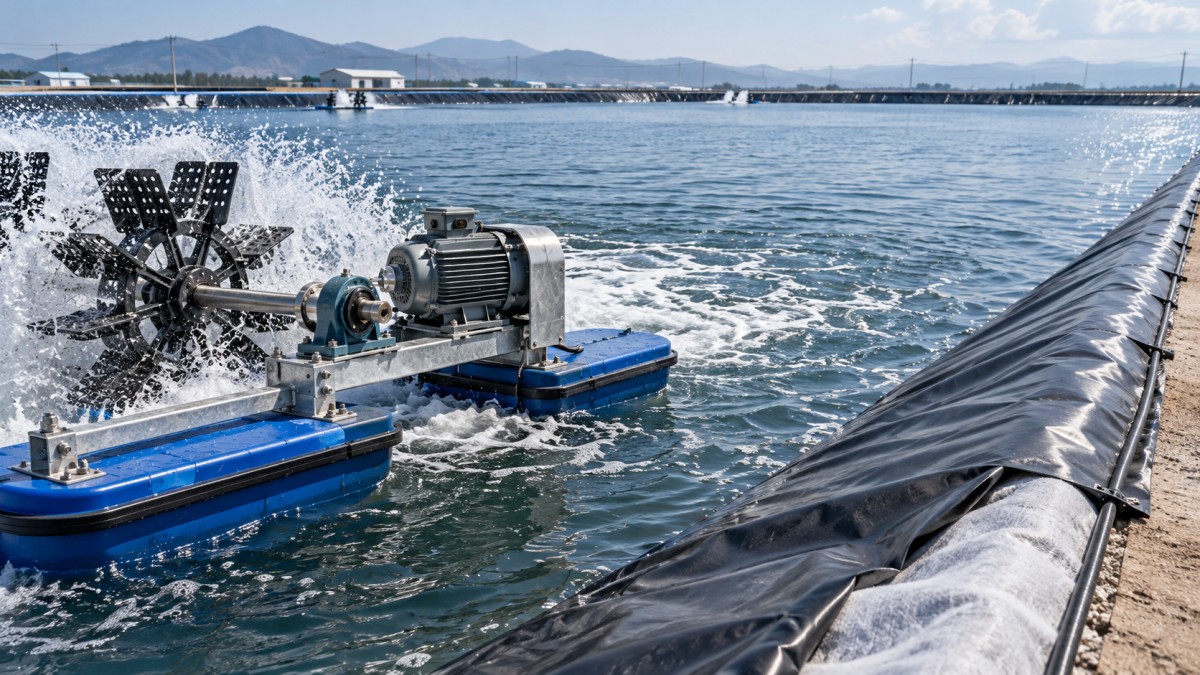
Saltwater can turn an aquaculture aerator into a costly maintenance problem when critical components lack suitable corrosion protection. For coastal farms and geomembrane-lined saline ponds, the vulnerable parts extend well beyond the paddles: shafts, bearings, fasteners, motor housings, electrical connections and mounting frames all need attention. The purchasing decision should focus on how each component handles its actual exposure—not whether the catalogue simply calls the machine “saltwater suitable.”
A paddlewheel throws saline spray onto parts that never sit underwater. A submerged aerator exposes its seals and cable entry continuously. Equipment beside a coastal pond may also collect airborne salt while idle. These are different service conditions, and a specification that addresses only submerged parts leaves substantial gaps.
Start with the exposure map, not the motor rating
Before comparing quotations, identify three zones: continuous immersion, intermittent splash and salt-laden air. Record expected salinity, water temperature, operating hours and cleaning practices. Include any treatment chemicals that may contact the equipment. Material suitability depends on that combination; salinity alone cannot establish service life.
The splash zone deserves particular scrutiny. Repeated wetting and drying can leave concentrated salt deposits around bolt heads, shaft shoulders and housing joints. On a floating paddlewheel unit, a bracket above the waterline may therefore need more attention than its position suggests.
Ask suppliers to mark these zones on an assembly drawing and identify the material or protective system for each exposed component. This is more useful than a general statement that the aerator has a stainless-steel structure.
Shafts, bearings and seals: where small defects become shutdowns
Shafts, hubs and couplings need documented material grades. Stainless steel is not automatically immune to seawater. Grade 316 generally offers better chloride resistance than 304, but it can still suffer pitting or crevice corrosion, particularly where deposits accumulate or water stagnates. More demanding conditions may justify another alloy, although strength, fabrication quality and cost must also be considered.
Look closely at shaft sleeves, keyways, welds and connections between unlike metals. A corrosion-resistant shaft attached to an unprotected hub does not make a durable assembly. Ask how dissimilar-metal contact is managed, and whether welded stainless parts receive appropriate post-fabrication cleaning and surface treatment.
Bearings need protection from ingress as well as corrosion. An ordinary sealed bearing should not be assumed suitable for continuous immersion. The housing, shaft seal, lubricant and any relubrication arrangement must work together. Depending on the design, the solution may involve protected rolling bearings, corrosion-resistant bearings or water-lubricated bushings. These options are not interchangeable without checking load and speed.
For mechanical seals, request the face materials, elastomer specification and permitted operating conditions. Compatibility with saline water does not automatically establish compatibility with pond disinfectants. Also ask whether dry running is permitted. A seal can fail through heat or abrasion even when its materials resist corrosion.
Replacement access matters. If changing a modestly priced seal requires dismantling most of the drive, the labour and downtime may outweigh a saving on the purchase price.
Protect the electrical system beyond the enclosure
Motor housings, end covers, cooling surfaces and terminal boxes all face saline spray. Painted cast iron or aluminium may be appropriate with a suitable coating system, but coating quality is difficult to judge from photographs. Request surface-preparation requirements, coating details and instructions for repairing transport or installation damage.
An IP rating describes enclosure protection against solid objects and water under specified test conditions; it is not a corrosion-resistance rating. It also does not mean every installation can remain submerged indefinitely. Check the stated rating against the intended operating position, especially for submerged motors and junction boxes.
Cable glands, connectors and terminal hardware often receive less attention than the motor. They should be specified for the exposure, correctly matched to the cable diameter and installed without unnecessary joints in wet areas. Salt deposits and condensation can create electrical problems even when the outer housing looks sound.
Keep control equipment outside routine spray where practical. Have a qualified electrical professional confirm earthing, protective devices and installation requirements under the applicable local rules. Corrosion protection cannot compensate for unsafe wiring.
Frames, fasteners and paddles deserve separate specifications
Frames and mounting brackets carry cyclic loads while exposed to spray. Coated steel can be a reasonable cost choice when inspection and recoating are practical. Stainless steel reduces dependence on coatings but still needs suitable grades and sound fabrication. Galvanized steel should be evaluated against exposure and maintenance expectations, not treated as permanently protected.
Specify bolts, nuts, washers and anchor hardware separately. A frame made from a suitable alloy can still become difficult to service because its fasteners seize or corrode. Stainless fasteners also require appropriate assembly practices to reduce galling; tightening torque and lubricant should follow the supplier’s instructions.
Plastic paddles and floats avoid metallic rust, but their durability depends on resin quality, UV resistance, impact strength and attachment design. Check inserts, paddle hubs and float mounting points. Cracking around a metal insert may disable an otherwise intact plastic component.
In lined ponds, protect the geomembrane too
An aerator installation must not trade corrosion resistance for liner damage. Sharp brackets, unsecured cables and moving anchor lines can abrade a geomembrane. Floating equipment also needs restraint that accounts for vibration, changing water levels and movement without dragging hardware across the pond floor.
When specifying Geosynthetics geotextile and geomembrane, consider the lining and aerator installation together. HDPE and PVC geomembranes are available options, but suitability requires confirmation of the selected formulation, chemical compatibility and mechanical properties. A geotextile protection layer may help manage contact risks; it does not make an unsuitable anchor detail safe. Liner thickness should follow project conditions rather than the aerator’s power rating.
What to settle before issuing the purchase order
Compare quotations against a component-level schedule. Before approval, obtain:
- Material grades for wetted and splash-exposed parts, including fasteners.
- Coating, sealing and cable-entry details tied to the proposed installation.
- Maintenance access requirements and part numbers for seals, bearings and couplings.
- Written warranty conditions covering saline service, corrosion and required maintenance.
For a supply-chain business such as Jinan Dingshun Import & Export Co., Ltd., which handles geosynthetics, aquaculture equipment and engineering equipment, these requirements should carry through procurement, inspection, shipping and after-sales support. Packing needs attention too: trapped moisture and salt contamination can damage equipment before commissioning.
The better purchase is not necessarily the aerator with the most stainless steel. It is the one whose exposed components are properly specified, whose protection matches the pond conditions, and whose wear parts can be replaced without an avoidable shutdown.