






How to Choose Geotextile by Strength, Permeability, and Soil Conditions?
Most geotextile selection mistakes come from looking at one parameter in isolation. A buyer compares tensile strength, or checks mass per square meter, or asks whether the fabric is woven or nonwoven, then assumes the answer is enough. It rarely is. In practice, geotextile performance is decided by how strength, water flow behavior, and the actual soil on site interact. A fabric that looks robust on paper can clog in fine soil, while a highly permeable option may deform or tear during installation over coarse aggregate.
That is why geotextile should be treated as a function-driven material, not just a commodity roll. In road construction, drainage systems, embankments, erosion control, and landfill-related works, the same product category may be expected to separate layers, filter water, relieve pore pressure, or provide limited reinforcement. The correct choice depends on which of these jobs is critical and which risks are most expensive if the material fails.
Strength is not only about breaking load
When buyers ask for “high-strength geotextile,” they often mean the fabric should survive construction. That is a reasonable starting point, but tensile strength alone does not describe installation durability. On a subgrade with angular stone, puncture resistance and tear resistance may matter more than peak tensile values. In soft ground stabilization, elongation behavior can also affect how the fabric performs under settlement and uneven loading.
Woven geotextiles are often chosen where separation and reinforcement are the priority, especially under roads or working platforms. Nonwoven geotextiles are more common where filtration and drainage are central. This is not a rigid rule, but it reflects how the structures behave. A woven fabric can offer high tensile performance with relatively low elongation, while a needle-punched nonwoven usually gives better water passage and conformability.
For procurement decisions, the useful question is not “Which product is stronger?” but “Stronger against what?” Traffic loads, compaction equipment, stone size, drop height during fill placement, and subgrade softness all change the answer.
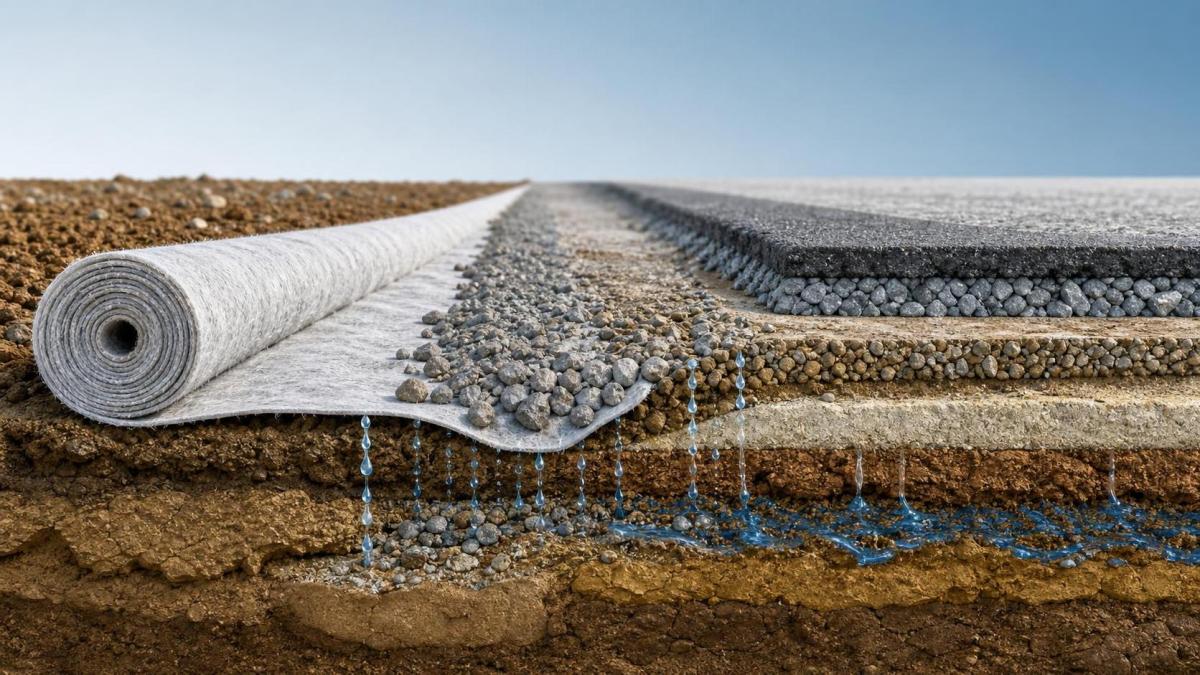
Permeability matters, but matching the soil matters more
A geotextile used for filtration must pass water while retaining soil. That sounds simple, but it is the point where many low-cost substitutions go wrong. If permeability is too low, drainage slows down and pore pressure can build up. If the opening structure is too large for the soil, fines may migrate through the fabric and undermine the system over time.
This is why apparent opening size and permittivity are often reviewed together with the site soil gradation. Silty and clayey soils behave very differently from clean sands or crushed rock. In fine-grained soils, long-term clogging risk becomes a serious concern. In coarser soils, the filtering challenge may be easier, but installation damage can become the larger issue. The geotextile has to fit the hydraulic and mechanical environment at the same time.
Buyers sometimes assume that a “more permeable” geotextile is automatically safer. It is not. Excessive flow capacity without appropriate retention characteristics can reduce filtration reliability. Good selection means balancing flow-through performance with soil retention, based on the project drainage path and the fines content of the surrounding ground.
Soil conditions should drive the specification review
Soil is where specification sheets meet reality. A stable sandy base, a wet clay subgrade, demolition fill with sharp fragments, and dredged soft soil may all appear in projects that simply request “geotextile.” Yet the risk profile is different in each case.
A practical review can be organized like this:
This is also where experienced sourcing teams ask for more than a datasheet. They look for the intended application method, the subgrade description, and whether the fabric will sit alone or as part of a composite system.
Do not confuse geotextile selection with liner selection
Another common misunderstanding appears in containment and seepage-control projects. Geotextiles are often paired with geomembranes, but they are not interchangeable. The geotextile may protect, filter, separate, or drain; the geomembrane provides the barrier. In pond, landfill, tunnel, or biogas-related works, buyers sometimes review only the liner thickness and overlook whether a cushioning or drainage layer is needed around it.
In those cases, composite solutions may be more relevant than a standalone fabric. For example, 1.5mm waterproof HDPE composite geomembrane can be used in biogas pools is positioned for anti-seepage applications where barrier performance, puncture resistance, and durability need to be considered together. That does not replace geotextile selection logic; it changes the system boundary. Once the application becomes seepage control rather than only filtration or separation, the buyer has to review interface behavior, hydrostatic conditions, and protection against construction damage.
What procurement teams should ask suppliers before comparing price
A low unit price is easy to compare. Performance risk is not. Before requesting final quotations, it is worth confirming a few basics:
- What is the primary function in the project: separation, filtration, drainage, protection, or reinforcement?
- What are the soil conditions, especially fines content and particle sharpness?
- Which mechanical properties are relevant to installation damage, not just laboratory breaking load?
- Are hydraulic parameters being matched to soil behavior, or copied from a previous project?
- Will the geotextile be used alone, or together with a geomembrane or other geosynthetic layer?
For companies managing international sourcing, this review often sits inside a broader supply-chain decision. Jinan Dingshun Import & Export Co., Ltd., for example, works across procurement, quality inspection, customs declaration, logistics, and after-sales service in geosynthetics and related engineering products. In practice, that matters because the “right” geotextile is not only the one with the correct specification, but the one that arrives with consistent quality documents, stable production control, and packaging suitable for site handling.
A better way to judge suitability
If the project team is uncertain, the safest approach is to judge geotextile by service conditions rather than by category labels. “High strength,” “heavy duty,” or “good permeability” are incomplete descriptions. What matters is whether the material can survive installation, maintain its intended hydraulic behavior, and remain compatible with the soil over time.
That is the real discipline behind choosing a geotextile. Strength answers how the fabric tolerates stress. Permeability answers how water moves through it. Soil conditions decide whether those two answers are actually useful on site. When these three are reviewed together, product selection becomes more defensible, and procurement decisions become less vulnerable to costly substitutions.