






Where does geotextile actually fit in a ground stabilization project?
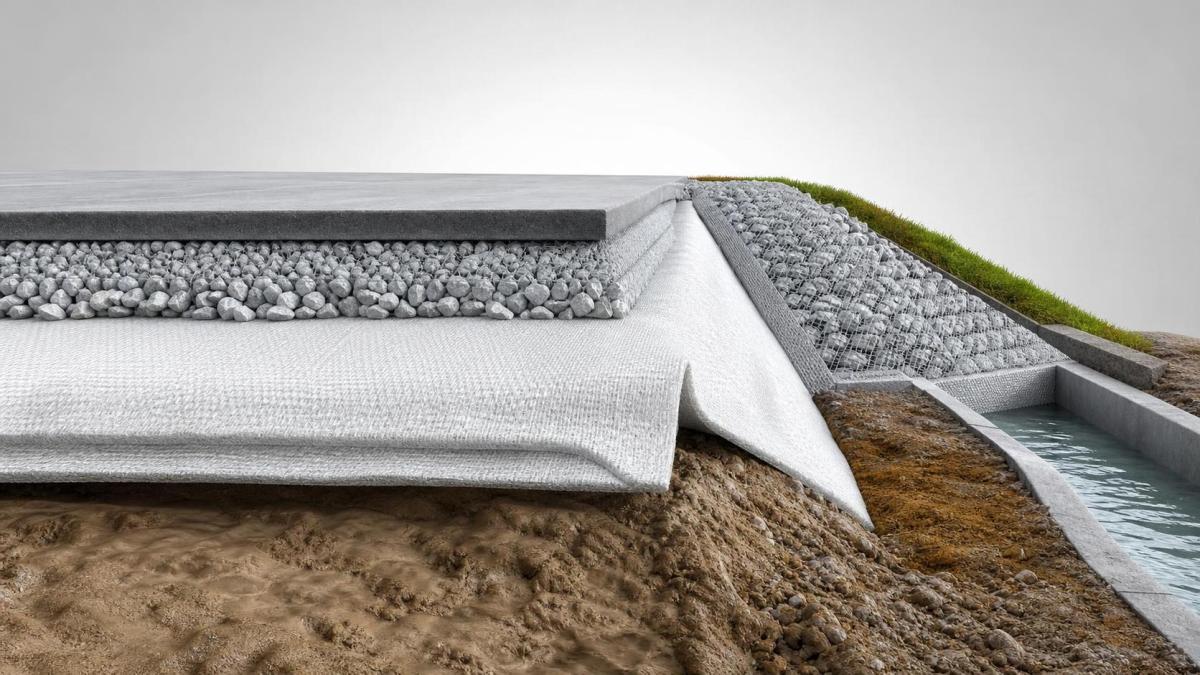
In practice, geotextile is used where soil alone cannot reliably do the job. Project managers usually run into it when a subgrade is soft, drainage is poor, fines are migrating into aggregate, or long-term settlement is a concern. The material sits between layers and performs one or more functions: separation, filtration, drainage, protection, or reinforcement.
That sounds simple, but it matters a lot on site. A road built over wet clay may fail early if the base course mixes with the subgrade. A slope may erode if runoff carries soil particles away. A retaining structure may lose performance if water pressure builds up behind it. In those situations, geotextile is not an accessory. It is often the layer that keeps the design working as intended.
What is geotextile used for in civil engineering, in plain terms?
The shortest answer is this: geotextile helps soil and water behave in a more controlled way.
Common uses include:
- Separating weak subsoil from gravel or crushed stone in roads and working platforms
- Filtering water while retaining soil in drains, embankments, and erosion control systems
- Improving load distribution over weak ground
- Protecting geomembranes from puncture by subgrade or drainage aggregate
- Supporting slope stabilization and shoreline protection
For a project lead, the key point is that geotextile is usually chosen to reduce one of three risks: contamination between layers, water-related instability, or premature structural deterioration.
Is it mainly for reinforcement, or are people using it for the wrong reason?
This is one of the most common misunderstandings. Not every geotextile is there to reinforce soil. In many jobs, its primary role is separation or filtration, and treating it like a reinforcement product leads to poor selection.
If the design problem is weak bearing capacity or lateral restraint, the engineer may need a geogrid, a high-strength woven geotextile, or a combined system. If the problem is aggregate pumping into wet subgrade, a separation geotextile is usually the better answer. The correct question is not “Do we need geotextile?” but “What function must the layer perform under real site conditions?”
How do you know when geotextile is necessary under roads, yards, or access routes?
You start with the subgrade and the traffic, not the roll spec. Geotextile becomes especially useful when the formation is fine-grained, wet, soft, or variable across the site. It is also commonly used where construction traffic would otherwise disturb the soil before the permanent pavement structure is even in place.
A practical review usually includes:
- Subgrade type and moisture condition
- Expected traffic loads during construction and in service
- Base course thickness and aggregate size
- Whether fines are likely to migrate upward
- Drainage path for water entering the pavement structure
If those factors point to contamination, rutting, or water entrapment, geotextile is usually a low-cost layer compared with the cost of rework.
What should a project manager check before approving a geotextile specification?
Check whether the specification matches the job function. That sounds obvious, but mismatches happen all the time. A product can have impressive strength data and still be the wrong choice if the critical need is filtration opening size or survivability during installation.
Also review roll dimensions, overlap requirements, submittals, and installation method statements. A suitable product on paper can still fail if crews place it over sharp protrusions, leave it exposed too long, or drive directly on it without cover.
Can geotextile be used together with geomembrane?
Yes, very often. In containment, water management, and some municipal or hydraulic works, geotextile and geomembrane perform different jobs in the same system. The geomembrane provides the barrier; the geotextile may protect it, separate adjacent materials, or help with drainage and stress distribution.
For example, when a liner system is exposed to angular stone or irregular subgrade, a protective geotextile layer can reduce puncture risk. In projects involving ponds, reservoirs, fish farming, or anti-seepage zones, that pairing is common. Products such as HDPE Pond Liner For Artificial Lake HDPE Pond Liner For Fish Farm are used where waterproofing and anti-seepage performance are required, while the surrounding geotextile layers may be selected to protect the membrane and improve system durability.
Where do projects usually go wrong?
Most failures are not dramatic design mistakes. They are ordinary coordination errors.
- Choosing by mass per square meter alone and ignoring function
- Using a filtration product without checking the site soil gradation
- Placing geotextile over muddy or rutted ground without proper preparation
- Insufficient overlaps or poorly managed joints
- Damage during stone placement, turning equipment, or temporary traffic
- Leaving rolls exposed where UV exposure or wind displacement becomes an issue
From a management standpoint, these are avoidable if the specification, submittal review, and field supervision are tied together. The material choice and the installation method should be reviewed as one package.
Does geotextile reduce cost, or does it just add another line item?
It adds cost upfront, but on many jobs it reduces total cost by limiting over-excavation, preserving aggregate performance, and lowering maintenance or repair exposure. That benefit is strongest where the soil is marginal and the consequences of contamination or drainage failure are expensive.
The mistake is treating it as a generic savings tool. If the site is well drained, the subgrade is competent, and there is no real separation or filtration problem, geotextile may bring little value. The commercial case depends on the failure mode you are trying to prevent.
What is a sensible way to make the final call?
Use a simple sequence. Define the problem at layer level. Decide whether the required function is separation, filtration, drainage, protection, reinforcement, or a combination. Then review the soil data, water conditions, loading, installation environment, and adjacent materials. Once that is clear, the specification becomes much easier to defend.
If your project also includes a liner or anti-seepage system, evaluate the interface as a system rather than as isolated products. That is usually where better decisions get made: not by asking whether geotextile is useful in general, but by asking exactly what it must stop, carry, filter, or protect on your site.