






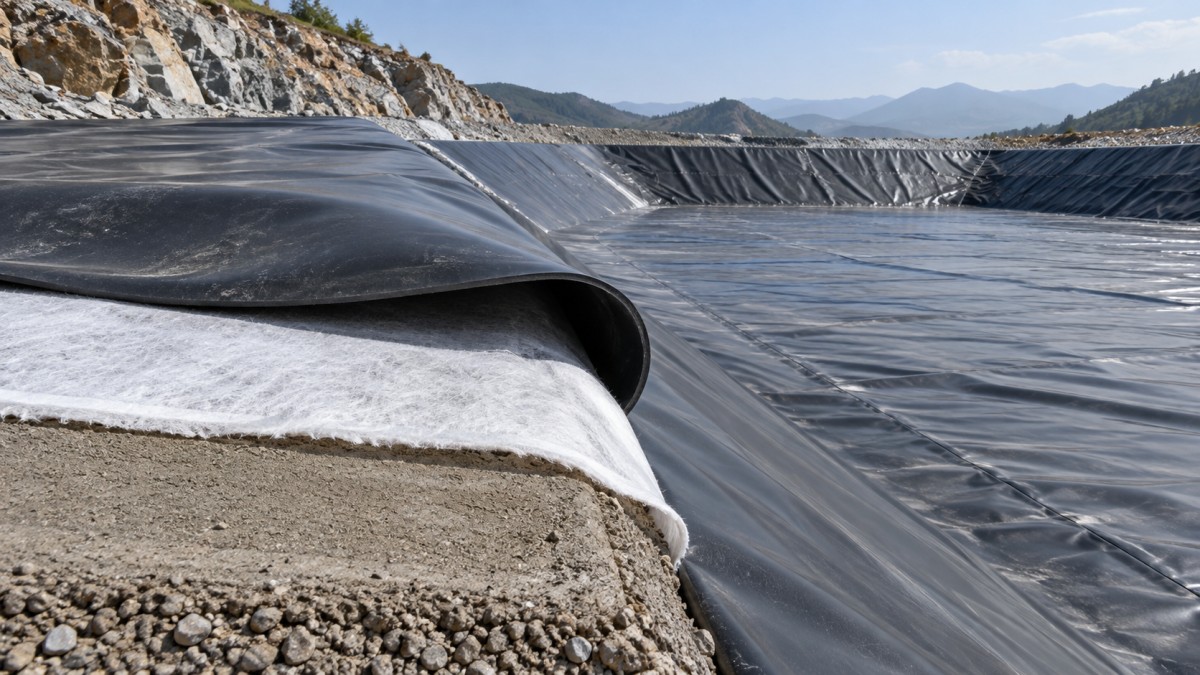
For Geomembrane Ponds on rocky soil, choose liner thickness only after defining the prepared subgrade and protective layers. A thicker membrane provides more puncture resistance, but it cannot make exposed, angular rock an acceptable foundation. Where stones remain beneath the liner, water pressure can press the sheet against individual points, causing damage that may not become visible until the pond is filled.
The practical decision is to compare complete lining systems: prepared ground, cushioning geotextile, membrane material and thickness, and installation controls. For preliminary budgeting, evaluate heavier pond-liner options rather than assuming a thin sheet will work with added fabric. Final thickness should follow site assessment and, where contact stresses remain uncertain, representative protection testing—not a rule based on rock size alone.
Start with the surface the liner will actually touch
“Rocky soil” can describe very different foundations. Rounded gravel within compacted soil is not equivalent to fractured bedrock with sharp edges. Walk the excavated pond bottom and slopes before approving the liner purchase, because excavation can expose conditions that were not apparent at the original ground surface.
- Loose angular fragments: Remove them rather than expecting a geotextile to bridge every sharp point.
- Protruding bedrock: Trim or cover projections with an engineered leveling layer that remains stable during installation and operation.
- Voids and abrupt steps: Fill and compact them so the liner does not span unsupported gaps or stretch across sudden changes in elevation.
- Unstable slopes: Resolve erosion, loose material and sliding risks before selecting membrane thickness.
A smoothing layer must remain in place. Fine material that washes downslope or migrates into coarse voids can leave the membrane exposed to rock after commissioning. Its grading, compaction and retention therefore belong in the earthworks specification, not merely in an installation note.
Also assess groundwater beneath the pond. Uplift during empty periods requires a separate drainage or pressure-relief design; increasing sheet thickness does not resolve it.
Compare thickness options without treating them as guarantees
Thickness improves resistance to localized damage, but nominal thickness alone is not a complete performance specification. Polymer type, manufacturing consistency, stress-crack resistance, seam quality and support conditions all matter. Compare products within the same material category and using compatible test methods.
These ranges are screening options, not site-specific design values. A properly supported thinner membrane may perform better than a thicker sheet laid over sharp projections. Conversely, where leakage would interrupt operations or require costly draining, the cheapest technically plausible option may offer insufficient construction tolerance.
Material choice changes the comparison
HDPE is commonly considered where chemical resistance and welded containment are priorities. Its relatively stiff behavior makes careful detailing important at corners, penetrations and uneven transitions. PVC is generally more flexible, but its formulation, exposure suitability and joining requirements must be confirmed for the intended service.
Do not substitute one material for another solely because the thickness matches. Request material-specific properties and installation requirements. For aquaculture ponds, also confirm suitability for the intended water and aquatic organisms rather than treating general chemical resistance as evidence of that suitability.
Water depth and operations determine the loading scenario
Increasing water depth raises pressure on the liner and presses it more firmly against the supporting surface. On smooth ground this pressure is distributed; over angular fragments it can create concentrated contact stresses. Record maximum operating depth, including credible temporary high-water conditions, before evaluating protection requirements.
The empty pond can be just as important. Maintenance workers, hoses, cleaning tools and sediment removal may impose localized loads without water covering the liner. Plan access routes and cleaning methods early. A membrane selected only for normal filled operation may be vulnerable during maintenance.
Separate these exposures in the design brief:
- Permanent water pressure and any sustained loading from cover materials.
- Temporary installation loads, including material placement and equipment movement.
- Maintenance access, repeated filling and draining, and exposed-liner weathering.
Where machinery must enter, specify a designed protective working layer or change the maintenance method. Do not interpret a thicker liner as permission to drive directly on it.
Specify the cushion as carefully as the membrane
A nonwoven protective geotextile can reduce contact severity between the prepared foundation and geomembrane. However, mass per unit area is only a purchasing descriptor, not proof that the fabric will protect against the site's rock geometry and loading.
Request puncture-related properties, thickness under load and relevant protection-performance information. Index puncture tests help compare materials, but they do not reproduce every field contact condition. Where sharp residual rock, substantial pressure or high leakage consequences remain, use a representative liner–geotextile–subgrade test arrangement to evaluate the proposed system.
Protection may also be needed above the membrane when aggregate or another cover is placed. Define placement equipment, drop heights and construction sequence so the cover installation does not damage the liner it is intended to protect. On slopes, evaluate interface shear strength: adding cushioning layers can change sliding resistance.
The listed Geosynthetics geotextile and geomembrane includes HDPE and PVC options and membrane thicknesses from 0.2 to 0.9 mm. Treat those as available options to assess, not as confirmation of suitability for rocky ponds. Ask for a clearly formatted datasheet identifying whether each property applies to the membrane, geotextile or composite; the supplied parameter strings do not establish an unambiguous grade-by-grade comparison.
Turn the selection into an enforceable purchase specification
Once the lining arrangement is selected, make the quotation describe the same system the design evaluated. “Pond liner with protective fabric” leaves too many opportunities for substitution.
- Identify the membrane: State polymer, nominal thickness, minimum acceptable thickness or tolerance, surface finish and required material properties.
- Define foundation acceptance: Describe leveling, compaction, removal of projections and inspection before deployment.
- Identify protection layers: Specify the geotextile grade, performance requirements, overlaps and any upper protection.
- Control installation: Require suitable joining procedures, qualified personnel, trial seams and seam testing appropriate to the material.
- Document repairs: Record damage locations, completed repairs and verification before filling.
Approve the prepared foundation before covering it; afterward, photographs alone may not reveal buried projections. Inspect the installed liner for wrinkles, bridging at transitions and damage from handling, and keep the inspection record with material traceability and seam results.
Compare bids on installed scope, not membrane price per square meter alone. A quotation excluding leveling, protection, seam testing or repairs is not equivalent to one including them. When the required system exceeds the supplier's listed thickness range, request a separately documented suitable option or revise the procurement shortlist rather than accepting the thickest available sheet by default.