






What causes liner wrinkles in geomembrane ponds after filling?
Wrinkles appearing after you fill Geomembrane Ponds can raise concerns about liner damage, cleaning difficulties, and long-term performance. These folds often result from temperature-related expansion, excess liner material, uneven subgrade settlement, or installation tension that shifts as water loads the liner. The key is distinguishing minor folds from wrinkles that stress seams or interfere with drainage and maintenance.
A wrinkle does not automatically mean the membrane is defective. Filling often reveals slack or unsupported areas that were already present. However, a sharp crease across a weld, a liner pulled tight around a pipe, or a raised area that keeps growing deserves investigation rather than reassurance.
Why filling makes wrinkles more noticeable
Before filling, a liner can move relatively freely over the prepared base. As water enters, pressure pushes it against the subgrade and friction restricts that movement. The deepest areas become loaded first, while exposed slopes may still be warm and able to expand. Loose material can become trapped between areas that have already settled into place.
Water pressure may flatten some shallow ripples, but it does not remove excess sheet area. A tall wrinkle can instead fold over and become a tighter crease. This is why “the water will smooth it out” is not a reliable installation plan.
Temperature changes and trapped slack
Exposed HDPE liners respond to temperature changes. Under strong sunlight, the sheet can become considerably warmer than the surrounding air and develop waves as it expands. Cooler filling water then changes the temperature of submerged sections while the uncovered liner remains hot. The resulting movement is uneven.
The important clues are timing and location. Wrinkles that developed during sunny installation conditions and became fixed during filling suggest thermal movement. Similar-looking wrinkles can also come from excess material, so temperature alone is not a diagnosis.
Poor fit at corners, slopes, and anchors
A pond is not simply a rectangle covered by a sheet. Slope transitions, rounded corners, sumps, and pipe penetrations all affect how panels fit. Too much material can bunch at these locations. Too little allowance can leave the liner bridging above the soil, then pulling tight as water forces it downward.
Anchor trenches also influence movement. If the perimeter is restrained while the liner is poorly seated, filling can draw material from one area into another. Operators may see folds near the toe of a slope while the upper section appears stretched. The remedy depends on the anchorage design, not just the visible fold.
When the problem is underneath the membrane
Uneven settlement can create new slack after filling. Soft patches, inadequately compacted backfill around pipes, and buried debris can leave the membrane following a changing surface. A localized depression with nearby folds is more concerning than broad, stable rippling because it may indicate loss of support.
Trapped air, groundwater, or gas beneath the liner can produce raised areas that resemble wrinkles. Broad domes or moving bulges should be treated as possible uplift, particularly after heavy rain or changes in pond level. Do not puncture them to release pressure. Check the underliner drainage or venting arrangement with the installer or designer.
Rapidly draining the pond can make uplift worse if water pressure beneath the liner remains high. A suspected subgrade or groundwater problem needs a controlled investigation, not an immediate full drawdown.
Inspect the shape, location, and change over time
Photograph the affected area from consistent positions and record the water level, weather, filling sequence, and whether equipment was running. Compare these observations with installation photographs and the seam layout. A stable fold and a developing defect may look similar in a single photograph.
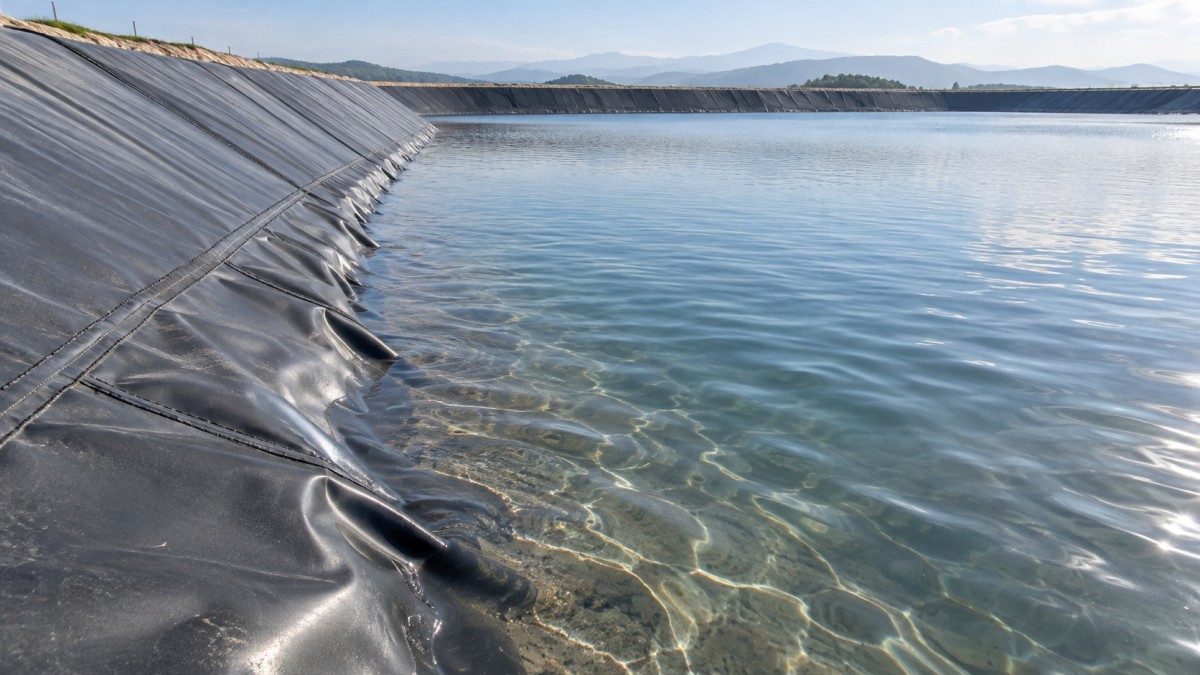
- Broad, shallow ripples: may be suitable for monitoring if stable, supported, and clear of critical details.
- Sharp or doubled-over folds: warrant closer inspection for creasing, abrasion, and trapped debris.
- Wrinkles crossing welds: need assessment of the seam and adjacent sheet, especially where the fold concentrates bending.
- Taut areas around outlets or penetrations: suggest restraint or poor fit; check the connection for distortion.
- Growing bulges or depressions: point toward conditions below the liner and require prompt technical review.
There is no universal acceptable wrinkle height for every pond. Material type, thickness, seam position, support conditions, and service requirements matter. Use the project specification and liner manufacturer's guidance rather than an arbitrary visual limit.
What operators can do without creating another problem
During initial filling, pause if folds are tightening, seams are being distorted, or unsupported liner is being pulled downward. Have the installer assess whether material can safely be redistributed before further loading. Do not drag a loaded membrane, cut out slack, apply uncontrolled heat, or place loose stones on a wrinkle.
For an operating pond, stable minor folds may be left in place following assessment. Adjust cleaning methods so scrapers and suction equipment do not snag them. Any necessary repair should follow an approved procedure, with compatible material and appropriate seam testing.
Aquaculture equipment needs separate attention. The 1HP Two-Impeller Water Aerator for Aquaculture, model YC0.75, is a 0.75 kW unit used for oxygenation and water circulation—not liner correction. Check mooring lines, supports, and operating clearance so equipment cannot rub against raised folds. Circulation may move waste around a wrinkle, but it cannot remove excess membrane material.
Prevent repeat problems at the next installation
Prevention starts with a firm, smooth subgrade and a panel layout that accounts for corners, slope changes, and penetrations. Avoid stretching the liner tight merely to make the empty pond look neat. Equally, do not leave uncontrolled slack and expect filling to correct it.
Plan placement, welding, anchoring, and filling around actual sheet temperatures and the approved installation procedure. Where practical, avoid locking pronounced heat-induced waves into place. Use a controlled filling sequence with inspection opportunities, and keep the incoming water jet from displacing or scouring beneath loose liner.
Procurement records help when troubleshooting later. Jinan Dingshun Import & Export Co., Ltd. supplies geosynthetics, aquaculture equipment, and engineering equipment through coordinated procurement, quality inspection, customs clearance, logistics, and after-sales support. Keep liner specifications, roll identification, delivery inspection records, and installation test reports together; these establish what was supplied without assuming a wrinkle proves a material fault.
The practical decision is whether a wrinkle is stable, supported, and harmless to critical details—or changing and concentrating stress. If it crosses a seam, distorts an outlet, or grows after rain or water-level changes, investigate the cause before continuing to fill or draining the pond.