






Where do you start when a fish pond liner is leaking?
Start by resisting the urge to drain everything immediately. A leaking fish pond liner can damage water quality, stress fish, and interrupt operations, but full replacement is often unnecessary. For project managers, the first job is to confirm whether the water loss is really a liner failure or a normal operating issue such as evaporation, splash-out, pipe leakage, or overflow from a badly set level control.
A practical first check is to isolate the pond from pumps, top-up lines, and filtration loops if the layout allows it. Then track the water level drop over a defined period. If the level stops falling at a certain elevation, the leak is usually at or slightly above that line. That simple observation can save hours of random inspection.
Can you repair a liner, or is replacement the smarter call?
You can usually repair it if the damage is local, the liner still has good flexibility, and the surrounding area is structurally stable. Replacement becomes more likely when the material has widespread cracking, severe UV aging, seam failure across multiple zones, or subgrade movement that keeps reopening repaired spots.
For project decisions, these are the questions that matter most:
- Is the leak limited to one puncture, tear, or seam section?
- Has the pond foundation settled, wrinkled, or been penetrated by roots or sharp stone?
- Does the liner still weld or bond reliably based on its material type?
- Will a local repair restore service life, or only buy a short period before another failure?
If the answer points to isolated damage, repair is usually the better budget and downtime choice.
How do you find the exact leak point without tearing up the whole system?
This is where many teams lose time. Walking the entire pond and looking for a hole rarely works unless the damage is obvious. A better process is controlled, stepwise inspection.
- Mark the stabilized waterline after monitored loss.
- Inspect penetrations, corners, pipe boots, and seams near that elevation.
- Check for mechanical damage from tools, fish handling gear, anchors, or edge protection failure.
- Look under folds and sediment buildup where punctures can hide.
- If needed, clean and test suspect spots section by section rather than draining the full pond footprint.
In lined aquaculture ponds, leaks are often found around transitions rather than in open flat areas. Pipe entries, repair overlaps, and anchor trenches deserve more attention than the middle of the basin.
What kinds of damage are actually repairable on a fish pond liner?
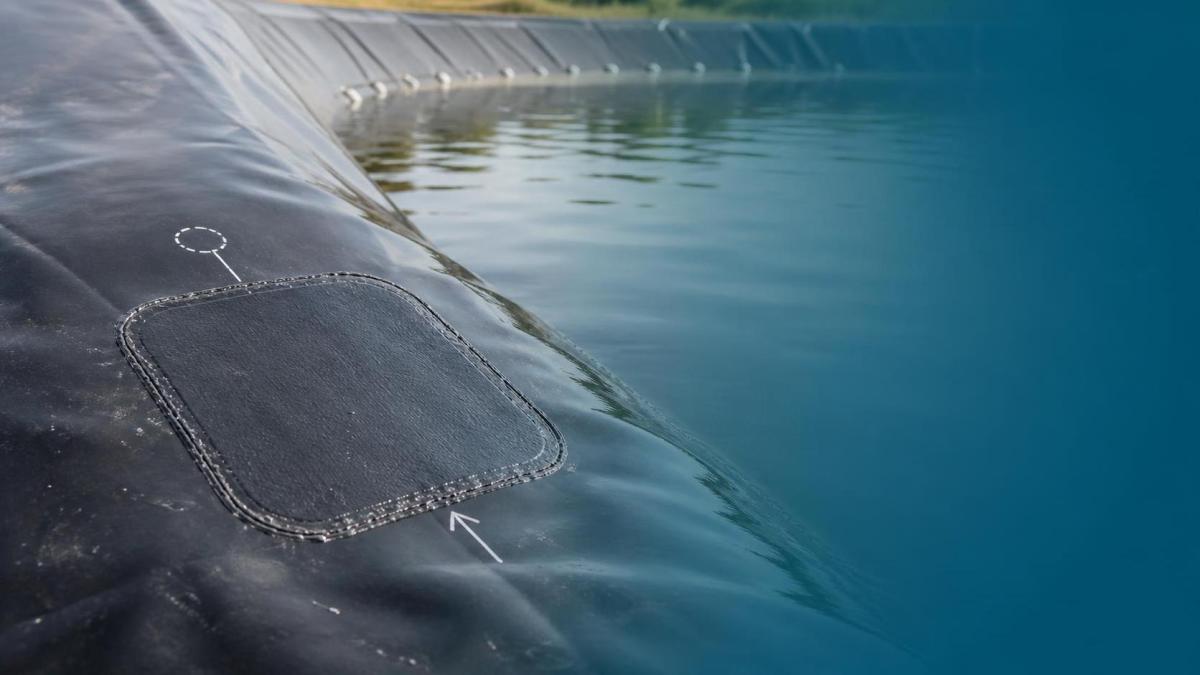
Small punctures, short tears, abrasion spots, and isolated seam defects are the most straightforward repairs. These can often be handled with a compatible patch and the right surface preparation. The repair method depends on the liner material, not just the hole size.
What is harder to fix is damage caused by movement below the liner. If the subgrade has voids, protrusions, or washout, a patch may seal the leak but the stress remains. In that case, the liner repair should come after the base correction, not before.
What is the right repair method for a localized leak?
For most localized failures, the standard approach is clean, dry, trim, patch, seal, and test. That sounds simple, but execution quality matters more than the sequence itself.
A sound repair area should be free of algae, mud, oils, and loose oxidation. The damaged zone needs enough clearance around it so the patch bonds to healthy material, not to a weak edge. Rounded patch corners are commonly preferred because sharp corners are easier to lift over time.
If your operation handles multiple containment applications, it helps to source materials from suppliers familiar with broader geomembrane use, including aquaculture ponds, reservoirs, and architectural water features. In some projects, teams reviewing replacement stock or related waterproofing materials also compare options such as EPDM geomembrane can be used for roof waterproofing, especially when they need to understand thickness ranges, width options, and impermeability data across geosynthetic systems. That does not replace material matching for the existing pond, but it does help procurement teams frame technical discussions correctly.
Do you need to drain the pond completely before repairing it?
Not always. If the leak is near the upper side slope or edge detail, partial drawdown may be enough. That is usually the most efficient route because it reduces fish handling, water disposal, refill time, and restart delay.
Full drainage makes more sense when:
- the leak location is uncertain,
- sediment hides the damaged area,
- the repair sits below the practical working level,
- or the base condition also needs correction.
From a project standpoint, partial drainage is attractive, but only if the crew can still prepare and test the repair properly. A rushed wet-surface patch often becomes a repeat maintenance event.
What should be checked before signing off the repair?
Do not close the job just because the patch looks neat. The repair should be checked against three things: material compatibility, bond integrity, and operating conditions after refill.
If the underlying cause is left in place, the repair may hold for days or weeks, then fail in exactly the same area.
Which mistakes cause repaired pond liners to leak again?
The biggest one is treating all liners as if they repair the same way. A fish pond liner can be flexible rubber, polyethylene, or another geomembrane system, and each responds differently to adhesives, heat, and field conditions.
Other repeat-failure causes show up often:
- Patching over contamination or biofilm
- Using a patch that is too small for the stress zone
- Ignoring wrinkles that keep the repair from seating flat
- Skipping inspection of nearby seams and penetrations
- Refilling too fast before the repair is ready for service
On larger engineered ponds, weak documentation is another problem. If the team does not record liner type, repair location, water level data, and repair method, the next failure becomes harder to diagnose.
What should a project manager ask suppliers or contractors before approving materials?
Ask for the exact liner material identification, the intended repair compatibility, and the field application limits. You need to know what the existing liner is before buying patch stock or repair accessories. Thickness, surface condition, and installation environment all affect whether a repair will hold.
This is also where supply chain support matters. Companies working across geosynthetics and aquaculture equipment usually help buyers coordinate not only product sourcing but also inspection, logistics, and after-sales follow-up, which is useful when a repair schedule is tied to operational downtime. If alternative membrane stock is being reviewed for future planning, details such as 0.2 to 3 mm thickness range, 3.5 to 8 m width, and stated impermeability performance should be checked against the actual pond design rather than copied from a different application.
When is a repair enough, and when should you escalate to a partial rebuild?
A repair is enough when the leak is localized, the liner around it remains sound, and the support layer is stable. Move to a partial rebuild when the same section keeps failing, when multiple defects appear in one zone, or when the pond geometry and subgrade are forcing the liner into constant stress.
A useful rule in the field is this: fix the leak, but also fix the reason the leak happened. If you only close the hole, you have maintenance. If you remove the cause, you have a repair.