






How to size a fish farming aerator for peak oxygen demand
Sizing a fish farming aerator requires more than matching motor power to pond volume. The real question is whether the equipment can deliver enough oxygen when biomass, feeding activity and background respiration are highest—and whether that oxygen reaches the fish. In geomembrane-lined ponds, circulation and equipment placement matter alongside oxygen transfer. A defensible selection starts with a peak-demand estimate, converts standardized performance into field capacity, and checks what happens when one unit or the power supply fails.
Define the operating condition that could break the system
Pond volume describes the water inventory, not the oxygen load. Two ponds of equal volume can need very different aeration capacities because they hold different biomass, receive different feed inputs or accumulate different amounts of organic material.
Build the design around maximum planned standing biomass and a credible high-demand operating period. Record species, fish size, water depth, temperature, salinity, elevation, maximum daily feed and feeding schedule. Also define the minimum acceptable dissolved oxygen (DO) for the species and production objective. A survival threshold is not necessarily an acceptable growth or feeding threshold.
Do not assume every worst-case variable occurs simultaneously. Instead, examine plausible combinations: heavy feeding in warm water, nighttime respiration near harvest biomass, or cloudy weather following strong algal growth. The lowest DO may occur before sunrise, but the highest hourly demand can also follow feeding. Measurements should cover both periods.
Build an hourly oxygen budget
Express demand in kilograms of oxygen per hour. Daily oxygen totals are useful for energy planning, but they can hide short periods when consumption exceeds transfer capacity.
Peak oxygen demand = fish respiration + microbial and organic-matter demand + other relevant oxygen sinks.
Estimate fish respiration by multiplying biomass by a species-appropriate oxygen consumption rate at the design temperature and activity level. Check the source carefully: rates measured for fasting fish should not be treated as post-feeding rates, and juvenile measurements may not represent larger fish.
Background demand includes decomposition of uneaten feed and feces, plankton respiration, and biological processes such as nitrification. HDPE lining separates pond water from native soil, but it does not eliminate oxygen consumption by accumulated sludge. Avoid double-counting: if a feed-based model already includes fish metabolism and waste oxidation, do not add those components again.
Use nighttime DO trends and production records to check the budget. Interpretation must account for operating aerators, water exchange, natural surface transfer and uneven mixing. Deliberately switching off aeration in a heavily stocked pond to measure depletion is not a safe validation method. Where information is weak, document a demand range and identify which assumption most affects equipment quantity.
Convert test ratings into usable field capacity
Motor kilowatts are not oxygen delivery. Request the standard oxygen transfer rate (SOTR), normally expressed as kilograms of oxygen per hour, together with the test conditions and method. Standard aeration efficiency describes oxygen transfer per unit of energy under standardized conditions; it is not a guarantee of pond performance.
Standardized tests commonly use clean water and defined reference conditions. Actual oxygen transfer depends on temperature, oxygen saturation, operating DO, water chemistry, atmospheric pressure, equipment configuration and, for diffusers, installation depth and fouling. Higher temperature can increase the transfer coefficient while reducing oxygen solubility; the net effect requires calculation.
Field oxygen transfer = SOTR × documented field-correction factor.
That factor should account for wastewater or pond-water effects on transfer, temperature correction and the actual oxygen concentration driving force. Ask suppliers to show their assumptions, including any alpha and beta factors used. Compare machines at the same operating DO—not one at nearly zero DO and another at the intended control setpoint. As DO rises toward saturation, atmospheric aeration transfers oxygen less readily.
For identical units, divide design demand by the verified field transfer per unit and round upward. If the corrected capacity is uncertain, resolve that uncertainty before treating the resulting unit count as final.
Check circulation before accepting the calculated quantity
A pond can have adequate total oxygen transfer and still contain low-oxygen pockets. Paddlewheel equipment combines surface aeration with directional flow; diffused-air systems depend on bubble transfer and induced mixing. Neither arrangement should be selected from an oxygen-transfer figure alone.
Map pond geometry, feeding areas, sludge collection points and expected flow paths. Check whether circulation carries oxygenated water through occupied zones or simply recirculates it near the equipment. Measure DO at multiple positions and depths, including locations away from aerators.
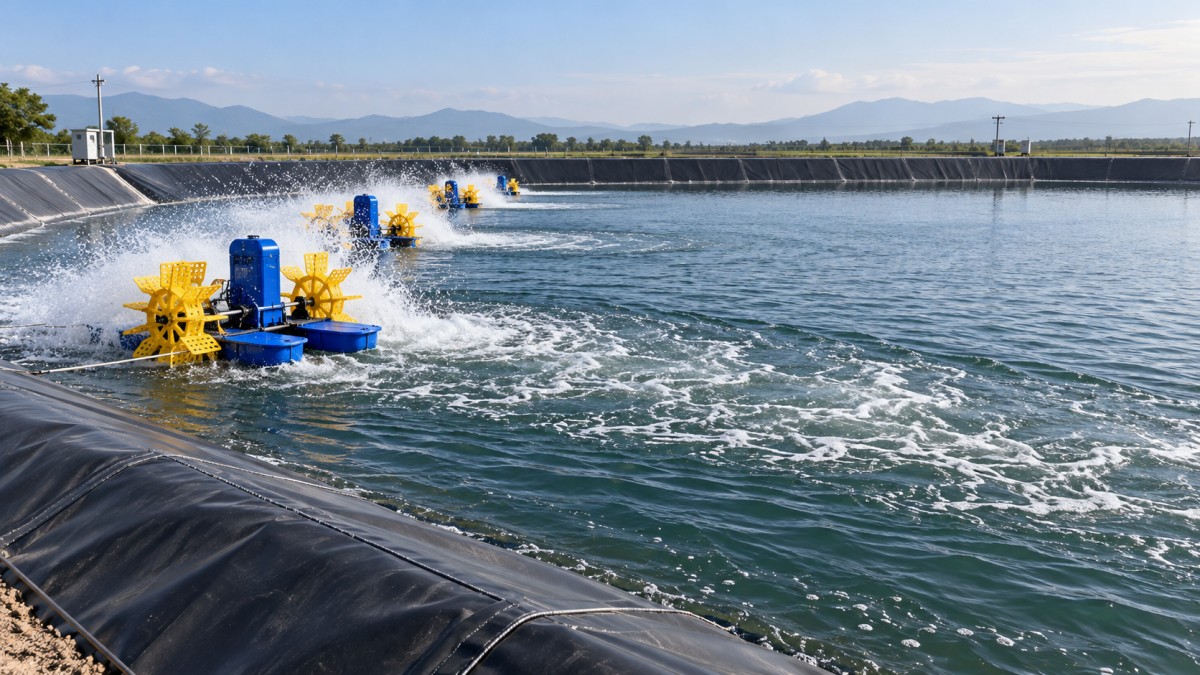
In geomembrane-lined ponds, anchoring and maintenance access must protect the liner. Prevent moving components, cables and anchors from abrading the membrane, and assess local flow near seams and slopes. Increasing aerator power is not a substitute for correcting a poor layout.
Liner construction belongs in the same engineering review, although welding equipment does not determine aeration capacity. For installation or repairs, the HDPE Geomembrane Welding Machine BGT-GM Series offers adjustable temperature, speed and pressure, with a listed single-film thickness range of 0.2–2.0 mm. Suitability still depends on the membrane and model; trial welds and seam testing remain necessary.
Separate design allowance from failure protection
A design allowance covers uncertainties such as biomass variation, background demand and declining transfer performance. Standby capacity covers equipment failure. These are different requirements: several machines operating near full capacity may offer little protection when one stops.
- Check whether remaining field capacity meets critical demand with the largest duty unit unavailable.
- Confirm backup power can start the required motors, not merely support their running load.
- Set DO alarms early enough to allow intervention, accounting for sensor error and local variation.
- Keep essential replacement parts accessible and define who responds outside normal working hours.
The oxygen buffer between the operating DO and minimum allowable DO is approximately pond volume multiplied by that concentration difference, with consistent unit conversion. Dividing this inventory by the net oxygen deficit gives a rough response window. It is not a guaranteed safe duration: poor mixing can expose fish to low DO before the whole-pond average reaches the limit.
Make the purchase decision auditable
A useful quotation should state corrected oxygen delivery, electrical demand, installation conditions, maintenance requirements and the proposed layout. Confirm supply voltage, frequency, phase, corrosion exposure and spare-parts availability. Commissioning should verify DO distribution and control response, with performance reviewed again as biomass approaches the design load.
Jinan Dingshun Import & Export Co., Ltd. supplies geosynthetics, aquaculture equipment and engineering equipment, coordinating procurement, quality inspection, customs declaration, logistics and after-sales service. For an integrated pond project, these activities should support a single technical schedule linking the liner, aerators, electrical supply and maintenance provisions.
Before approving a fish farming aerator, require three clear answers: the peak demand it must meet, its oxygen delivery under your actual conditions, and the capacity available after a failure. If any answer relies only on motor power or pond volume, the sizing assessment is incomplete.