






Uncovered liners in Geomembrane Ponds can lose flexibility and become more vulnerable to cracking as ultraviolet exposure promotes polymer oxidation. The risk is often greatest on exposed slopes, around the waterline, and at tensioned details—not necessarily across the entire pond bottom. A liner can remain watertight while its resistance to future mechanical damage is declining.
The practical question is whether the supplied formulation has documented resistance to outdoor exposure under conditions relevant to the site. Polymer identification, stabilizer performance, weathering test results, and installation stress provide a stronger basis for assessment than a general “UV-resistant” description. Accelerated testing helps compare materials, but it does not establish a universal conversion from laboratory hours to years of pond service.
Sunlight damage is a material-and-stress problem
UV radiation can initiate chemical reactions in susceptible polymers and additives. In polyethylene geomembranes, photo-oxidation may involve molecular chain scission and other structural changes. Stabilizers slow these reactions, while properly dispersed carbon black helps shield the polymer from UV radiation. These protective systems do not make the material immune to aging.
Exposure also occurs alongside heat and oxygen. A sunlit surface may become substantially warmer than the surrounding air, increasing the rate of some aging processes. Daily heating and cooling cause expansion and contraction; restrained areas cannot move as freely as loose panels. Oxidative deterioration and mechanical loading can therefore combine to produce cracking even when neither would cause immediate failure alone.
Discoloration, chalking, or a change in surface feel may justify investigation, but they are not reliable measures of remaining containment performance. Conversely, an apparently normal surface does not prove that antioxidant protection or crack resistance remains unchanged. Material testing is needed when observations suggest deterioration or when consequences of leakage are significant.
Identify the exposure zones before comparing liners
A pond does not expose every part of its liner equally. Permanently submerged areas generally receive less direct UV radiation, although protection depends on water depth, clarity, and operating level. Seasonal drawdown exposes previously submerged material and creates a moving band of wetting, drying, heating, and sunlight exposure.
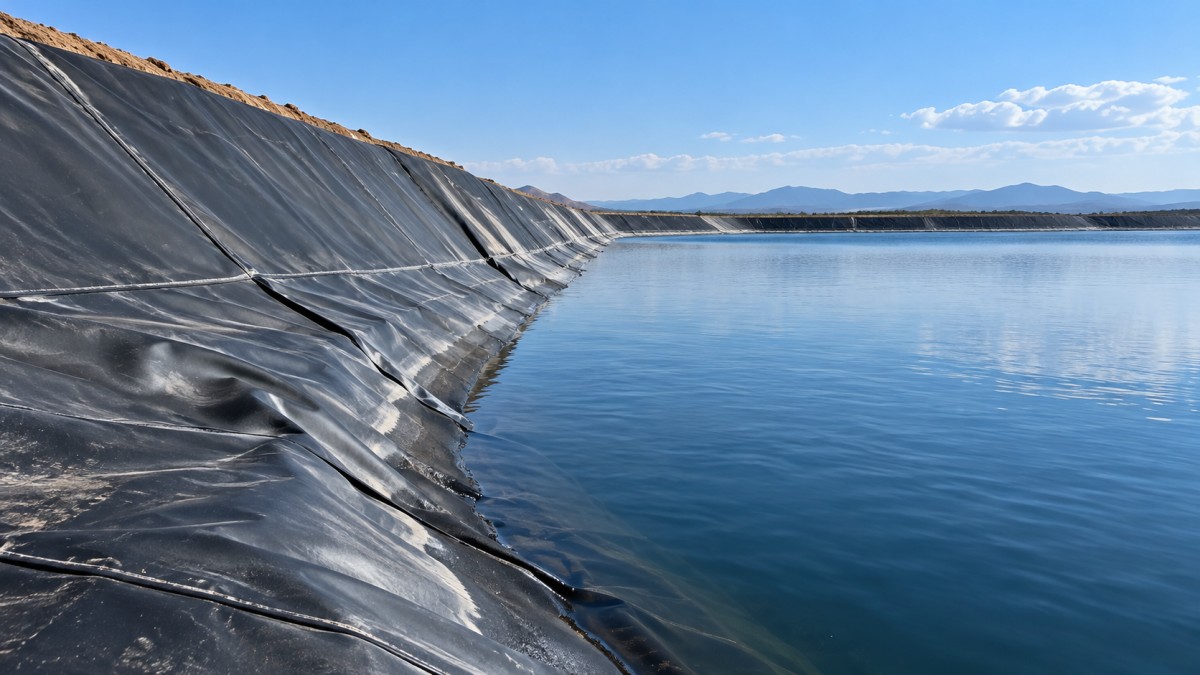
- Upper slopes and freeboard: These areas may remain exposed throughout operation and should be included in weathering assessments.
- Waterline bands: Fluctuating levels change exposure duration and may leave deposits that complicate visual inspection.
- Wrinkles, corners, and penetrations: Local restraint, bending, or movement can amplify the consequences of reduced ductility.
- Anchorage transitions: Settlement or inadequate slack can introduce sustained tension near exposed edges.
Record slope orientation, shading, typical water levels, drainage periods, and surface temperatures where practical. Climate descriptions based only on annual air temperature overlook solar intensity and actual liner temperature. These observations help define the exposure scenario against which supplier evidence should be judged.
Material descriptions that need closer examination
Black HDPE and LLDPE geomembranes are common candidates for exposed applications, but resin type alone does not establish outdoor durability. Carbon black content and dispersion, antioxidant formulation, manufacturing consistency, and thickness all affect performance. HDPE assessment should include stress-cracking resistance; greater flexibility in LLDPE does not eliminate the need to verify weathering performance.
PVC, EPDM, and other geomembrane systems require evidence appropriate to their chemistry. Plasticizer stability, reinforcement, and formulation-specific aging behavior may matter more than the polyethylene indicators used for HDPE or LLDPE. Test criteria should not be transferred between material families without justification.
Thickness is relevant to robustness and damage tolerance, but a thicker sheet with an inadequately stabilized formulation is not automatically the better exposed liner. Likewise, white or gray appearance should not be treated as proof of UV resistance. Reflective surfaces can alter heating behavior, while UV durability still depends on the formulation and any multilayer construction.
Read weathering evidence alongside the applicable specification
For polyethylene liners, GRI-GM13 for HDPE and GRI-GM17 for LLDPE provide commonly used specification frameworks. Confirm the current revision and the actual project requirements rather than accepting an unqualified statement of compliance. Such specifications describe material properties and testing requirements; they are not site-specific service-life guarantees.
Request the exposure cycle, duration, measured endpoint, initial result, and retained result. Where a specification uses retained high-pressure OIT after weathering, that result should not be described as retained tensile strength. Different endpoints answer different questions. ASTM D5397 stress-cracking data, where applicable to polyethylene, provide another relevant indicator rather than a substitute for weathering evidence.
The report should identify the tested formulation, thickness, and production relationship to the proposed supply. A report for a different grade or an unidentified sample offers limited assurance. Reject simple claims that a certain number of chamber hours equals a fixed number of outdoor years unless the supplier provides a defensible, application-relevant correlation.
Inspection should distinguish aging from installation damage
Establish a baseline before prolonged exposure: photographs of representative areas, panel and seam records, material certificates, and retained samples where specified. Later inspections should revisit comparable locations, especially after drawdown, severe weather, or changes in operating conditions.
- Map the defect pattern. Record whether damage follows exposed orientations, folds, seams, or isolated contact points. Abrasion and punctures may resemble aging-related failure but require different corrective measures.
- Check restraint and support. Look for bridging over depressions, tight transitions, unstable subgrade, and objects beneath the liner. Relieving a mechanical cause may be essential before repair.
- Compare material condition. Where justified, arrange testing of exposed samples against retained or less-exposed material. Sampling from an installed liner requires a controlled repair plan.
- Verify containment separately. Appropriate seam testing or leak-location methods can identify defects, but a leak-free result does not establish remaining UV durability.
Do not diagnose UV failure from a photograph alone. Cracks concentrated at strained details may reflect several interacting causes. Widespread embrittlement, recurring cracks, or damage extending beyond repair boundaries warrants engineering review of the remaining liner, not merely repeated patching.
Protection measures must address the actual exposure
Reducing direct sunlight through a properly designed cover can reduce UV exposure, but cover design introduces loading, sliding, drainage, and maintenance requirements. Soil or other protective layers must be compatible with the slope geometry and liner system. Maintaining water levels may reduce exposure in some areas, but it is not a dependable substitute for exposed-service material selection.
A nonwoven geotextile can provide cushioning beneath a liner or protection within an engineered cover assembly. The Black/White/Grey Polyester/Polypropylene Filament Spunbonded/Staple Fiber Needle Punched Nonwoven Geotextile for Farmland Reclamation is listed in polyester or polypropylene options, with weights from 100 to 800 g/m² and widths from 1 to 6 m. Selection for cushioning should be based on contact conditions, puncture demands, and compatibility—not weight alone.
That geotextile is not itself the pond’s impermeable barrier, and its listed properties do not establish suitability as a permanently exposed UV cover. Placing it beneath the geomembrane does not shield the upper surface from sunlight. Any exposed textile layer needs its own durability verification and securement design.
For an uncovered pond, acceptance should therefore link documented formulation and weathering performance to the expected exposure zones, while controlling installation strain. Where that evidence is missing, obtain clarification or change the material or protection design before relying on a stated service life.